
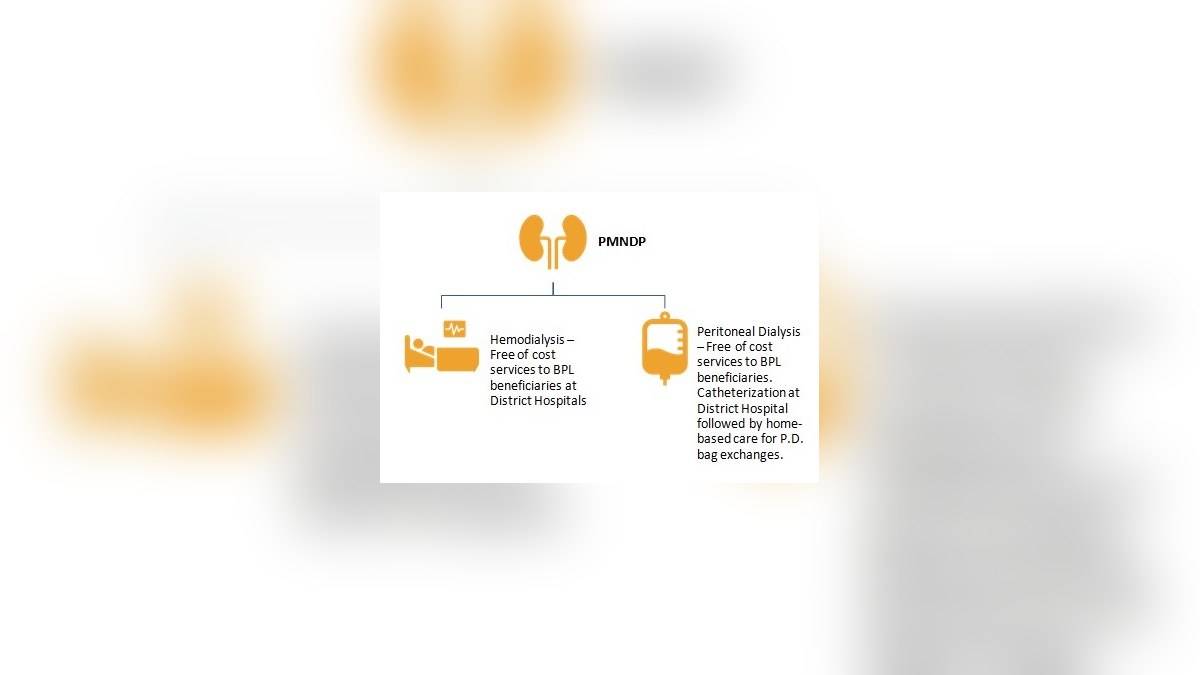
The Pradhan Mantri National Dialysis Programme, or PMNDP, provides free dialysis services to eligible Below Poverty Line patients at public health facilities. The Ministry of Health and Family Welfare's operational guidelines also provide for subsidised services for Above Poverty Line patients. To access care, start with the district hospital or participating dialysis centre, where staff can check eligibility, register the patient and explain available sessions.
This is a service programme rather than a fixed cash payment to a patient's bank account. An online search for a registration form should therefore lead to a conversation with the treating facility about admission, documents and scheduling. A listing on a government website does not by itself confirm a vacant treatment slot.
| Question | Programme position |
|---|---|
| Who receives free services? | Eligible BPL patients at public health facilities |
| What services are included? | Haemodialysis and peritoneal dialysis |
| Where should a patient begin? | District hospital or participating dialysis centre |
| Which identifier supports registration? | ABHA ID, with authentication through the programme system |
| Is there a national application closing date? | The programme guidance does not set an annual application deadline for patients |
Who is eligible for free dialysis under PMNDP?
The ministry's operational guidelines hosted by NHSRC specify free dialysis for BPL patients and subsidised rates for APL patients. They describe haemodialysis beneficiaries as children aged five to 18 and adults. Clinical assessment remains necessary: the programme's existence does not mean every kidney condition requires dialysis or that a patient can choose a treatment method without medical assessment.
Families should ask the facility which evidence it accepts to establish the relevant beneficiary category. The national material reviewed does not provide one universal patient document checklist that can safely replace local instructions. Carry existing clinical records and ask about the required eligibility evidence before making a separate journey for registration.
The programme began in 2016 under the National Health Mission. Its purpose is to bring dialysis services closer through district hospitals, using government delivery, public private partnerships or a combination. The administrative model can vary between states, so a centre operated by an implementing partner may still be part of PMNDP. Confirm participation with the hospital rather than inferring it from a private operator's name.
How does PMNDP registration work?
The guidelines require a registration or helpdesk function at the centre. They also direct centres to register new patients on the PMNDP portal using an Ayushman Bharat Health Account, or ABHA ID, and biometrics. The identifier is used for subsequent visits and recording dialysis sessions. Staff should explain the process and help the patient understand the next appointment.
- Ask the district hospital whether its dialysis service operates under PMNDP and where the registration desk is located.
- Present the treating doctor's records and ask staff to confirm clinical assessment and the evidence required for free or subsidised care.
- Ask the desk how your ABHA ID will be linked to the programme record and what authentication is required.
- Confirm the session date, any waiting list position and the arrangements for the next visit before leaving.
These are practical questions for accessing the service, not a substitute for a hospital's admission instructions. For the identifier itself, our ABHA guide explains health records and consent. ABHA registration and approval for free dialysis serve different purposes; ask the centre to confirm both the patient record and the applicable benefit category.
How to check centres and arrange dialysis in another state
The NHSRC programme page provides district coverage information, programme data, guidelines and a facility user manual. The official PMNDP portal also publishes statewise information. Use these resources to identify the relevant service, then verify with the facility that it is functioning and can accept the patient.
The national portal was launched on 5 May 2022 to support integration and portability. Its features include searching through ABHA ID, patient transfers, vacant slots and waiting lists. For someone travelling, these functions can help coordinate care across facilities. Ask the current centre to assist with the receiving centre and confirm acceptance before travel; portability should not be read as an immediate appointment guarantee.
The need for that check is reflected in the ministry's 11 August 2026 update. It says responsibility for making centres operational and deploying trained staff rests with state or Union Territory governments and implementing partners. National coverage information therefore needs a local availability check.
What about charges, help and treatment choices?
Haemodialysis is generally delivered at a dialysis facility. Peritoneal dialysis has a different service pathway involving patient selection, training and continuing support. The guidelines assign these tasks to medical institutions and linked health facilities. Families should seek the treating team's assessment rather than selecting a method because one appears more convenient on a website.
The guidelines' patient rights charter calls for rates to be displayed, access to records, informed consent, privacy and grievance redressal. If asked to pay, request an explanation of the charge and how it relates to the patient's approved category. Start with the centre helpdesk or hospital administration for service difficulties and ask for the appropriate programme contact.
For other access routes, read our Ayushman card eligibility and hospital guide. Its checks are separate from PMNDP registration. Before relying on any benefit, confirm the applicable scheme, accepted documents and available care with the official facility.