Noise REP Band Varanasi Review: Whoop for ₹10,000?
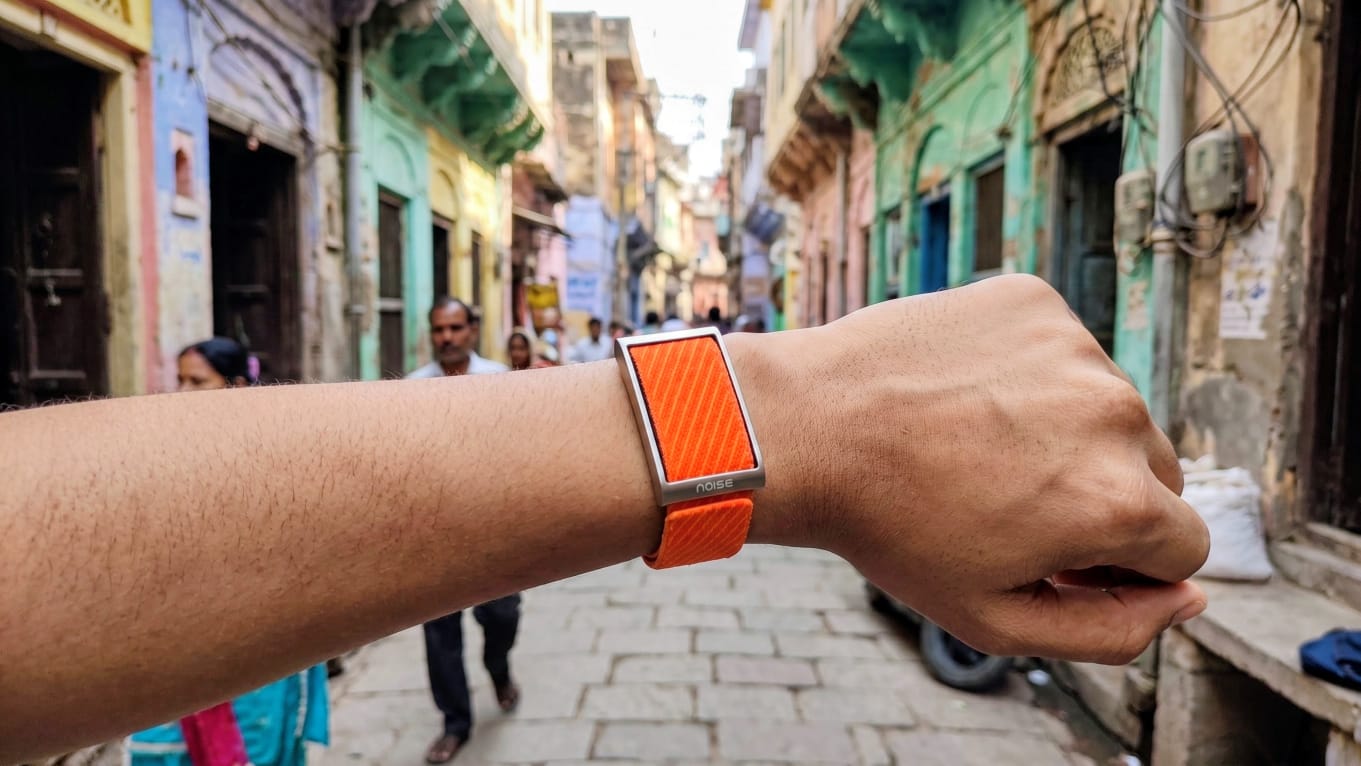
Varanasi: Seven days ago I strapped an orange fabric band to my left wrist and stopped being able to check the time.
That's the pitch, by the way. That's not a complaint yet. The Noise REP Band has no screen — none, not a tiny OLED sliver, not even an LED that tells you it's alive — and that is the entire product. It costs ₹9,999, or ₹7,999 if you were quick enough with the ₹999 pre-book pass, which you probably weren't because it sold out on day one. There is no subscription. Ever. That last bit is the whole reason this review exists.
Because the thing it's chasing, the Whoop 5.0, will cost you somewhere between ₹26,000 and ₹34,000 in India for the band plus twelve months, and then it wants money again next year. Forever. And if there is one thing a Banarasi understands in his bones, it is the difference between buying a thing and renting a thing.
So: can a ₹10,000 Indian band do what a ₹30,000-a-year American one does? Let me tell you what happened.
First, an honest disclaimer about this review
Noise says the REP Band needs seven days of continuous wear to build your personal baseline before Recovery, Sleep, and Effort scores mean anything.
I have worn it for seven days.
So take everything below as first impressions from a man whose band has only just finished figuring out who he is. I'll do a proper long-term piece in a month. Anyone publishing a confident verdict on this device after five days is selling you something.
It looks like nothing, and that's the best part
26.5 grams. A small sandblasted stainless steel frame with "noise" written on the bottom edge, a nylon twill strap, a clasp you can do one-handed. My unit is Vivid Orange, which in this city is a genuinely funny choice — I wore it to a wedding in Nadesar and two separate people assumed it was some kind of mauli-adjacent thing, and one uncle asked which hospital I'd been admitted to.
But here's what I actually noticed by day three. Nobody asked me the price.
If you have ever owned a nice watch in Banaras you know the ritual. You put your hand out for chai and someone says kitne ka hai bhaiya, and then there's a conversation, and then there's an opinion. Wearing a screenless band, that never once happened. There's nothing to show. It just sits there being a wristband.
I did not expect the social invisibility to be the feature I liked most. It is.
Comfort in monsoon, though — mixed. The twill strap is genuinely breathable and dries faster than silicone would, and 5ATM meant I stopped thinking about rain entirely. But after a full humid day at 87% and a two-hour outdoor shoot, the strap holds damp against the skin, and by night five I had a faint pressure mark under the sensor. Loosen it a notch and the readings get flaky. Tighten it and your wrist knows about it. This is a monsoon problem, not a Noise problem, but you're buying it in a monsoon so it's your problem.
The Kashi Vishwanath test, which it passed brilliantly
You cannot carry your phone into the temple. You deposit it outside with a token and you go in and for forty-five minutes you are a person with no device, which honestly is the best forty-five minutes of most people's week.
The REP Band stayed on my wrist through security without a word — no screen, no camera, nothing to object to — kept recording heart rate the whole time, and synced everything to the phone afterwards. Same thing at a couple of places where a smartwatch would have made someone frown.
Small thing. But this is a city where you're constantly putting your phone in a locker or a bag or a boatman's dry sack, and a tracker that keeps working without the phone in your pocket is genuinely more useful here than it would be in Gurugram.
Where it actually falls down: it doesn't know what we do
Auto-detection covers running, walking, cycling, elliptical, and rowing.
Look at that list again, then look at how this city trains.
I took it to an akhada in Ramnagar on Sunday morning. Dands, baithaks, mud, rope work, the whole thing — an hour and forty minutes of the hardest physical work I have done this year. The REP Band logged some of it as elevated heart rate and gave me an Effort score that was, to be fair, high. But it detected no exercise. No session. No "you did kushti." Nothing in the app that says a workout happened.
Same in a normal gym. Deadlifts, presses, anything with a bar — invisible. Heart rate goes up, effort registers, but there's no strength training detection at all.
If your fitness life is running along the ghats and cycling, this thing is excellent. If your fitness life is lifting or wrestling or anything that isn't repetitive cardio, you are buying a very good passive health monitor and a very incomplete workout tracker. Know which one you're paying for.
Oh, and rowing is on the list, so obviously I tested it on a boat from Assi to Manikarnika. Reader, I made the boatman let me row for ten minutes. It picked it up. It also picked up my complete lack of technique, in the sense that my heart rate hit 148 while a sixty-year-old man watched me with visible pity.
The sleep data is honest, and Banaras is brutal about it
Here's where the band earned its money.
Sleep tracking picked up things I have spent years lying to myself about. The 4am bells. The generator that kicks in on our lane. The loudspeaker during Sawan that starts before you've decided whether you're awake. Every single night showed fragmentation between 3:30 and 5:00 that I had genuinely convinced myself wasn't happening because I "felt fine."
My sleep scores across the week ranged from a 51 to a 78, and the low ones lined up exactly with the nights I'd eaten late at a wedding or worked past midnight. No mystery, no magic. Just a mirror.
The Recovery score is the more interesting number and also the one I trust least so far. Twice this week it told me I was poorly recovered on mornings I felt great, and once it gave me a green light on a day I was clearly running on fumes. Some of that is the baseline still settling. Some of it, I suspect, is that these algorithms have a hard time separating "you are fatigued" from "it is 34 degrees and 90% humidity and your resting heart rate is up because you live in a steam room." Nobody's tracker handles an Indian August well. This one is no exception.
About those accuracy claims
Noise cites a Bland-Altman analysis against a Polar chest strap during outdoor running, with a mean difference of -0.06 BPM and 95.8% of readings inside agreement limits. They also say the optical sensor is calibrated specifically for Fitzpatrick skin types II to VI and for Indian skin tone and hair-density variation, which is a real and underrated problem with wearables designed around narrower datasets.
I want to be clear about two things. One: that calibration claim matters, and if it holds up it's the single most genuinely Indian thing about this product. Two: those accuracy figures are Noise's own internal testing, not independent third-party validation. Every brand's own numbers look great. Treat them as a claim, not a result, until someone outside the company runs it.
My unscientific version: strapped against my chest strap during a 5k along the ghat road, the numbers tracked close enough that I stopped checking. Steady-state cardio is where optical sensors are easiest. The hard case is intervals, and I haven't done enough yet to say.
The app is the risk
Everything lives in NoiseFit. Sleep, recovery, effort, HRV, SpO2, skin temperature, respiratory rate, VO2, stamina, plus AI-written daily highlights. All of it free, all of it from day one, no paywall. Syncs out to Strava, Apple Health and Google Health.
The insights are... fine. Readable, mostly sensible, occasionally stating the obvious with great confidence ("your sleep was shorter than usual"). Yes bhai, I was there.
But NoiseFit's history is as a companion app for ₹3,000 smartwatches, and this device is asking it to be a serious health platform. Twice this week the band didn't sync until I opened the app and waited. Noise's own FAQ page tells you to keep the app running in the background for a stable connection, which is not a great sign. The hardware here is punching well above ₹10,000. The software is the part I'd want to see six months from now before I fully commit.
Also: there's no GPS in the band. Outdoor runs need your phone. And the charging dock is proprietary and magnetic, and Noise explicitly warns you to use a 5V/1A adapter and not a fast charger — so don't grab the nearest 65W brick out of habit.
So. Whoop for ₹10,000?
No. And also, for most of you, yes.
No, in the sense that Whoop's platform is deeper — Strain, Healthspan, the coaching layer, years of refinement, third-party validation. If you are an athlete whose performance actually depends on this data, that gap is real and you should pay for it.
Yes, in the sense that maybe four people in this city need that depth, and the other ten thousand of you who've been curious about recovery tracking have been locked out by a subscription model that never made sense here. ₹9,999 once, versus ₹30,000-odd a year forever. That is not a comparison. That is a different category of decision. The REP Band's real competitor isn't Whoop. It's the ₹5,000 smartwatch on your wrist right now that buzzes at you all day and tells you nothing.
Buy it if: you want to understand your sleep and recovery, you're tired of screens, you run or walk or cycle, and the idea of renting your own health data annoys you on principle.
Skip it if: you lift, you wrestle, you need workout detection that understands anything other than cardio, or you want a device you can look at.
Rating: 4 / 5, provisional. Half a point held back for the app, half for the accuracy claims nobody outside Noise has checked yet. I'll revisit in a month.
Right now it's still on my wrist. A week in, I've stopped noticing it's there, which for a device whose entire job is to disappear is probably the highest score I can give it.
Disclosure: Unit purchased at retail. Not a Noise review sample, no brand involvement, nobody at Noise saw this before you did.
Sources and reporting
First-hand testing of a retail-purchased Noise REP Band over seven days in Varanasi. Product specifications, pricing and manufacturer claims were checked against official information published by Noise and Whoop. The product was not supplied by the brand.
Related Stories
CAG Flags Rs 949 Cr HSPCB Sewage Gap

HHRC Orders Citywide Drainage Audit

MCG Fines 32 Shopkeepers Rs 91,500

MCG Contractors Allege Bribes After Arrest

Garbage Piles Persist in Sectors 3, 5 and 6