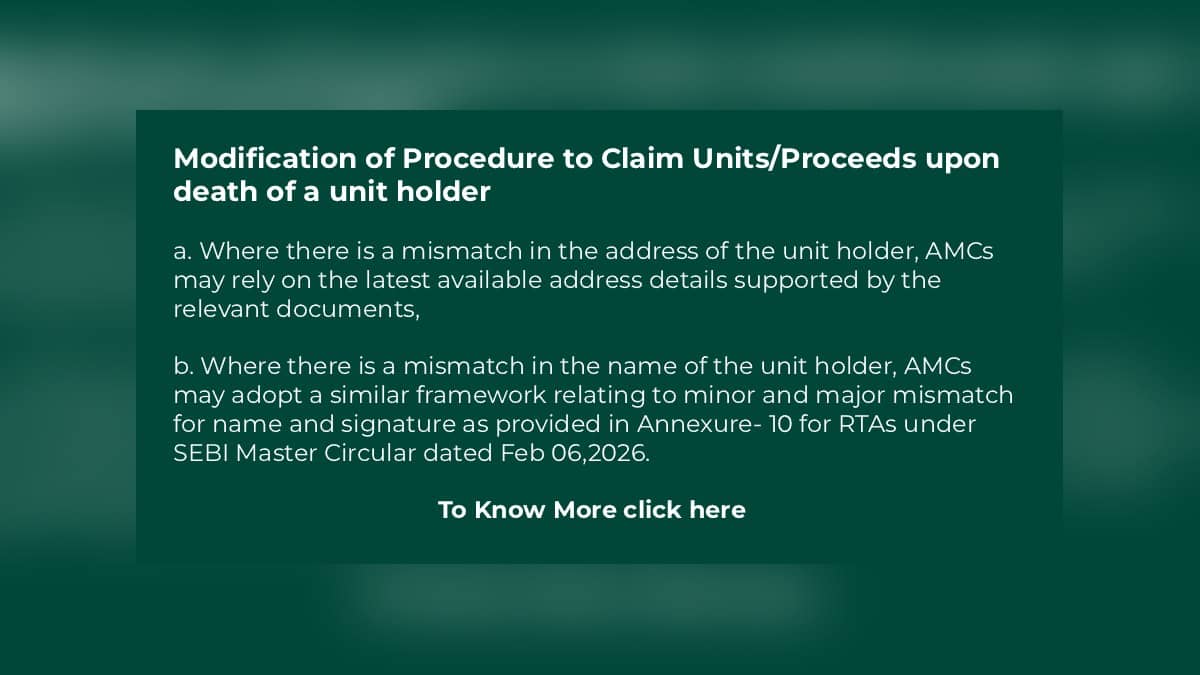
SEBI's mutual fund categories now include Equity, Debt, Hybrid, Life Cycle Funds and Other Schemes. The regulator's circular dated 26 February 2026 sets out this framework and discontinues the earlier Solution Oriented Schemes category. A category describes a scheme's investment mandate; it does not tell you that its returns are assured or that every fund carrying that label has an identical portfolio.
The official categorisation circular, read for this guide on 2 November 2026, supersedes the specified categorisation clause in the earlier master circular. This matters when an older educational page still lists retirement and children's schemes under Solution Oriented Schemes. The date and version of the rule are part of the answer.
| Broad group | What the category describes |
|---|---|
| Equity | Predominantly equity and related instruments |
| Debt | Predominantly debt and related instruments |
| Hybrid | A permitted mix of asset classes |
| Life Cycle Funds | A glide path with predetermined maturity |
| Other Schemes | Funds of funds and passive schemes such as index funds and ETFs |
Large cap, mid cap, multi cap and flexi cap: what changes?
The detailed equity categories impose different minimum allocations. A large cap fund must invest at least 80% of total assets in equity and equity related instruments of large cap companies. Mid cap and small cap funds each have a 65% minimum in their respective segments. These percentages are mandate requirements, not a comparison of potential performance.
Multi cap and flexi cap are also different. A multi cap fund has a minimum 75% equity allocation, including at least 25% of total assets in each of large, mid and small cap companies. A flexi cap fund has a minimum 65% equity allocation across those segments without that same three way minimum split. Reading the full category avoids treating similar sounding names as interchangeable.
What are Life Cycle Funds and what happened to solution oriented schemes?
The circular describes Life Cycle Funds as following a glide path across permitted asset classes, with a predetermined maturity and a structure for goal based investing. A glide path is an allocation plan that changes over time. It describes the scheme's design, rather than a guaranteed sum available on a future date.
For the discontinued Solution Oriented Schemes category, SEBI directs existing schemes to stop subscriptions immediately and merge into another scheme with a similar asset allocation and risk profile, subject to prior approval. This is not a reason to assume the destination or completion date of any particular merger. That requires the fund house's own scheme notice.
How to read a mutual fund factsheet against its category
Start with the scheme's full name and category, then find its stated investment objective and asset allocation. The circular's category tables provide the reference limits. An allocation floor is different from the actual percentage held on a factsheet date. The actual mix can move within the permitted mandate.
Next, separate the scheme mandate from the plan and option. A factsheet can show several return series, so the plan, option, measurement period and benchmark need to match the comparison being made. The category itself is not a return figure. A category table cannot establish what an individual portfolio earned over a particular period.
SEBI also requires monthly category wise portfolio overlap disclosures on AMC websites. This can help explain why two differently named schemes hold some of the same securities. The circular sets a separate three year compliance period for its existing sectoral and thematic scheme overlap limits; it would be inaccurate to treat every transition provision as having the same deadline.
This guide makes no named fund selections. For the other labels encountered on a factsheet, read our explanations of NAV and its calculation, expense ratios and plan labels, and SIP calculator assumptions.