VARANASI: A Dandi sanyasi associated with the Puri Peeth has asked calendar publishers and governments to reconsider how the birth and death anniversaries of saints are labelled, arguing that fixed Gregorian dates can mislead readers when the observance traditionally follows a lunar tithi.
Vanvaibhavaranya Saraswati, who is in charge of Dakshinamurti Math at Assi, said calendars should not place an English-calendar date in brackets as though it were the permanent date of a religious anniversary. He cited recent examples in which the anniversaries of Karpatri Ji and Tulsidas were shown as August 14 and August 19. His concern is that younger readers may assume those dates remain the same every year.
The monk has requested that the Union and state governments issue guidance to calendar makers and printers. The request is not, at this stage, a government order or a change in official policy. It is a proposal from a religious figure about presentation and accuracy in calendars used by devotees.
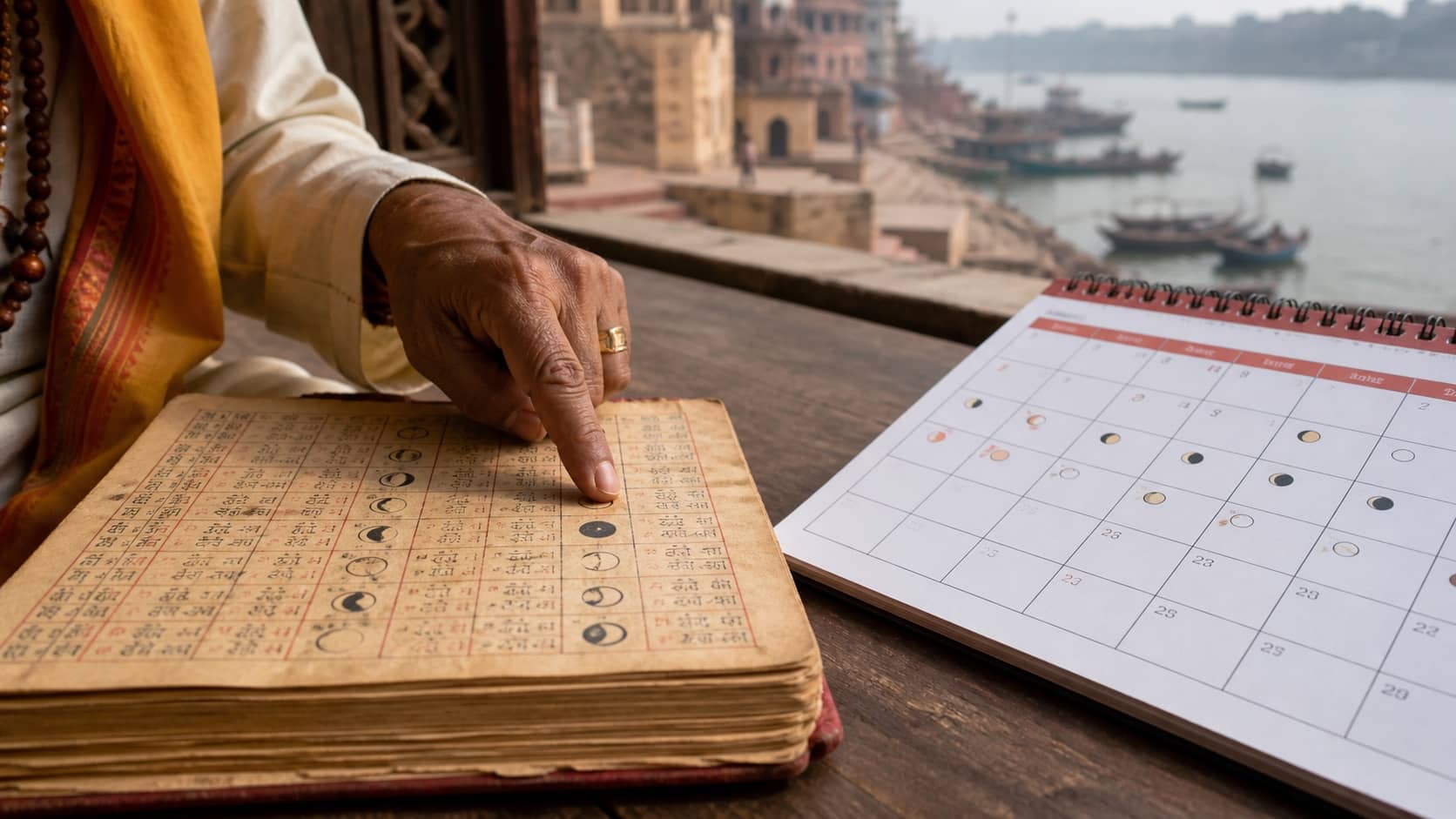
The underlying issue is easy to understand. A Gregorian birthday returns on the same numbered date each year, subject to the ordinary structure of that calendar. Many Hindu festivals and commemorations, however, are tied to a tithi, nakshatra or month in a lunisolar system. When translated into the Gregorian calendar, the corresponding date shifts from one year to the next.
Calendar editors therefore face a design problem as well as a cultural one. Readers want an immediately usable date, but a fixed label can erase the rule by which the observance is actually calculated. One practical solution would be to print the relevant tithi prominently, followed by the Gregorian date for that specific year and a note explaining that it changes annually.
Such clarity matters beyond religious circles. Schools, cultural bodies, trusts and public institutions often organise commemorative events from printed calendars. If an entry is ambiguous, two groups may mark the same anniversary on different days while each believes it is following the authoritative date.
The proposal also highlights the importance of editorial verification. Calendar content is frequently copied from older editions or circulated images without checking a current panchang. Publishers should identify the calendrical basis they use, consult qualified experts and correct mistakes transparently. Governments need not dictate theology to encourage accurate labelling.
At the same time, India’s plural calendar traditions do not always produce a single universally accepted observance. Regional panchangs and sectarian practices can differ. Any guidance should leave room to state the tradition followed rather than pretending that every disagreement is a printing error.
Vanvaibhavaranya Saraswati’s appeal is ultimately about how one line of small print shapes public memory. In a city such as Varanasi, where ritual time guides daily movement, the distinction between a tithi and an English date is not academic. A well-designed calendar can give readers both: the traditional basis of the anniversary and the modern date on which it falls that year.