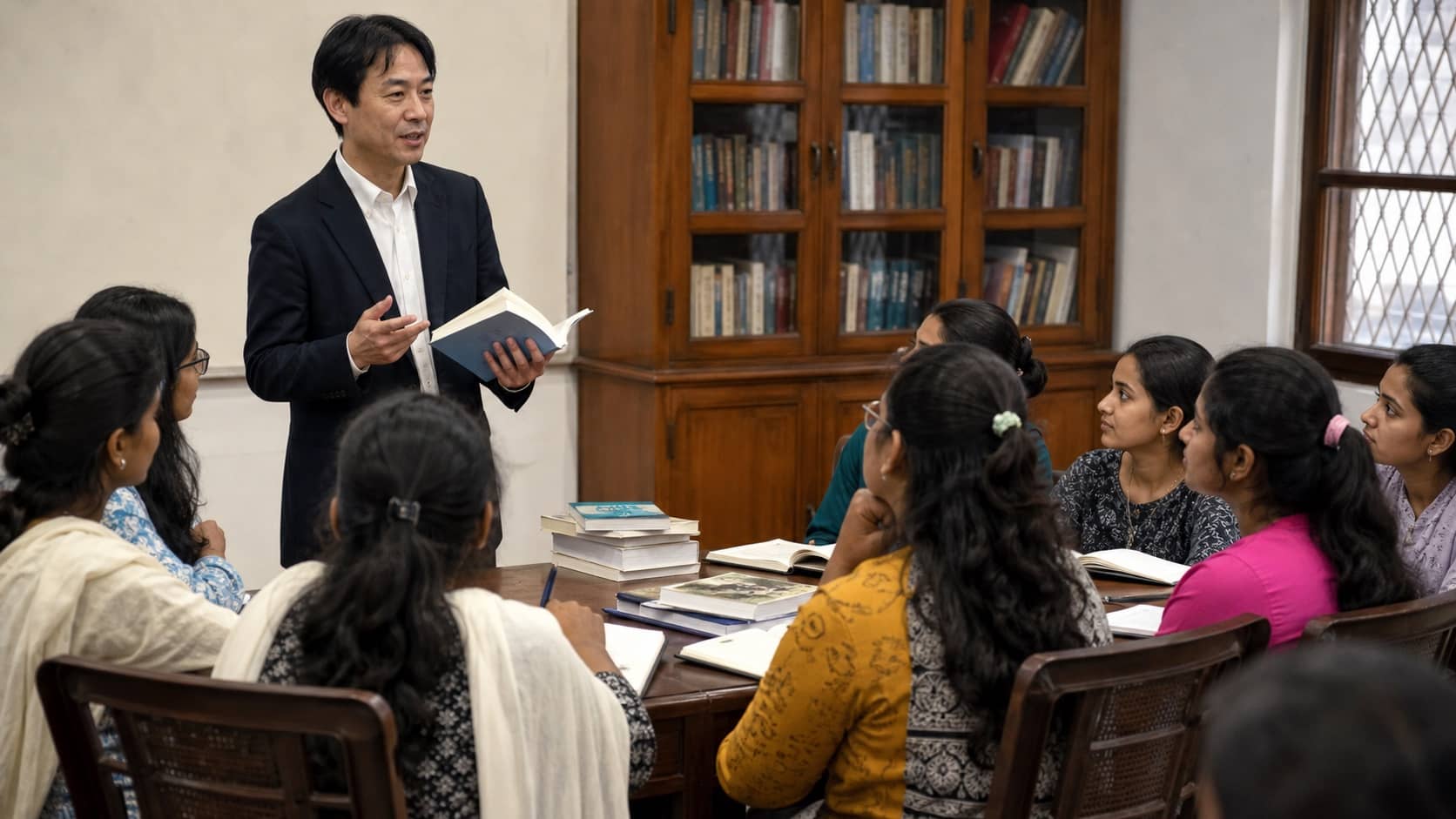
VARANASI: The French department of Vasant Women’s College in Rajghat hosted a lecture on Thursday examining migration in the novels of French-language author Somona Sinha, with a visiting scholar from Japan guiding students through the writer’s transnational work.
Professor Loïc Renaud of Okayama University delivered the lecture and argued that migrants and the experience of displacement are central to Sinha’s fiction. College principal Professor Alka Singh opened the programme, Dr Sandeep Kumar Pandey presided and French department teacher Sakshi Singh gave the vote of thanks. Faculty members from several departments attended.
Somona Sinha was born in India and writes in French, a biographical fact that naturally invites questions about language, belonging and the audiences an author addresses. Her fiction does not fit neatly inside a single national shelf. That makes it useful for students learning French in Varanasi, where language study can otherwise become dominated by grammar exercises detached from contemporary life.
Migration literature is not only about crossing a border. It often explores the smaller negotiations that follow: how a name is pronounced, which memories can be translated, how work changes identity and what happens when a person feels partially at home in more than one place. A novel can hold those contradictions without forcing them into the simplified categories used by forms and official documents.
The presence of a scholar from a Japanese university added another layer to the discussion. An Indian-origin author writing in French was being read in Varanasi through research based in Japan. That route demonstrates how literature circulates across institutions and how a text can gather interpretations far from the geography in which it began.
For students, the challenge is to read the work rather than rely only on the author’s biography. Migrant identity can be a useful frame, but it should not become a label that predetermines every character or sentence. Close reading asks how narrative voice, irony, rhythm and imagery create meaning—and what may be altered when a passage is translated.
Departments can extend the value of such a lecture through bilingual reading groups. Students might compare a French passage with an English or Hindi translation, identify choices and attempt their own version. That exercise reveals why translation is interpretation, not the mechanical replacement of words.
International guest lectures also need continuity. A single visit can spark curiosity, while shared seminars, student exchanges or collaborative reading lists can build an academic relationship. Digital sessions make follow-up possible even when travel budgets are limited.
Rajghat’s academic setting made the conversation especially fitting. Varanasi has long attracted scholars and travellers who arrive with one language and encounter several more in the same street. The city itself offers daily evidence that culture is translated, imperfectly but creatively.
Thursday’s lecture placed a contemporary author at the centre of that process. It reminded students that studying French in Varanasi is not an escape from local reality. It is another way to examine movement, identity and the uneasy work of making a home in language.