
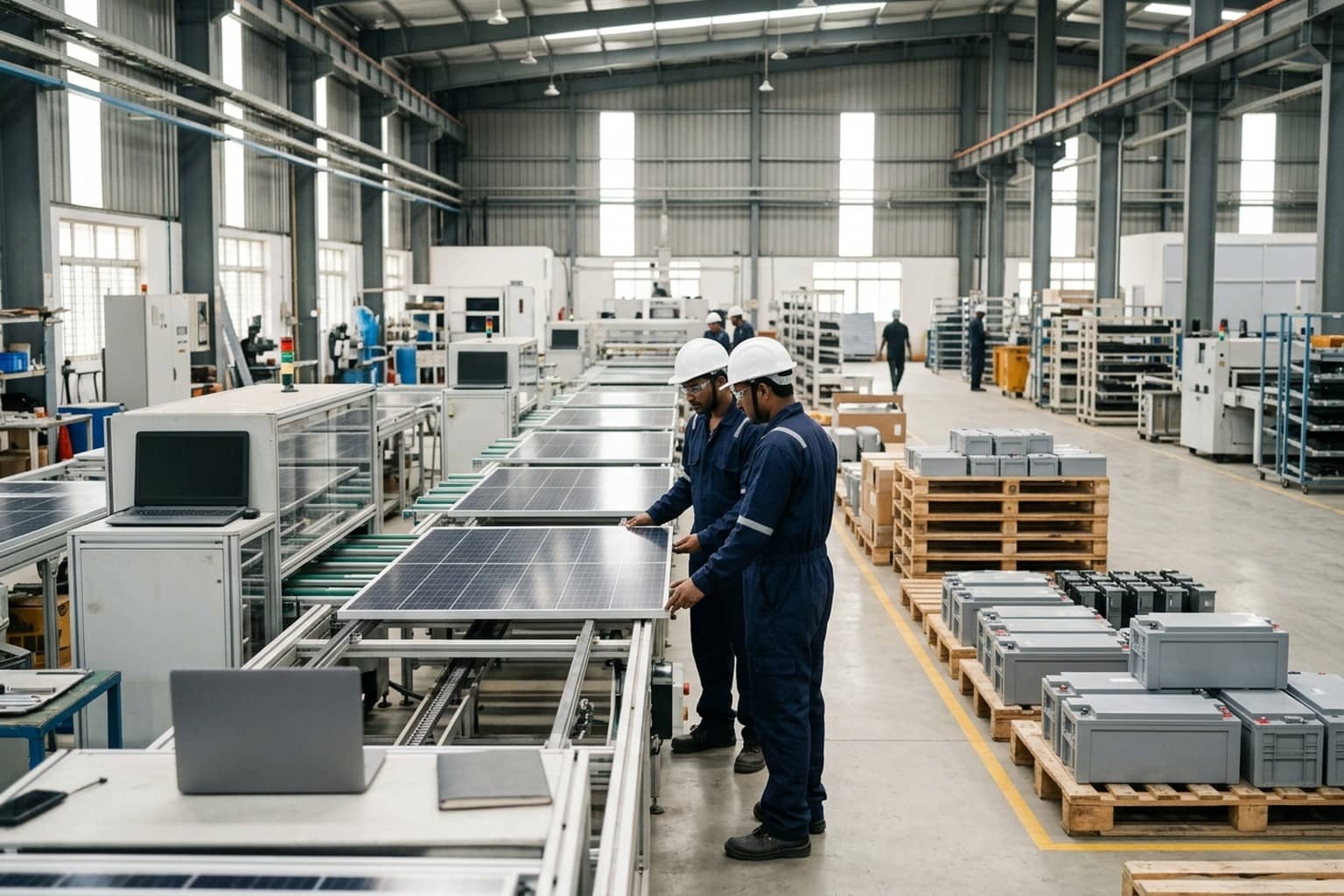
India has put its name to a joint statement, led by the United States, that targets what trade officials call structural excess capacity in five manufacturing sectors: autos and electric vehicles, batteries, chemicals, foundational semiconductors and solar panels. The Office of the US Trade Representative published it on 7 October 2026.
Fifteen trade ministers signed it: Argentina, Australia, Canada, the European Union, France, Germany, India, Italy, Japan, South Korea, Mexico, Poland, Türkiye, the United Kingdom and the United States. Senior officials from these economies met the same day on the margins of the OECD Trade Committee to start work.
What structural excess capacity means
The statement defines it as capacity and production that persistently exceed global demand, would not exist under market conditions, and are created, sustained or helped by government policies or interventions. The signatories say it leads to overproduction and too much production in too few places, discourages market-based investment and undercuts exports from countries that do not support their industries in the same way.
There is a supply-security argument as well. According to the statement, when one country dominates a product, its trading partners become more dependent on it and more exposed to economic coercion, including arbitrary export restrictions.
The document does not name any country. It talks about non-market policies and practices and calls on all countries to end them.
Where the statement came from
It grew out of the G20 Trade Ministerial held in Milwaukee, Wisconsin, on 30 September and 1 October under the US G20 presidency. The text recalls that G20 trade ministers raised concerns about excess capacity in Shanghai in 2016, which led to the Global Forum on Steel Excess Capacity, and that G20 leaders said at Hangzhou the same year that subsidies can distort markets and add to excess capacity. The signatories say the problem has become worse since then.
Not every G20 member joined. In his chair's statement after Milwaukee, US Trade Representative Jamieson Greer said many members had expressed resolve on the issue but that he was disappointed a handful had rejected creating a pathway towards cooperative action.
What the signatories have committed to
The commitments are about process, not tariffs. The countries say they will work in new, dedicated platforms for each of the five sectors. They have promised to meet at technical level before December 2026 to draw up terms of reference, share non-confidential data on excess capacity and its effects, and identify gaps in information, drawing on OECD work where useful.
They also commit to exploring effective and, where possible, complementary actions to defend their economies. The statement notes that more and more countries are already acting on their own to protect their industries, and argues that such steps work better when concerned countries share information and act together. Other countries, inside and outside the OECD, are invited to join.
The other statements from Milwaukee
The excess capacity text was not the only outcome of the meeting. All G20 trade ministers reached consensus on a separate statement condemning the use of food and farm products as a tool of economic or political coercion, which USTR described as the one text the whole group backed. A statement on removing forced labour from global supply chains was signed only by the United States, Mexico and Argentina after the G20 failed to agree on it.
Greer also said members across the development spectrum saw merit in looking at how the most-favoured-nation principle, the basic rule that a trade concession to one member applies to all, might be improved for today's conditions. For a country like India, which has long relied on that principle at the WTO, that debate may matter as much as the sector platforms over time.
Why it matters for Indian industry
All five sectors are ones where India is trying to build up its own manufacturing, through production-linked incentive schemes for autos, advanced chemistry cell batteries, solar modules and electronics, and through its semiconductor programme. Cheap imports from countries with large surplus capacity are a direct challenge to those plans, so India's signature fits its own industrial policy.
For Indian exporters the picture has two sides. Coordinated action could help protect markets such as the US, the EU and the UK, where Indian firms sell, from a flood of very low-priced goods. It could also bring closer checks on where components come from, especially for Indian manufacturers that import cells, wafers or chemical inputs and assemble them locally. Rules of origin and supply-chain records, already central to trade deals and carbon border rules, are likely to matter more.
Solar and battery makers that rely on imported inputs have the most reason to follow the sectoral platforms closely. Auto component and speciality chemical exporters selling to the US and Europe will want to watch as well, because any later measures would most likely be framed around those markets.
What it does not do
Nothing changes at the border today. The statement sets no tariffs, quotas or duties and creates no binding obligations. Any trade measures would have to come later, from individual governments, through their own legal processes. The first concrete milestone is the technical meeting before December, where the terms of reference should be agreed.
What to watch next
The next signals will come from who else joins the sectoral platforms, what the working groups agree to share and whether any signatory announces trade steps for a specific sector that refer back to this statement.
Indian exporters are already adjusting to several dated trade changes, from the EU's carbon border rules to the India-New Zealand trade agreement that starts on 20 October. This statement is far less concrete than either, but it shows where trade policy in India's largest export markets is heading on clean-energy and electronics goods. This is information, not advice.