
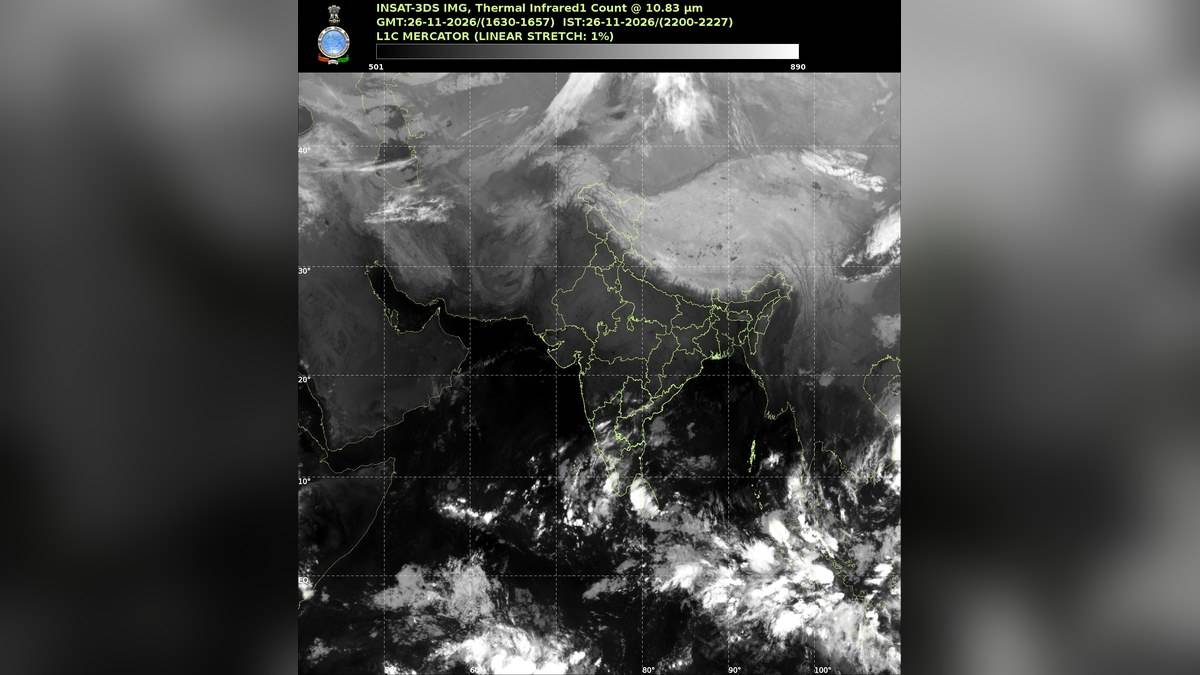
NEW DELHI: IMD has forecast cold-wave conditions in isolated parts of East Rajasthan from 26 to 28 November 2026. Its Jaipur centre names Ajmer, Sikar and Tonk for all three days, while Bundi and Kota have warnings for 26 and 27 November. The district bulletin was issued at 11:00 IST on 26 November; the national forecast, issued at 13:15 IST, confirms the East Rajasthan warning period.
The practical distinction is between a warning for a meteorological region and the dates listed against an individual district. Residents planning early outdoor work or travel should read their district row rather than assume every part of Rajasthan has the same alert. This report uses the dated bulletins, including Jaipur's evening observations, checked on 26 November 2026.
| Districts | Cold-wave warning dates |
|---|---|
| Ajmer, Sikar, Tonk | 26, 27 and 28 November 2026 |
| Bundi, Kota | 26 and 27 November 2026 |
| Jaipur | No warning in this district bulletin |
Which Rajasthan districts have a cold-wave warning?
The Meteorological Centre Jaipur district warning gives separate columns for each day through 2 December. Ajmer, Sikar and Tonk retain the cold-wave entry through 28 November. Bundi and Kota change to no warning from 28 November. The western Rajasthan rows carry no warning in this issue.
Those entries describe the warning status in that forecast. A no-warning entry does not provide a temperature for every neighbourhood or promise comfortable conditions outdoors. Equally, the regional warning should not be expanded into a claim that the entire state faces a cold wave. The named districts and the dated columns are the useful information for a household deciding which forecast applies to it.
The warning table and the evening weather table also have different issue times. Keep the 11:00 IST warning date attached to the district list and the 20:30 IST issue attached to the observations. An evening temperature summary does not, by itself, replace the dates printed in a district warning.
What temperatures did IMD record on 26 November?
Jaipur's daily state weather bulletin issued at 20:30 IST lists Sikar's minimum at 5.0 degrees Celsius, 4.8 degrees below normal. Ajmer recorded 9.3 degrees, also 4.8 degrees below normal, while Kota recorded 10.0 degrees, 5.2 degrees below normal. These are observations dated 26 November, rather than predicted overnight lows for the following day.
The same table puts Jaipur's minimum at 12.2 degrees Celsius and Churu's at 7.6 degrees. That comparison helps explain why the lowest raw temperature is only part of the story. An observation and a warning answer different questions: one reports what a station measured, while the other identifies an expected hazard over a stated period. Reading both together avoids turning a single cold reading into a statewide declaration.
Why can a cold wave be declared above 4 degrees?
IMD's cold-wave FAQ explains that departures from normal matter alongside actual temperatures. For plains, the minimum-temperature consideration begins at 10 degrees Celsius or below. Its departure-based cold-wave band is 4.5 to 6.4 degrees below normal. There is also an actual-temperature route for plains stations at 4 degrees or below.
The FAQ adds a regional persistence requirement: qualifying conditions at least at two stations in a meteorological subdivision for two consecutive days, with declaration on the second day. Readers should therefore use IMD's issued warning instead of declaring a cold wave from a home thermometer. Our guide to IMD cold-wave criteria explains the thresholds in more detail.
What precautions does the official bulletin recommend?
The 26 November national press release recommends several loose layers of warm clothing, adequate covering for exposed body parts, limiting outdoor activity and changing wet clothing promptly. It also says heating arrangements need ventilation. Its advice to protect vulnerable people is particularly relevant when someone cannot easily move indoors or arrange warm clothing without help.
For farms in East Rajasthan, the release recommends light, frequent evening irrigation for standing crops and using mulch or covers for vegetable nurseries and young fruit plants. These are the bulletin's precautions for low-temperature stress. Farmers should match them to their crop and local agricultural guidance, rather than treat a district warning as evidence that frost has already damaged a particular field.
Cold-wave warnings and fog warnings should also be checked separately before a journey. The same national issue forecasts dense fog in isolated parts of East and West Uttar Pradesh, Punjab and Haryana, Chandigarh and Delhi during 26 to 28 November. Our fog-warning explainer and earlier Uttar Pradesh fog report provide related context. Check a fresh local bulletin and the transport operator's schedule before departure, since a regional forecast alone cannot establish whether an individual service will run late.