IIT-BHU Lunar Soil Simulant Targets Space Mining and 3D Construction
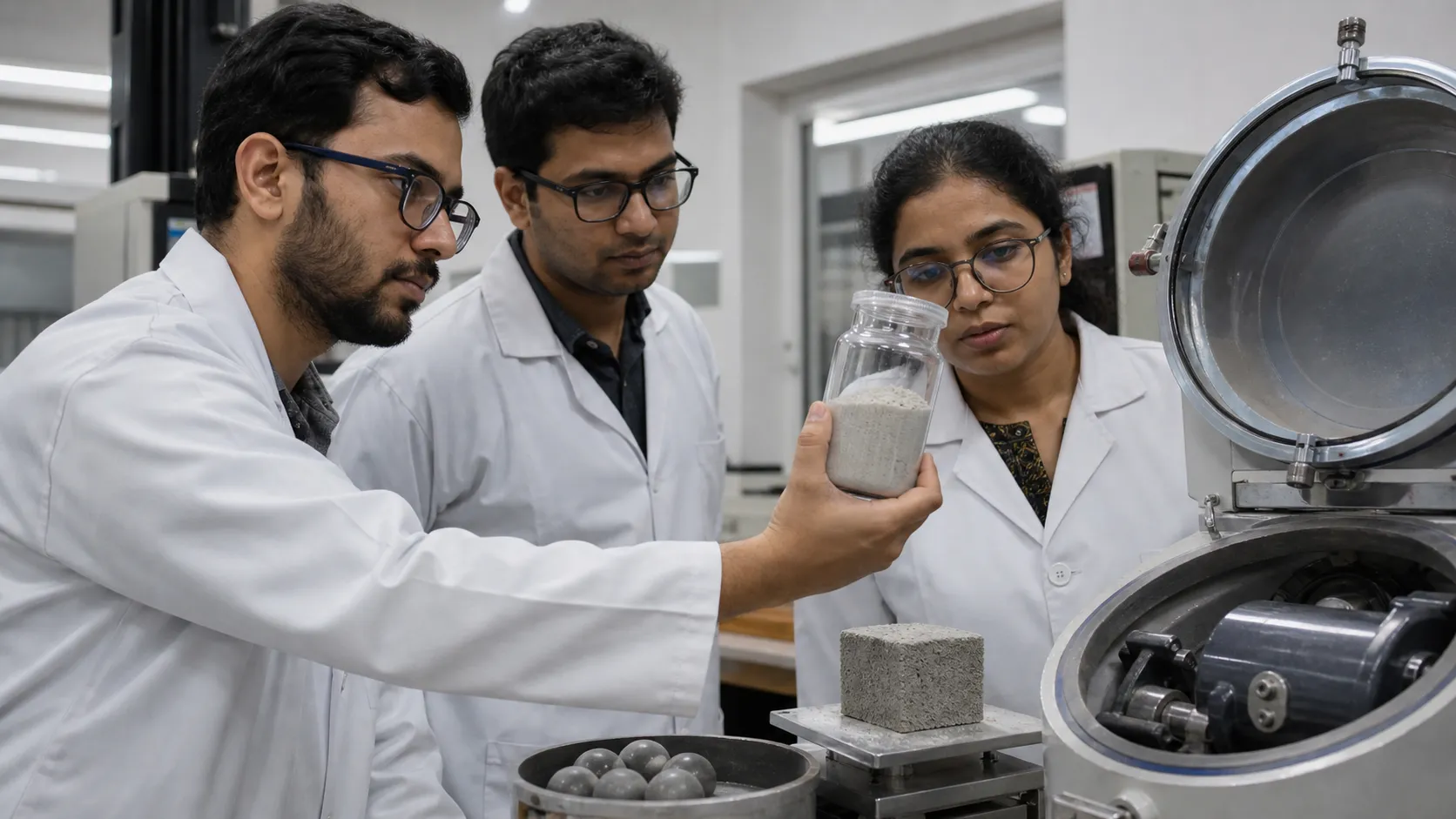
A pale grey powder developed in an IIT (BHU) Varanasi laboratory could help researchers test how future missions extract materials and build structures on the Moon. The ISRO-funded team has engineered a high-fidelity lunar soil simulant designed to reproduce important physical and chemical characteristics of lunar regolith.
Actual lunar material returned to Earth is exceptionally scarce and reserved for tightly controlled research. Most experiments in mining, machinery and construction therefore need a terrestrial substitute. A useful simulant cannot merely look like Moon dust. Its mineral composition, particle size, density, abrasiveness and flow behaviour must be close enough for the experiment being performed.
The IIT-BHU team used carefully selected Earth minerals and chemical additives, processing them through ball milling to produce particles smaller than 40 microns. The resulting material is intended to reflect the fine and abrasive character of the lunar surface layer. Different areas of the Moon have different geology, so every simulant must state which properties and target region it is designed to represent.
One application is space-resource extraction. Carrying every kilogram of metal, water and construction material from Earth is costly. If a mission can process local regolith, it could reduce dependence on repeated supply launches. The simulant allows researchers to test extraction techniques, equipment wear and separation processes without consuming priceless lunar samples.
The team is also exploring slurry-based inks made from the engineered soil. These could be used in additive manufacturing to print bricks, landing surfaces or elements of a habitat. A landing pad built from local material could limit the cloud of abrasive dust thrown up by a spacecraft engine, while modular printed components may reduce the mass carried from Earth.
That future remains experimental. A material that prints successfully under laboratory conditions on Earth must still be tested for low gravity, vacuum, temperature extremes and radiation. Binding agents that work here may not be practical on the Moon. Strength, cracking, thermal cycling and the energy required for processing will all affect whether a method is viable.
The project’s immediate value is as a repeatable testing platform. Researchers can compare machines and recipes using a consistent material, refine a process and identify failures before proposing an expensive space demonstration. The composition and preparation method should be documented so that other laboratories can reproduce results rather than treating the powder as a black box.
IIT-BHU’s lunar soil work connects materials science in Varanasi with one of space exploration’s least glamorous but most important problems: how to work with the dust already there. The jar on a laboratory desk is not Moon soil, and it should not be described as such. Its promise lies precisely in being a carefully engineered substitute—common enough to experiment on, accurate enough to teach engineers what may happen when their tools finally touch the lunar surface.
Sources and reporting
Based on the verified Dalimss News Banaras research post published on 5 August 2026 about an ISRO-funded IIT (BHU) Varanasi team developing a high-fidelity lunar soil simulant.
Related Stories

BHU: Below 4.0 CGPA Will Cost Hostel and Health Facilities

Sewer and Water Pipeline Work Starts in Four Wards Under CCTV Watch

BHU Issues 69-Page PhD Bulletin for About 1,500 Seats in Three Modes

Lolark Shashthi Draws Long Queues at Bhadaini’s Lolark Kund

Ganga Level Keeps Falling; Silt Clearing Starts as Boat Ban Holds