GURUGRAM: The Gurugram Metropolitan Development Authority has ordered a set of immediate and longer-term drainage interventions after about 80 millimetres of rain overwhelmed roads on Monday and trapped commuters in hours of congestion.
GMDA chief executive officer PC Meena inspected Subhash Chowk, Vatika Chowk, the area near Airia Mall on Sohna Road, Medanta Road, the adjoining underpass, Tau Devi Lal Stadium and parts of Old Gurugram on Tuesday. Officials were told to identify the engineering cause at each location rather than rely only on emergency pumping after the next storm.
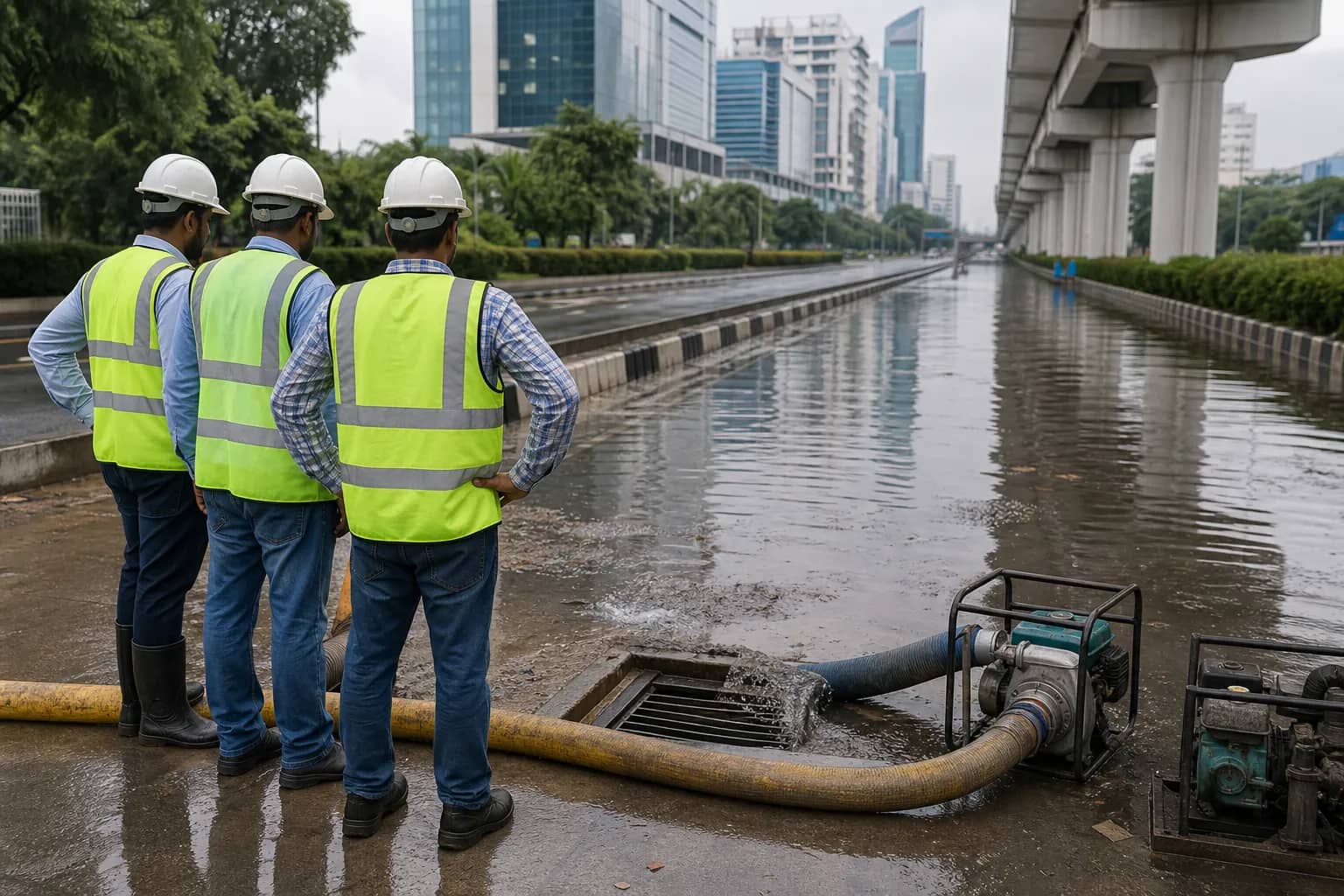
At Subhash Chowk, the authority plans a sump and an additional pumping arrangement to move stormwater out more quickly. Super-sucker machines were ordered for desilting sewage and stormwater drains, while officials were also asked to ensure rainwater-harvesting systems remain functional.
At Vatika Chowk, the direction is to divert as much stormwater as possible into the Leg 4 drain, reducing the immediate load on the Badshahpur drain. Near Airia Mall, temporary pumps are to discharge accumulated water towards nearby ponds. A proposed surface drain along the Sector 68-69 road is presented as the longer-term outlet.
Medanta corridor needs connected drains
Meena asked engineers to connect the existing surface drains around Medanta Road, its underpass and Tau Devi Lal Stadium with the new drain so water has a continuous discharge path. That instruction addresses a recurring urban problem: individual drains may exist, but a missing or poorly graded link leaves water trapped at the lowest point.
The authority said Monday's rain exceeded the capacity of the stormwater system at several locations and that accumulated water was removed in four to five hours. For commuters, that interval was still long enough to turn routine journeys into multi-hour ordeals. A drainage benchmark should therefore measure recovery time road by road, not simply whether water eventually disappeared.
Immediate pumps are not the final answer
A sump, pump or super-sucker can be essential during the monsoon, but each requires power, maintenance and a receiving drain with spare capacity. Moving water from one junction to an already overloaded channel can transfer the problem downstream. Engineers need flow calculations and level surveys to show where the water will go.
The use of ponds near Sohna Road also requires care. A johad can provide temporary storage when it has capacity and a protected overflow route. It cannot become an unmonitored dumping point for sewage-contaminated stormwater or remain overfilled before the next spell.
Monday's collapse of mobility has given GMDA a detailed map of where the network failed under a real storm. The value of Tuesday's inspection will depend on whether each direction receives an owner, deadline and completion record before public attention moves on.
Residents do not need another general assurance that permanent measures will be taken. They need visible evidence that the Subhash Chowk sump, the Vatika diversion, the Airia outlet and the Medanta drain links progress from site instructions to functioning infrastructure.