GURUGRAM: Every civic and government department in Gurugram has been told to hand in a written plan by Tuesday on how it will pump less groundwater and put more rainwater back into the ground, after a review meeting called on the orders of the Punjab and Haryana High Court.
The meeting on Monday was chaired by Gurugram Metropolitan Development Authority (GMDA) chief executive officer P.C. Meena. GMDA said in its statement after the review that the plans must cover both cutting extraction and raising recharge, and that the authority would pull them together into one document.
That document is due before the High Court on 8 October. On 1 October a division bench had described the city's groundwater position as grim and directed Meena to call the meeting, as Dalimss reported in its story on the court's directions. The court has also asked whether borewell pumping can be stopped in areas that already get piped water from GMDA.
Submissions before the court put Gurugram's annual extraction at about 212.8 percent of the groundwater that can be drawn safely in a year. In plain terms, the district is taking out more than twice what the rain puts back.
The district administration has been asked to draw up a separate plan to find unauthorised borewells and act against them. Departments that run their own borewells were told to look for other sources and phase them out in their areas.
Keeping the rain inside the city
Much of Monday's discussion was about rain that the city loses every monsoon. Officials want it held back instead of being sent straight into stormwater drains and out towards Najafgarh. The measures listed include reviving natural water bodies, clearing encroachments from them, lowering green belts so that they collect runoff, and turning suitable parks into bioswales.
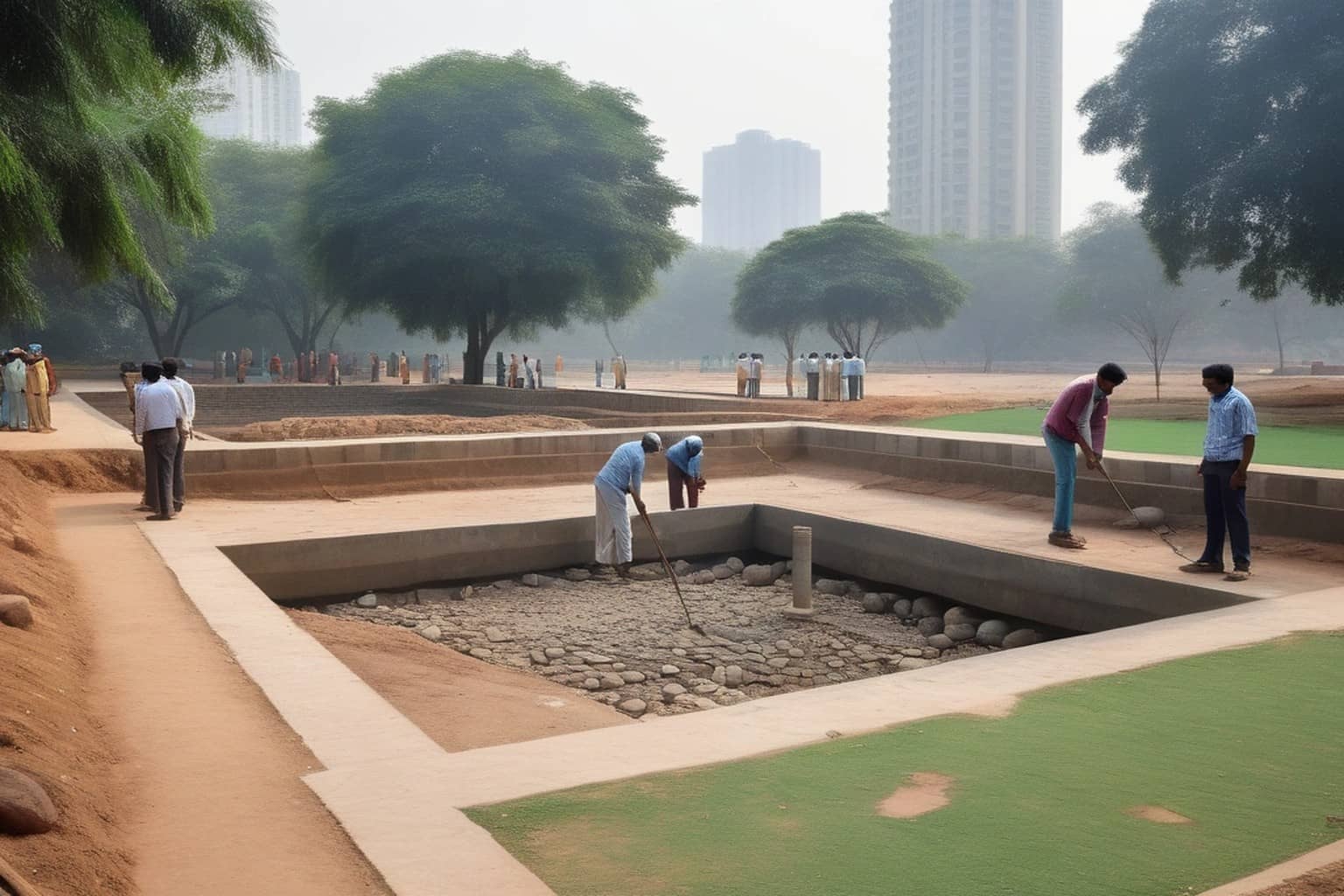
GMDA is also checking whether large underground storage tanks can be built beneath parks and playgrounds. A feasibility study is under way for one such tank under the football ground at Tau Devi Lal Stadium in Sector 38.
Five scientifically designed recharge structures are being built by GMDA with technical support from IIT Delhi. Those in Sectors 31 and 39 and at AIT Park in Sector 55 are complete, and a fourth at Rezangla Chowk is under construction. Officials said more would follow if the pilots work. Separately, the Municipal Corporation of Gurugram plans injection wells with IIT Gandhinagar.
Pond revival is the other big piece. According to the Haryana Water Resources Authority, 142 ponds in the district have been picked for rejuvenation, of which 68 are done and 74 are in progress. Within the MCG area, 32 ponds have been redeveloped and work is on in 21 more. In August GMDA had also floated a Rs 8.5 crore plan to turn seven green belts into rainwater sinks.
The petitioners have pushed for tougher steps. A submission placed before the court seeks a halt to all borewell extraction in Gurugram, with every existing borewell identified, geo-tagged and sealed within a fixed time, and no fresh permissions in the meantime. The same filing cites a GMDA survey which found 826 of the 1,216 water bodies it mapped to be retrievable.
Officials at the meeting also flagged how uneven the problem is. Groundwater cell figures discussed there showed the water table at around 200 metres below ground in parts of Sector 21, against about 3.5 metres in Sector 104, which is why recharge work is to be planned zone by zone rather than city-wide.
Industry is being asked to use more treated sewage water instead of borewells. GMDA currently supplies about 10 million litres a day of tertiary-treated water to textile units, and officials want other industrial clusters to follow.
For residents of group housing societies and independent houses that still run private borewells, nothing changes yet. Any curbs on private pumping will depend on what the court makes of the consolidated plan when the report reaches it on Thursday, 8 October.