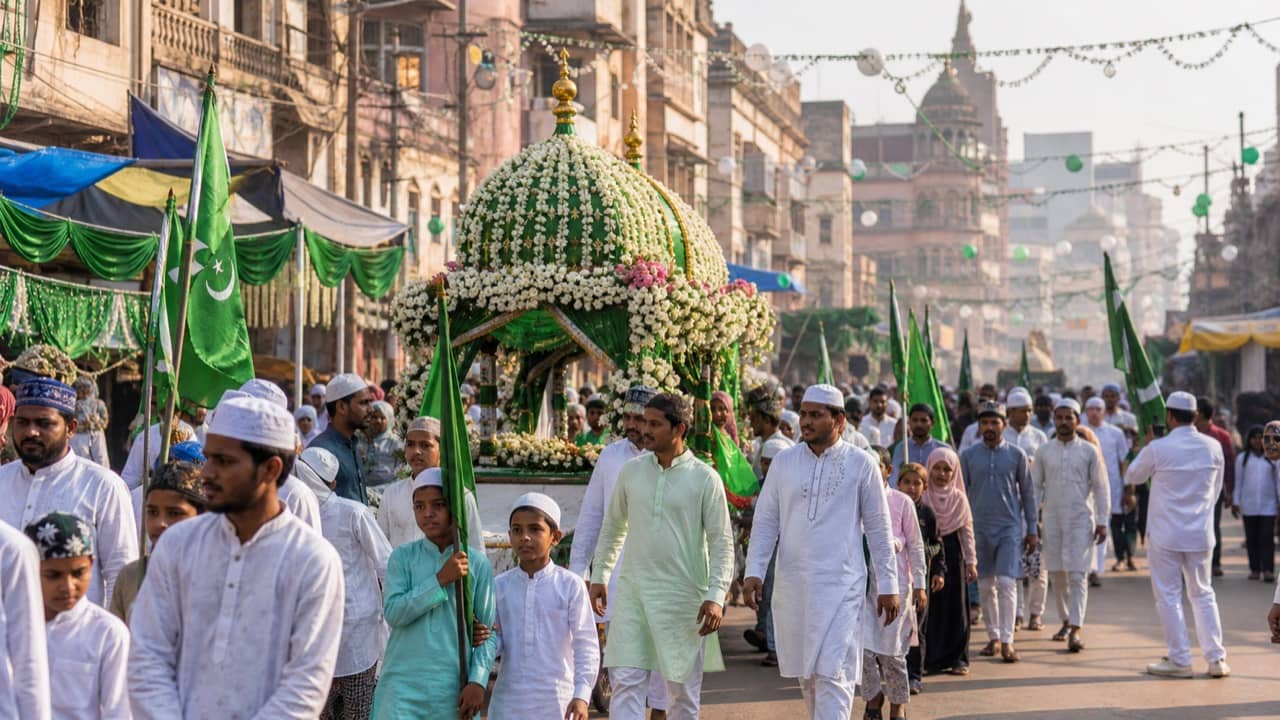
VARANASI: Streets between Revri Talab and Maidagin filled with flags, devotional verse and family groups on Wednesday as the city's main Eid Milad-un-Nabi procession moved through central Varanasi. The gathering marked the birth anniversary of Prophet Muhammad, bringing together children, young people and elders in a public expression of faith that began early in the morning and continued for several hours.
The procession set out from Azhari Maidan under the leadership of the city's Sadar Qazi, Maulana Hasin Ahmad Habibi, and reached Maidagin at around 11 am, according to the published account. Participants recited naats and familiar devotional refrains along the route. Homes, shops and neighbourhood lanes in several Muslim-majority localities had been decorated, while smaller religious programmes were also organised away from the main procession.
The mood was celebratory but ordered. Volunteers tried to keep walkers together at crossings, and police personnel were visible on important stretches to manage traffic and prevent crowding at narrow points. In a city where festival routes frequently overlap with busy markets, even a peaceful procession requires patient coordination between organisers, shopkeepers, commuters and the traffic police. Maidagin became the busiest point as separate groups converged near the end of the route.
Eid Milad, also called Barawafat in much of Uttar Pradesh, is observed through prayer meetings, charitable activity, illuminated neighbourhoods and processions recalling the Prophet's life and teachings. Varanasi's observance carries the city's own texture: the event passes through mixed commercial areas where residents of different communities share the same streets. That everyday proximity is why route discipline and respectful sound management matter as much as the scale of participation.
For local businesses, the morning brought both footfall and temporary diversions. Families planning travel through Revri Talab, Nai Sarak, Chowk and Maidagin needed extra time, while vendors serving water and food saw steady demand. The most useful measure of an event this size is not only attendance but whether emergency access, resident movement and cleanliness are maintained throughout. Organisers and civic teams face a final shift after the crowds leave: clearing disposable cups, food packaging and decorations from drains.
No major law-and-order incident was reported in the source account. Authorities should nevertheless publish any traffic restoration update and note lessons for the next large procession, particularly at bottlenecks where pedestrians and two-wheelers meet. Community organisers can help by documenting volunteer deployment, medical support points and waste collection. Those practical records turn an annual tradition into a safer, more predictable event for participants and neighbours alike.
Residents should rely on official route advisories during large religious gatherings and avoid forwarding old videos as if they show the current event. Parents accompanying young children should choose a meeting point in case a group separates and keep identity and emergency-contact details accessible. A festival procession is at its best when devotion is visible not only in slogans and decoration, but also in the care shown to the city carrying it.
This report is based on a Live Hindustan account published on 26 August 2026. Dalimss News independently rewrote, checked and contextualised the available information. Where a claim, allegation or opinion is attributed to a person or institution, it remains their statement; no on-scene reporting or independent interview is claimed.