
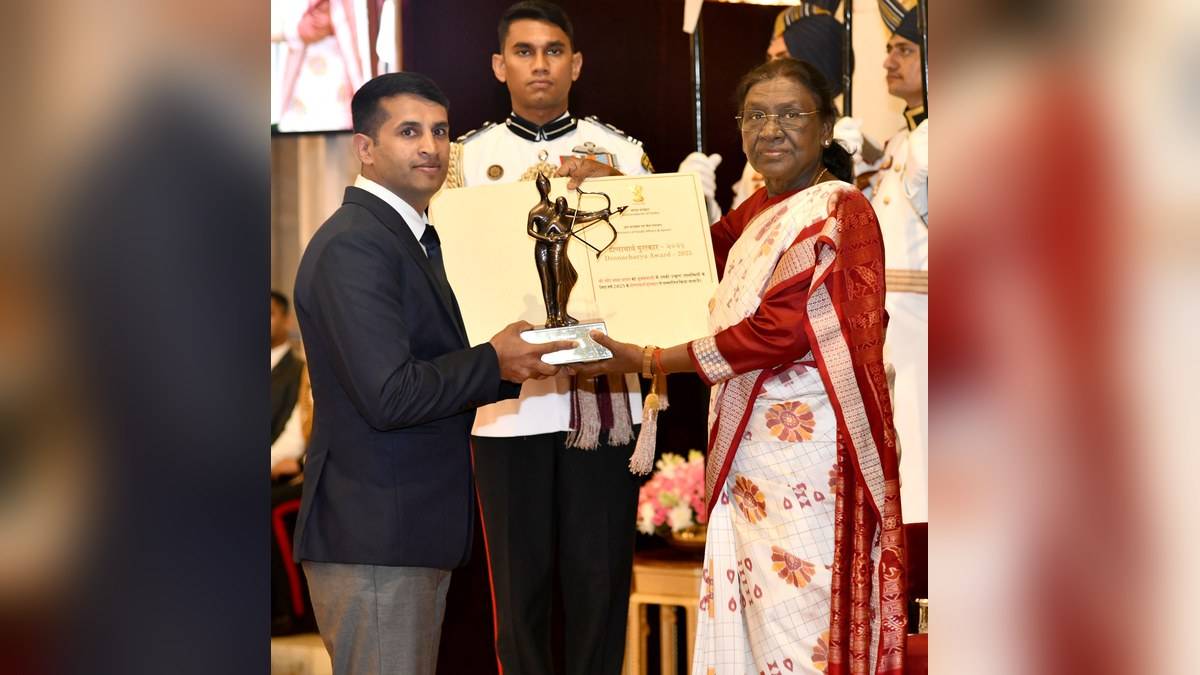
Dronacharya Award eligibility covers coaches at grassroots, development and elite levels, including those working part time. The regular category examines outstanding coaching achievements over the preceding four years; the lifetime category considers a contribution spanning at least 20 years. The Ministry of Youth Affairs and Sports scheme provides cash prizes of Rs 10 lakh and Rs 15 lakh respectively, alongside a statuette, certificate and ceremonial dress.
These rules appear in the scheme amended on 14 October 2024 and attached to the ministry's National Sports Awards 2025 application documents. The distinction between regular and lifetime recognition matters: the categories use different assessment periods, and the regular category's medal marking formula does not apply to lifetime selections.
| Question | Official scheme provision |
|---|---|
| Who is recognised? | Outstanding coaches in eligible sports |
| Regular assessment | Four years immediately preceding the award year |
| Lifetime assessment | 20 years or more |
| Cash prize | Regular: Rs 10 lakh; lifetime: Rs 15 lakh |
| Ordinary annual number | Up to five, including two for lifetime contribution |
Who is eligible for the Dronacharya Award?
The scheme covers Olympic disciplines, non Olympic disciplines recognised by the ministry, and indigenous sports recognised under government rules. A coach's job title alone does not establish eligibility. The central requirement is a record of producing outstanding sporting achievement, supported by details of the athletes trained and the period of coaching.
For the regular category, the assessment normally covers the four years immediately before the award year. In years containing the Olympics, Commonwealth Games or Asian Games, performances through the conclusion of those Games can also be considered. Applicants therefore need to match achievements to the relevant award cycle rather than simply submit an unrestricted career record.
The scheme expressly includes full time and part time coaches at grassroots, development and elite levels. Where more than one coach claims credit for the same athlete's achievements, the ministry reserves the right to seek an affidavit from that athlete. Keeping a precise coaching timeline is consequently important, especially when an athlete has moved between academies or training groups.
What is different about the lifetime award?
Lifetime consideration requires the production of outstanding sportspersons over 20 years or more. A grassroots or development coach should have been associated with an athlete for more than five years within that period. Long service by itself is therefore different from the sustained athlete development the scheme asks the selection committee to examine.
Ordinarily, no more than five Dronacharya Awards are given in a calendar year, with two earmarked for lifetime contribution. The criteria permit relaxation of that number in exceptional circumstances with reasons recorded in writing. No recipient can receive the award for a second time, and the scheme permits a posthumous award.
How are coaching achievements scored?
For the regular category, 80 per cent weight goes to medals won in specified international competitions by athletes trained by the coach for at least 180 days immediately before the tournament. The remaining 20 per cent comes from the selection committee's assessment, including the profile and standard of the sporting events.
The medal table assigns 80 points for Olympic or Paralympic gold, 70 for silver and 55 for bronze. A World Championship or World Cup held once in four years carries 40, 30 and 20 points respectively. Different competition periodicities receive proportionate marks, while team events use a separate calculation that takes team size into account.
Those medal points are then normalised. The scheme's example gives the leading coach in a discipline 80 marks for 45 medal points; a coach with 40 points receives 80 multiplied by 40 divided by 45, or 71.11 marks. A medal point and a final assessment mark are therefore different quantities. Lifetime candidates are assessed on their long contribution without this marking formula.
How do applications and verification work?
The scheme allows eligible candidates to apply themselves through the online portal without a recommendation. Applications are invited for a specified calendar year, and successful submission generates a unique registration number. Applicants should use the notice for their particular award cycle: the attached 2025 documents do not establish an open application window for a later year.
Employed applicants must obtain the prescribed employer report covering vigilance, disciplinary and related matters. Those not working or self employed must provide the specified undertaking. The Sports Authority of India verifies coaching achievements against official records, while the ministry seeks anti doping reports for shortlisted applicants. An application is consequently more than a list of medals.
The scheme also excludes recipients of the Arjuna Award (Lifetime) from applying for Dronacharya recognition. Valid applications proceed through screening and selection, and canvassing can lead to disqualification. For the surrounding distinctions, read our guides to Arjuna Award eligibility, the Khel Ratna Award criteria and TOPS athlete support.