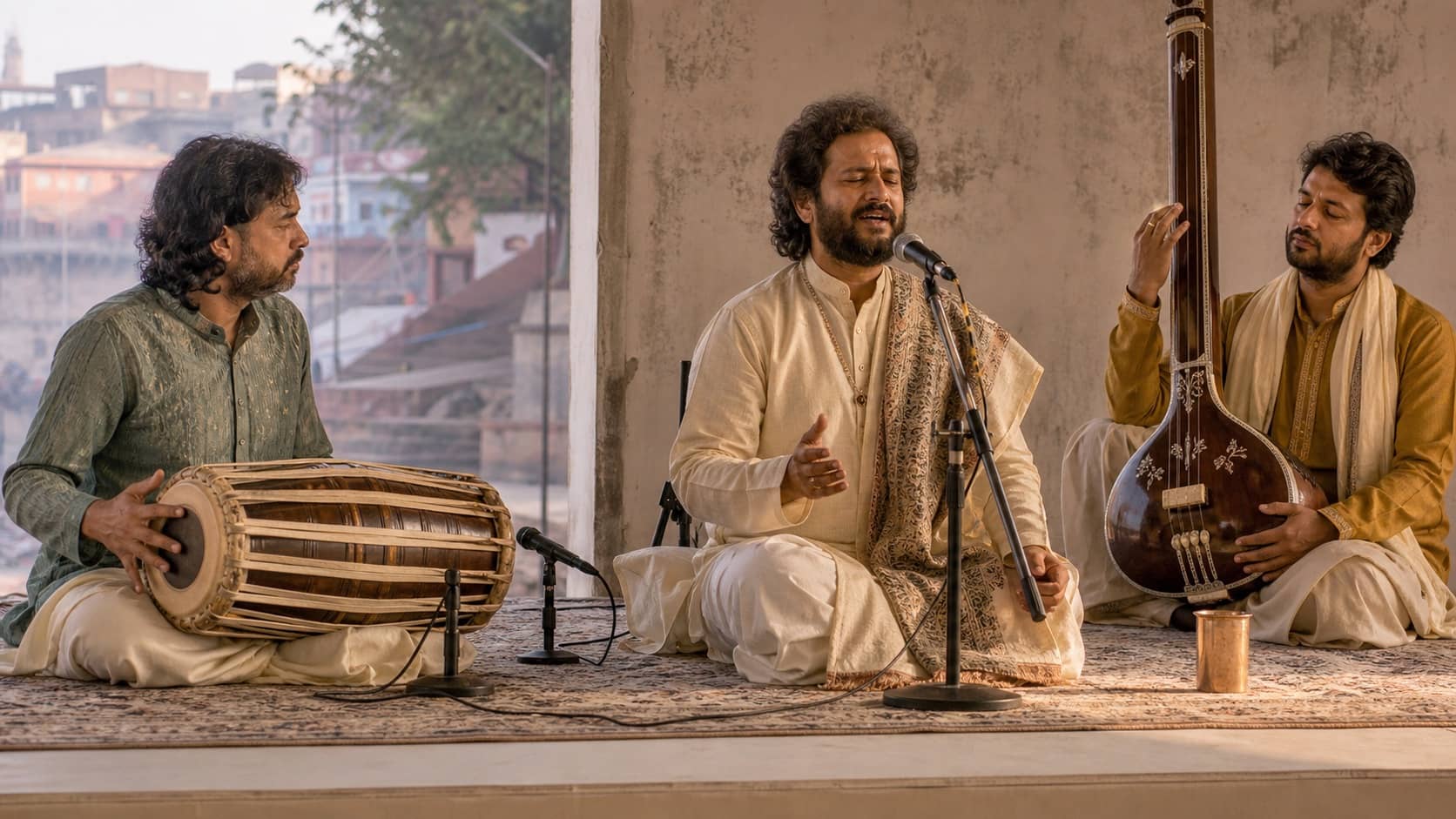
VARANASI: The spacious, unhurried grammar of dhrupad shaped the morning at Assi on Sunday as vocalist Dr Ashish Jaiswal presented Raga Bilaskhani Todi during a Subah-e-Banaras Prabhati programme at a local hotel. With pakhawaj and tanpura providing the frame, the recital offered listeners a measured beginning to the day rather than a performance built around quick applause.
Jaiswal opened with the raga’s alap, allowing its sombre phrases to settle before moving into the composed section. Bilaskhani Todi is traditionally associated with the morning and carries a reflective emotional colour. In dhrupad, where the gradual unfolding of notes is central, that character emerges through sustained tone, careful intonation and rhythmic restraint.
Manoj Solanki accompanied on pakhawaj, the barrel drum whose deep, resonant strokes give dhrupad its distinctive rhythmic architecture. Avinash Yadav supported the performance on tanpura, maintaining the continuous drone against which minute shifts of pitch become audible. The balance between voice, pulse and drone is one reason the form rewards concentrated listening.
Varanasi has a crowded classical calendar, but morning concerts retain a special place because Hindustani ragas are closely linked with time. Presenting them at the appropriate hour is not merely a ritual convention. The quality of light, the pace of the city and the audience’s state of attention all influence how a recital is received.
The Prabhati format also gives working musicians a platform outside the city’s large festivals. Short, regular programmes can be more valuable to an ecosystem than a handful of high-profile events: they create repeated opportunities for accompanists, younger listeners and visiting artists to meet. They also make classical music part of the city’s routine rather than an occasional spectacle.
Dhrupad demands patience from both performer and audience. Its phrases are not designed to rush towards a familiar refrain, and the pakhawaj enters only after the melodic world has been established. For new listeners, the best approach is often to stop searching for a tune and instead follow the way a single note is approached, held and released.
Assi’s cultural life is frequently associated with open-air music near the ghat, yet performances in smaller indoor venues can offer a different intimacy. Without traffic noise or a large stage, listeners can catch the grain of the voice and the interaction between singer and percussionist more clearly. That proximity suits dhrupad’s disciplined scale.
Sunday’s recital did not depend on elaborate production. Its strength lay in the old essentials: a morning raga, a steady drone, a grounded pakhawaj and a singer willing to let the music develop at its own speed. In a city famous for sound, the performance made a case for listening slowly.