
Varanasi TV Tower: The Forgotten Story of Banaras’ Iconic 150-Metre Doordarshan Landmark
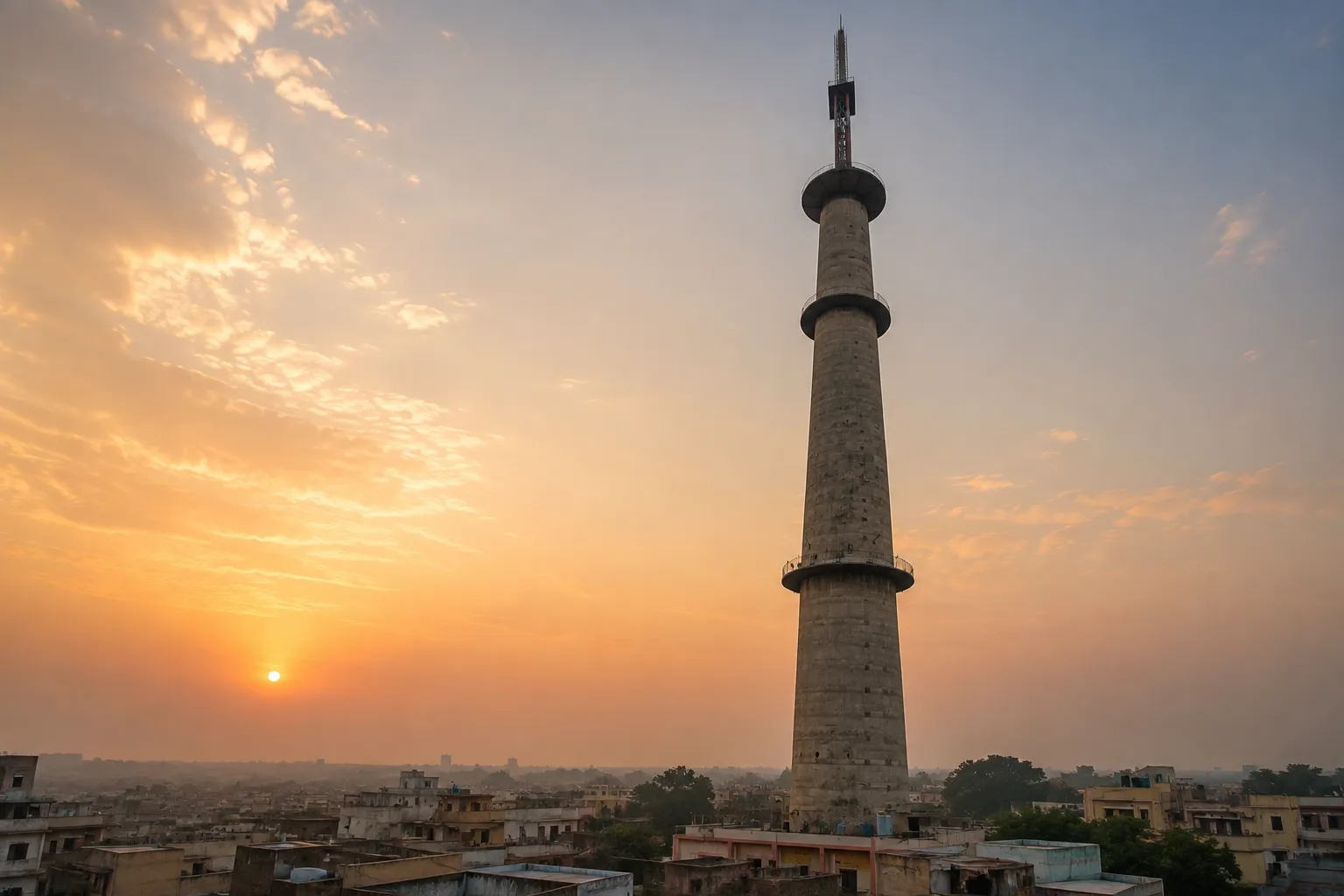
Varanasi: I had been back in Varanasi for only a few weeks when I properly noticed the TV Tower again.
Not while doing anything remotely nostalgic. I wasn't walking by the ghats at sunrise or rediscovering kachori in some old lane. I was somewhere around Nadesar, sitting in traffic, half-looking out of the window and half-looking at my phone, when it suddenly appeared between the buildings.
That ridiculously tall, familiar concrete column with its steel mast disappearing into the Banaras sky.
And for a second, I wondered how I had managed to forget it.
Mumbai teaches you to look up. You begin reading neighbourhoods through their skylines: cranes, glass towers, flyovers, balconies stacked endlessly above one another. After almost a decade there, verticality becomes part of the way you understand a city.
Banaras is different. Here, we are trained to look sideways and downwards — into lanes, courtyards, shops, temples, chai stalls, traffic and the river.
But somewhere near Nadesar and the Cantonment, Banaras has been asking us to look up for more than four decades.
At 150 metres — roughly 492 feet — the Varanasi TV Tower is one of those pieces of the city that everyone recognises and almost nobody talks about. It isn't on the standard tourist itinerary. You can't buy a ticket and go to the top. There are no heritage walks built around it and no influencers queueing up for sunrise photographs.
It is simply there.
And perhaps that is exactly why it has become so deeply Banarasi.
When television was still an event
To understand why this tower mattered, you have to return to an India in which television itself still felt futuristic.
Doordarshan's first experimental broadcasts had begun in Delhi in 1959. Regular service followed in 1965, television reached Mumbai and Amritsar by 1972, and Doordarshan became a separate government department in 1976. Then came the real cultural turning point: India's first colour telecast and the beginning of the national programme on 15 August 1982.
Those of us who grew up with hundreds of channels, streaming apps and a phone permanently within reach have to make a small imaginative leap here.
Television wasn't background noise.
Television was the thing.
Families arranged evenings around programmes. Neighbours gathered around the same set. Antennas rose from rooftops. A picture becoming clearer after somebody adjusted an aerial could genuinely improve everybody's mood.
And in the early 1980s, Doordarshan was rapidly trying to take that experience beyond India's largest cities.
Varanasi was part of that expansion. Prasar Bharati's own records say DD Varanasi was commissioned in 1984 with a 10-kilowatt High Power Transmitter. Local archival accounts place the formal inauguration on 26 August 1984, when the transmitter was inaugurated by then Prime Minister Indira Gandhi.
The tower associated with that broadcasting complex followed into service in 1985. An engineering paper published that year describes it specifically as part of Doordarshan's drive to build a television network across the country, with the Varanasi structure also intended for microwave relay.
For Banaras, a city whose visual identity had for centuries been defined by temple shikharas, minarets and riverfront architecture, this was a very different kind of landmark.
Modernity had arrived in reinforced concrete.
And they really built this thing
Once you start reading the original engineering documents, the TV Tower becomes even more fascinating.
The structure is not simply "a 150-metre pole."
Its lower 106.5 metres are reinforced concrete, formed as a circular shell. Sitting above that is a 43.5-metre square steel mast. The concrete section is 11.5 metres across at its base and gradually narrows to 5.9 metres near the top.
Inside it is a steel staircase reaching the top of the concrete section. Engineers even provided a two-metre-by-two-metre liftwell for the possibility of installing a lift later. Outside, maintenance platforms were constructed at approximately 40 metres, 80 metres and 100.5 metres.
Under the ground, things get even more serious.
The foundation rests on 156 under-reamed piles, each about 8.5 metres long.
And here is possibly my favourite piece of TV Tower trivia: the engineers actually designed the structure with the possibility of making it taller.
The original plan allowed another 23 metres of steel tower to be added, which would have taken the total height to 173 metres. It never happened, but somewhere in the calculations for the Banaras skyline of the 1980s was an even taller version of the tower we know today.
Construction itself took around 18 months. The concrete tower was raised using a jump-form construction technique, while sections of the galvanised steel mast were hauled upwards and assembled piece by piece.
There is something strangely romantic about imagining that happening in mid-1980s Varanasi.
No luxury high-rises on the horizon. No smartphones documenting every stage. Just a giant concrete structure slowly climbing above the city because India was building a national television network.
Before the skyline became crowded
Perhaps that explains why people of a certain generation remember the tower so clearly.
Today, Banaras has flyovers, hotels, apartment blocks, shopping complexes, enormous illuminated signboards and construction happening in every direction.
But imagine the same city around 1985.
A 150-metre tower would not merely have been noticeable. It would have been almost absurdly dominant.
You could see it from far away. It helped tell you which part of town you were approaching. For children sitting in cars or on scooters, spotting it meant something geographically even before anyone bothered explaining what the tower actually did.
And over time, function became familiarity.
That is how cities manufacture landmarks.
Not everything beloved was designed to be beautiful.
Sometimes it is a railway bridge. Sometimes an old cinema sign. Sometimes a water tank. Sometimes a strange concrete tower that spent forty years appearing in the corner of your vision until one day you realised it had become part of your idea of home.
The Doordarshan story kept growing
The arrival of the transmitter and tower was only the beginning of Varanasi's television story.
A dedicated Doordarshan studio was established in the city in 1998. In 2000, DD Varanasi began producing a 30-minute local programme. That expanded to an hour later the same year and then to 90 minutes from 2001.
The technology around the tower inevitably changed too.
Satellite television arrived. Cable exploded. Hundreds of private channels entered Indian homes. DTH followed, then YouTube, Instagram, Netflix and an entire generation for whom the idea of waiting until a certain time to watch a programme now feels faintly prehistoric.
Doordarshan itself began moving from analogue terrestrial broadcasting towards digital transmission. By 2018-19, Prasar Bharati's annual report was specifically documenting a Digital Terrestrial Transmitter at Varanasi as part of that changing technical landscape.
The tower had lived long enough to see the technology it represented transform completely.
And yet the tower remained.
Banaras' own Burj Khalifa
At some point, younger Banaras decided the TV Tower needed a rebrand.
Naturally, the internet provided one.
Scroll through enough local Varanasi reels and posts and you will eventually encounter the affectionate joke: "Banaras ka Burj Khalifa."
Technically, the comparison is ridiculous. Dubai's Burj Khalifa is more than five times taller.
Emotionally, though, I understand it completely.
Because Banaras doesn't really do skyscrapers.
Our skyline flex has traditionally been different: temple spires above old neighbourhoods, palace façades along the Ganga, minarets in the distance, the occasional water tank and, rather unexpectedly, this enormous piece of 1980s broadcast infrastructure.
The nickname works precisely because everyone knows the tower isn't the Burj Khalifa.
It is ours.
Coming home makes you notice strange things
Moving back to your hometown after being away for years is a peculiar experience.
The famous things don't necessarily surprise you.
Of course the ghats are still beautiful. Of course the Ganga still does something to the light in the evening that no camera gets entirely right. Of course there are lanes where your childhood sense of direction suddenly returns even though you haven't walked through them in years.
It is the ordinary things that ambush you.
A turn in the road.
An old school wall.
A bakery you assumed would always exist.
A particular stretch near the Cantonment.
And apparently, a television tower.
The Varanasi TV Tower will never compete with the ghats for postcards. It shouldn't.
But cities are not only their monuments. They are also the pieces of infrastructure around which everyday life quietly accumulated.
For roughly four decades, generations of people in Banaras have crossed Varuna Bridge, driven through Cantonment and Nadesar, returned from the railway station, gone to school, come home from weddings, sat in traffic, watched the city grow — and seen that tower somewhere above them. The Doordarshan complex remains around the Kachari Road/Varuna Bridge side of Varanasi Cantonment.
Most probably didn't stop to photograph it.
They didn't need to.
It was always going to be there tomorrow.
And maybe that is the nicest definition of a hometown landmark I can think of.
So the next time you're somewhere around Nadesar, Cantt or Varuna Bridge, put the phone down for a moment and look up.
That strange, slender tower above Banaras isn't merely an old television transmitter.
It is a little piece of the city's modern history hiding in plain sight.
And for once, Banaras' past isn't several hundred years old. It's just high enough that we forgot to look at it.
Sources and reporting
Archival research using Doordarshan and Prasar Bharati records, historical engineering documentation on the Varanasi TV Tower, and locally documented accounts of the tower’s inauguration, construction and role in Varanasi’s broadcasting history.
Related Stories
VMC Launches Doorstep E-Waste Pickup With On-the-Spot Payment
Family Alleges Youths Chased Car, Assaulted Women and Children Near V-2 Mall in Lanka

Sigra-Trained Shooter Kamaljeet Wins Asian Games Gold in Mixed Air Pistol
Sarnath Police Arrest Three Over Locked-House Burglaries, Claim ₹7 Lakh Recovery

NER Varanasi Division Runs 2,915 Chlorine Tests on Station and Colony Water