
VARANASI: A notice published on Sunday, November 22, 2026, on the Central Institute of Classical Tamil's Sangamam portal extends institution registration to November 27 at 5 pm IST, giving Varanasi colleges and their students a fresh application window. The new deadline replaces November 21, as reported earlier on dalimss.news. Assessment and student nomination dates have also changed.
For students at Varanasi institutions, including those around the BHU campus in Lanka, the immediate step is to ask their college's institutional coordinator about selection. This is an institution led application: each participating institution assesses interested students and nominates one student on merit, with endorsement from its head. Students should establish whether their own institution has registered before preparing a nomination.
The official extension notice brings three tasks into the same closing period. Institution registration and submission of the selected student's nomination close on November 27 at 5 pm IST. Institutions must also complete their assessment of interested students by November 27. A college that has registered still needs to finish selection and submit its nomination.
What the revised dates mean
The registration deadline moves from November 21 to November 27. The assessment deadline moves from November 23 to November 27, while the nomination deadline moves from November 24 to November 27 at 5 pm IST. These are separate administrative stages, so completion of the first does not establish completion of the other two.
- Institution registration: November 27, 5 pm IST.
- Assessment of interested students: by November 27.
- Selected student nomination: November 27, 5 pm IST.
- Inaugural function: November 28, with online participation.
- Valedictory function: December 12, with online participation.
The November 22 notice retains the inaugural and valedictory dates. The portal says nodal institutions, participating institutions and nominated students will join these functions online, with joining links shared separately. Applicants should use that description when discussing participation with their college, rather than treating nomination as confirmation of travel arrangements.
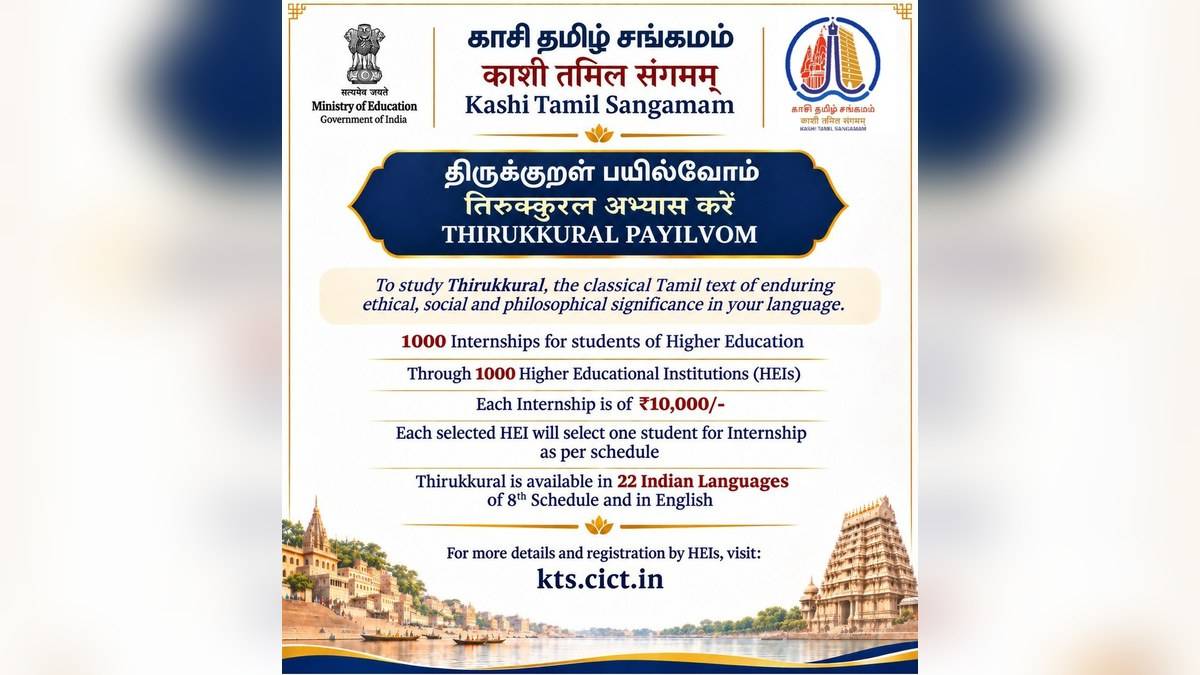
Every institution that registers becomes a participating institution, according to the portal. The programme involves studying the Thirukkural using multilingual resources, academic orientation and preparation of an article or research note. The homepage describes a programme for 1,000 students from 1,000 participating institutions. Its stated stipend of Rs 10,000 for each eligible selected student remains subject to the programme guidelines and completion of the prescribed requirements.
What students and colleges should do
The official participation guide asks institutions to register details of the head of the institution, institutional coordinator and faculty supervisor or guide. Where a nodal institution has issued an invitation, registration should be completed through that invitation. Colleges should identify the person responsible for assessment and nomination so that the revised closing time is met.
The guide permits institutions to use the portal's online assessment or another suitable assessment method. In either case, the process should be fair, documented and approved by the head of the institution or an authorised committee. The online assessment records scores for the institution. A student assessed by another method can be entered separately by the institution before selection.
For nomination, the institution must provide the selected student's photograph, identity proof, a nomination form signed and sealed by the head of the institution, and the faculty supervisor's details. The guide says an application number appears after submission. Students should therefore check with their coordinator that the nomination has actually been submitted and recorded.
Institutions also have responsibilities beyond selecting one student. The guide calls for Thirukkural activities such as essay writing, quizzes, recitation, storytelling and poster making for students, with a brief report in the prescribed format. Assessment records, attendance, photographs and reports should be retained as part of the programme documentation.
What follows the nomination
The participation guide places verification by nodal officers on December 5. Academic orientation and study material are scheduled by December 14, followed by a research and writing period from December 15 to January 14, 2027. Research work and reports are due by January 14. The institution must guide the student's article or research note and organise a one hour presentation, whose video recording is submitted to the institute.
The guide also requires the institution to validate the student's bank details when requested by the portal. Students should coordinate this through their college and follow the official instructions for the stipend requirements. Programme questions can be directed to the published contact, kts@cict.in or 044-22540125.
For other local academic deadlines, readers can consult the separate reports on BHU diploma and certificate admissions and Sanskrit university examination forms. Those notices concern different processes and do not replace the Sangamam institution registration and nomination requirements.