Varanasi’s Iconic Shri Naivedyam South Indian Restaurant Demolished After Over Two Decades
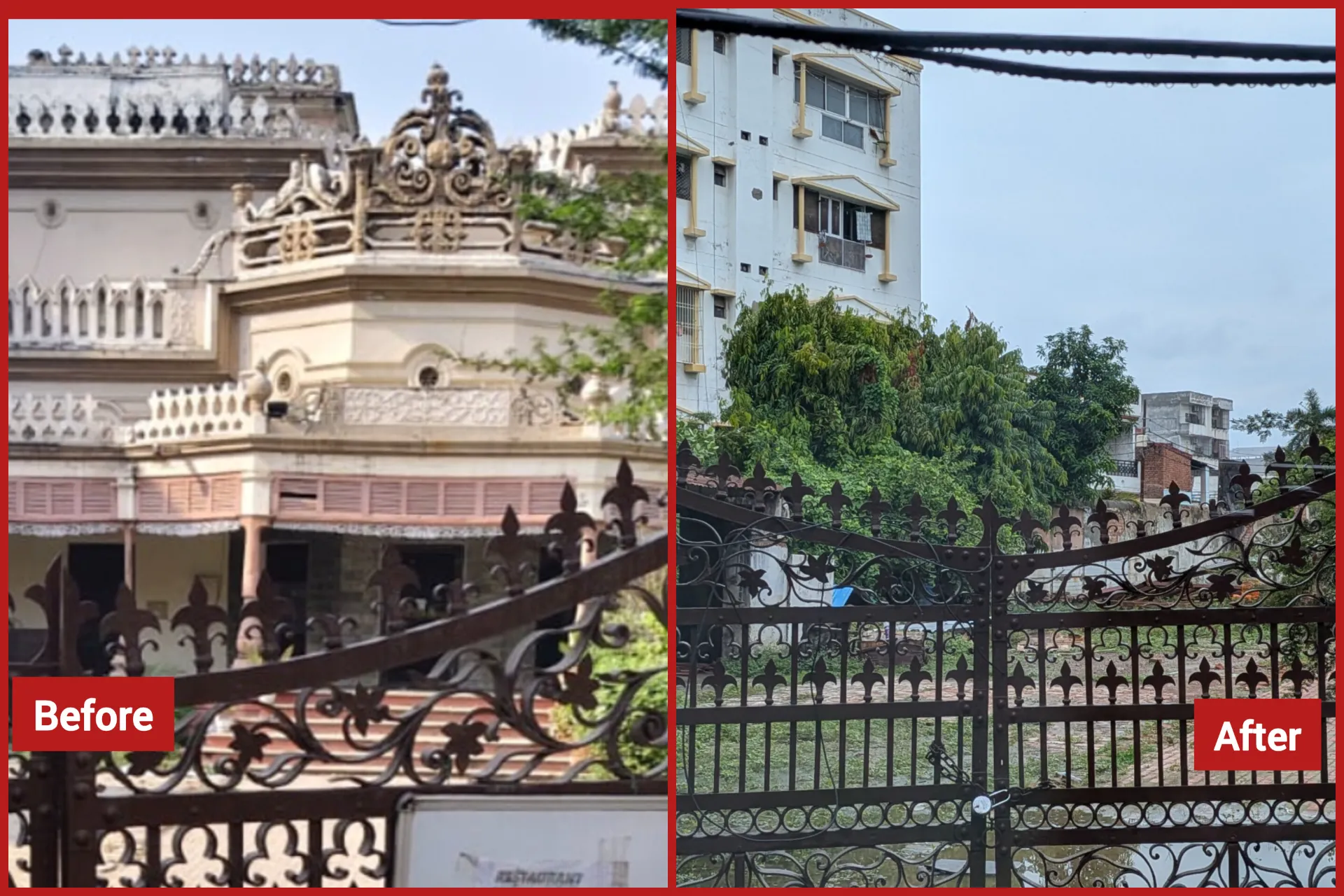
VARANASI: Shri Naivedyam, one of the most familiar family restaurants on the Sigra–Mahmoorganj Road, has permanently closed. The large, heritage-style building that housed the pure-vegetarian restaurant has been demolished, leaving behind little more than its distinctive wrought-iron gate and the greenery that once surrounded it.
For anyone passing the site today, the absence is immediate. The pale, multi-storey building with its ornamental balconies, carved parapets and slightly eccentric old-world character is gone. The gate still stands, but it now opens onto an empty space rather than a restaurant.
For residents of Mahmoorganj, this is not merely the disappearance of another place to eat. It is the removal of a landmark that had quietly become part of the neighbourhood’s family history.
I have lived in Mahmoorganj all my life. Shri Naivedyam was never a restaurant I discovered through an online recommendation or a food blogger’s list. It was simply there—on a road we travelled regularly, opposite Sri Runmukteshwar Mandir, waiting behind that elaborate iron gate.
My family went there when eating out was still treated as a proper family occasion. My grandparents would come with us. We would order dosa and pav bhaji, almost by habit, and sit together in a building that felt more like an old family home than a commercial restaurant.
My grandparents are no longer alive. Looking at the space where Shri Naivedyam once stood, I realised how strongly a place can remain attached to people who are gone.
I do not remember every conversation we had around those tables. I remember smaller things: waiting impatiently for the dosa, tearing pieces from its crisp edge before everyone had been served, and the smell of butter arriving with the pav bhaji. I remember my grandparents sitting across from me. Memory is selective that way. It often keeps the table and the faces while allowing the words to disappear.
A Restaurant Inside an Old House
Shri Naivedyam stood out because it did not look like the restaurants that have since come to dominate Varanasi’s commercial neighbourhoods.
It occupied a large, ornate building that resembled an old bungalow or mansion converted into a dining space. The decorative façade, shaded corridors and ageing interiors gave it an atmosphere that many customers described as peaceful and old-fashioned. One long-time visitor recalled travelling from Mirzapur to eat there and remembered the restaurant for its old-world surroundings as much as its South Indian food.
The restaurant’s address was variously listed as D-63/4 and D-59/546 along the Sigra–Mahmoorganj stretch, opposite Sri Runmukteshwar Mandir in the Tulsipur–Mahmoorganj area. Online dining platforms listed it as a vegetarian restaurant serving South Indian, Chinese and North Indian food, with an estimated cost of around ₹400 for two people.
Yet numbers and menu categories do not fully explain its place in the neighbourhood.
Shri Naivedyam belonged to a period when a restaurant did not need a dramatic entrance, a neon sign or a wall created specifically for Instagram photographs. Families went there because everyone could find something familiar. Grandparents could order idli or dosa, children could ask for noodles or pav bhaji, and parents did not have to worry that the evening would become prohibitively expensive.
Its menu stretched beyond the South Indian dishes for which it was best known. But the dosas remained central to its reputation. Customers repeatedly mentioned masala dosa, Mysore masala dosa, rava dosa, idli, medu vada, sambhar and coconut chutney in reviews accumulated over the years.
The food was not always reviewed uncritically. In later years, some diners complained about inconsistent quality, slow service and interiors that appeared to need attention. Others continued to describe its dosas as among the best in the city.
That disagreement was, in its own way, evidence of how long the restaurant had been part of local life. People compared every visit with an earlier one. They remembered how the sambhar once tasted, how crowded Sundays used to be and whether the dosa remained as good as it had been during their childhood.
Only places with history are judged against their own past.
Operating Until Recently
Available public records indicate that Shri Naivedyam continued receiving customers well into 2025. A review posted on Justdial in July 2025 described a family visiting the restaurant the previous day for dosa and takeaway food.
Its closure has since outpaced several online listings. Some platforms continue to display the restaurant’s address, phone number, menu and supposed opening hours, while another dining directory now labels it as possibly permanently closed.
The contradiction is a reminder that a restaurant can disappear from a street long before it disappears from the internet.
A person searching online may still find photographs of the dining hall, menu cards and old reviews. On the ground, however, the building is no longer there. The restaurant has also reportedly opened at a new location somewhere near BHU
The precise reason for the permanent closure and demolition of the Mahmoorganj outlet has not been publicly confirmed. There has been no widely available statement explaining whether the property is being redeveloped, transferred to a new owner or prepared for another commercial use.
Until such information emerges, speculation would be unfair. What is certain is that Shri Naivedyam, in the form generations of Varanasi residents knew it, has come to an end.
What a Neighbourhood Loses
Mahmoorganj has changed considerably over the past two decades. The long commercial stretch connecting Sigra, Rathyatra and Manduadih has grown denser and busier. New cafés, branded restaurants, clinics, offices, gyms and retail outlets have replaced many of the quieter residential properties that once defined the area.
Change is neither unusual nor entirely unwelcome. Cities need new businesses, housing and infrastructure. Restaurants also close for ordinary reasons—rising costs, changing ownership, competition, ageing buildings or the simple exhaustion that comes with running a business for years.
But something is lost when every old neighbourhood landmark is viewed only as a piece of real estate.
Restaurants like Shri Naivedyam documented a less visible history of Varanasi. They recorded birthdays that were never photographed, post-examination lunches, hurried family dinners and evenings when grandparents insisted on paying the bill. They held the everyday memories that rarely enter official accounts of a city.
Many people will remember the restaurant differently. Some will remember the dosas. Others will recall the building, the service, a particular table or a meal that arrived late. A few may remember that the quality was no longer what it had once been.
All those memories are valid. Affection does not require pretending that a place was flawless.
For me, Shri Naivedyam will always be connected to my grandparents. The building’s demolition does not erase those evenings, but it removes the physical place to which those memories could return.
There is something reassuring about being able to pass an old restaurant and think: We used to go there together. Even without entering, the building confirms that the past happened.
Now, on the Sigra–Mahmoorganj Road, only the gate remains.
Behind it is an empty space. In front of it, traffic continues as usual.
And somewhere between the two is the memory of a dosa being shared across a family table, while the people around it still seemed as permanent as the restaurant itself.
Sources and reporting
On-ground visual verification of the demolished site, archival photographs, publicly available restaurant listings and customer reviews, along with the writer’s first-hand memories of visiting Shri Naivedyam with her family while growing up in Mahmoorganj.
Related Stories
BHU: Below 4.0 CGPA Will Cost Hostel and Health Facilities
Sewer and Water Pipeline Work Starts in Four Wards Under CCTV Watch
BHU Issues 69-Page PhD Bulletin for About 1,500 Seats in Three Modes
Lolark Shashthi Draws Long Queues at Bhadaini’s Lolark Kund
Ganga Level Keeps Falling; Silt Clearing Starts as Boat Ban Holds