Varanasi Ropeway Begins 880-Kg Load Trials Between Rathyatra and Girjaghar
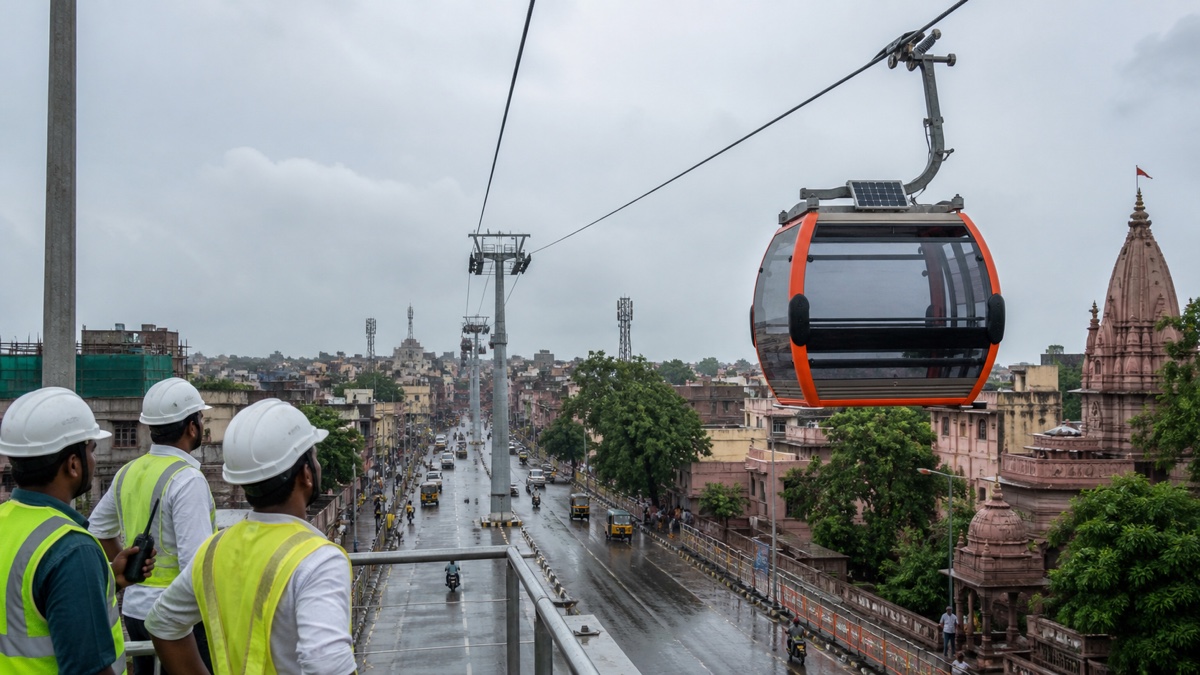
VARANASI: Engineers have begun load testing gondolas on the Rathyatra–Girjaghar section of the Varanasi urban ropeway, moving the project from visible construction towards the less glamorous but essential work of proving that its systems can operate safely under weight.
Each gondola is expected to be tested with an 880-kilogram load and to complete at least four trial runs, according to the latest project update. The repeated journeys are designed to show how cabins, cables, grips, towers, braking and station equipment respond under a controlled burden before higher-speed trials or passenger operations are considered.
What the test can reveal
A load trial is not a ceremonial first ride. Engineers watch cabin movement through stations, clearance around towers, acceleration and deceleration, vibration, emergency braking and the behaviour of the hauling system. Repeating a run helps expose intermittent faults that may not appear during a single demonstration.
The Rathyatra–Girjaghar stretch passes through one of the city’s most congested urban corridors. That gives the ropeway its potential value: it aims to carry people above roads where expanding carriageway space is difficult. It also raises the standard of assurance required, because the system will operate over active streets and close to dense neighbourhoods.
Testing is not an opening date
Residents watching gondolas move may reasonably assume that commercial service is imminent. The current exercise should not be confused with final commissioning. Electrical integration, evacuation procedures, communications, backup power, fire response and staff drills must also be checked. The competent safety authority must review the results before public boarding begins.
Project managers should publish a plain-language commissioning schedule so that trial footage does not produce unrealistic expectations. That schedule should explain what has passed, what remains and how emergency rescues would work if a cabin stopped between stations.
For commuters, the central questions are reliability, travel time, fare integration and access to stations. For the technical team this week, the task is narrower: make the gondola carry its test weight repeatedly and record every deviation.
The start of 880-kilogram trials is a meaningful milestone because it puts hardware under measurable stress. It is not, by itself, proof that the ropeway is ready for passengers. The quality of the data, the correction of any faults and independent certification will determine when Varanasi’s most closely watched transport project can safely shift from testing to service.
Independent observers and emergency agencies should be included before the first public ride. Passenger drills need to account for elderly people, children and persons with disabilities, not only an able-bodied test crew. If the project documents those scenarios now, the eventual launch will be judged by preparedness instead of spectacle.
Sources and reporting
Based on a verified Dalimss News Banaras report and local coverage published on August 12, 2026. Trial parameters are reported figures; final passenger service approval remains subject to safety certification.
Related Stories

Kashi Marks Baba Lat Bhairav’s Wedding Day After Tilak and Haldi Rituals
Over 800 Doctors Converge as API UP Chapter Conference Opens in Rohania
Chitaipur Arrests Two After Homeguard Anuradha Tiwari’s Alleged Suicide
Lanka Registers Assault Case After Narottampur Youth Dies During Treatment
Storm Uproots Electric Pole in Cholapur’s Jagdishpur; Local Supply Cut