VARANASI: Jewellers in Varanasi are competing to offer lower jewellery making charges, with some promotions claiming 0% making charges, according to Dalimss News reporter Tanishka's Instagram city report published on 5 November 2026. For buyers comparing those offers, the amount payable on the finished bill remains the figure to check.
The Dalimss News desk has also confirmed that this kind of making-charge competition extends beyond a single shop in the city. That confirmation establishes a wider local pattern; it does not verify the terms of any individual promotion. No retailer is being identified in this report.
The reported 0% offers are promotional claims, rather than independently verified final prices. The available city reporting does not establish which individual pieces qualify, how long an offer lasts or what conditions attach to it. Buyers should seek those details for the ornament they actually intend to purchase. Ask whether the advertised concession applies to that design and weight, whether there are purchase conditions, and when the quoted offer expires. Keep those answers with the estimate so the terms can be checked at billing.
Read the offer alongside the whole bill
A useful starting point is to separate the metal value, making charges and taxes. The India Bullion and Jewellers Association rates page, checked on 6 November 2026, explicitly says its listed gold and silver benchmarks exclude GST and making charges. A benchmark therefore cannot, by itself, be read as the final retail price of an ornament.
For a comparison in writing, ask each seller to record the metal rate being used, the purity, the net precious-metal weight and the resulting metal value. Keep the date of the quotation with those details. Comparing a making-charge offer without the underlying weight and purity leaves essential parts of the purchase unspecified.
Ask for the making charge as a rupee amount for the selected piece, together with an explanation of how it was calculated. If the quotation uses a rate per gram or a proportion of metal value, have that basis written down too. This lets a buyer compare the actual charge across quotations instead of comparing slogans.
Where a seller uses the term wastage, ask what it means in that particular quotation, how it is calculated and whether it adds to the amount payable. Do not assume the term has been included in an advertised making-charge concession. Request a written explanation of any separate line whose purpose or calculation is unclear.
For an ornament containing stones or other components, ask for their weight and price to be explained separately from the precious metal. The practical aim is to know what quantity of metal is being priced, what other material is included and what work is being charged for before choosing between offers.
Hallmarking checks answer a different question
The Bureau of Indian Standards operates the hallmarking scheme to provide assurance about precious-metal purity. Its general FAQ distinguishes hallmarking charges from making and wastage charges. BIS does not set jewellery making charges, and a hallmark should not be treated as approval of a promotional price.
For hallmarked gold jewellery bearing a HUID, check the BIS logo, the purity marking in caratage and fineness, and the six-character alphanumeric identification code. BIS explains that buyers can use the Verify HUID feature in the BIS Care app before purchase. Ask to see the markings on the piece being selected.
BIS also advises consumers to obtain an authentic invoice with details of the hallmarked article for dispute or complaint redressal. Keep that invoice with the written quotation and offer conditions. A purity check and a price comparison serve separate purposes, and buyers need both when assessing a discounted ornament.
Check taxes and the final amount before payment
The Central Board of Indirect Taxes and Customs, in its gems and jewellery sectoral FAQ checked on 6 November, says GST is payable on the total transaction value of jewellery whether making charges are shown separately or not. A claim of no making charge should therefore not be read as a claim that the purchase is free of tax.
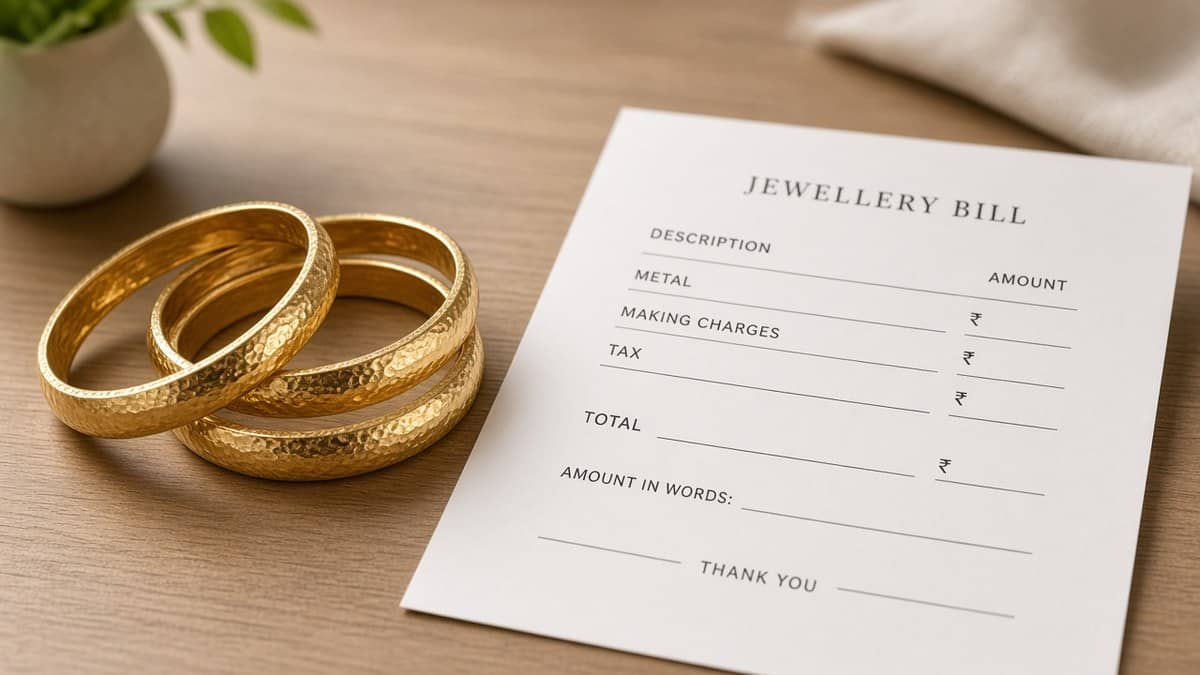
Before payment, ask for a final itemised calculation showing the metal value, any other components, the making charge after the offer and applicable taxes. Have any additional charge explained. If the final calculation differs from the earlier quotation, ask for the reason and check the revised total before agreeing to the purchase.
For the competition reported in Varanasi, this provides a concrete way to assess what an offer delivers: compare written totals for pieces with clearly stated specifications. The local reporting establishes that lower making charges are being promoted. Whether a particular promotion reduces a buyer's bill has to be assessed from that piece's terms and final calculation.