
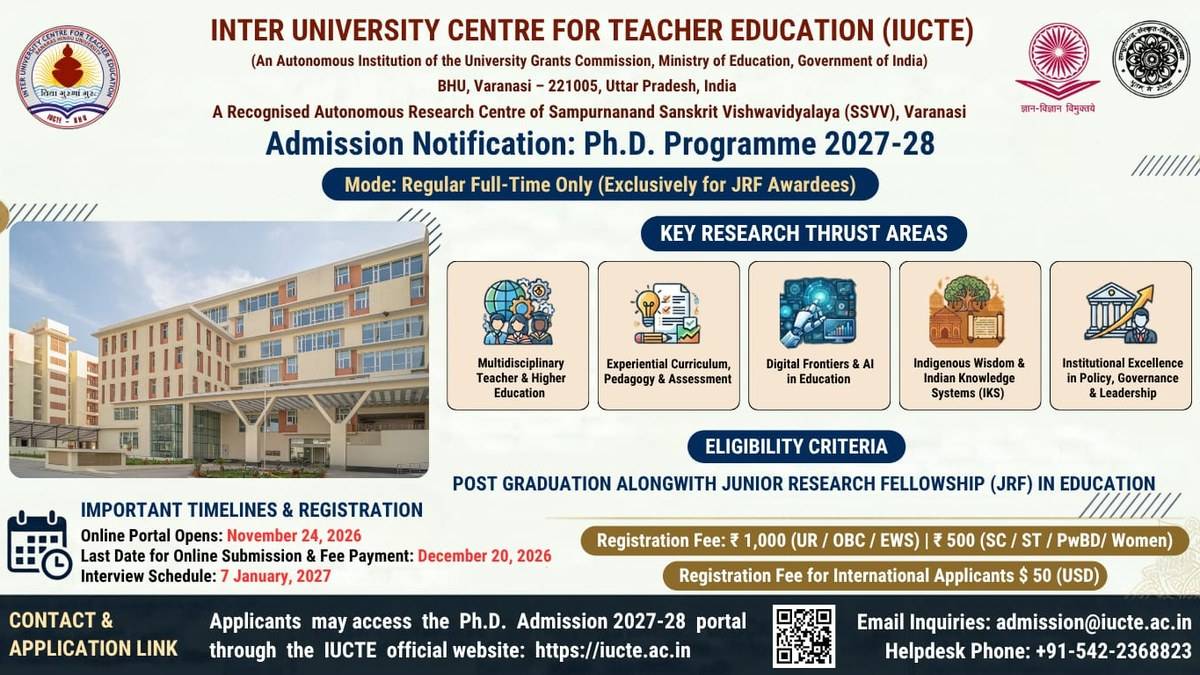
VARANASI: The Inter University Centre for Teacher Education opened its Education Ph.D. admission process on Tuesday, November 24, 2026, listing 32 seats and a December 20 application deadline. The centre's campus is at Sundar Bagiya on Nariya to B.L.W. Road in Varanasi. Postgraduates seeking this research route must also hold Junior Research Fellowship qualification in Education, according to the official admission brochure.
For eligible applicants in the Nariya and BHU areas, the immediate task is to assemble the JRF certificate, scorecard and academic documents before completing the online process. The centre accepts applications through its official admission portal. Registration, fee payment and final submission are separate steps in the instructions, so creating an account alone does not complete an application.
The brochure labels the academic session 2027-28 and describes the intake in relation to January 2027. Its indicative schedule places document verification and interviews on January 7, 2027. Applicants should follow the centre's subsequent notices for any changes and confirm arrangements before planning a campus visit.
Who can apply and how the seats are divided
The seven page official brochure specifies postgraduate qualification together with JRF in Education. It requires proof of JRF qualification and the scorecard with the application. A valid JRF certificate or equivalent documentary evidence is necessary for scrutiny; the admission category is restricted to that qualification route.
The vacancy table allocates 15 seats to the unreserved category, eight to Other Backward Classes, four to Scheduled Castes, two to Scheduled Tribes and three to Economically Weaker Sections. These add up to the announced 32 places. It separately specifies five per cent horizontal reservation for Persons with Benchmark Disabilities, which is not an additional block of seats to add to the total.
The centre describes itself as an autonomous institution of the University Grants Commission and a recognised autonomous research centre of Sampurnanand Sanskrit Vishwavidyalaya. The brochure places the research programme within that institutional arrangement. The official admission flyer describes the mode as regular and full time, exclusively for JRF awardees.
Fees and the application checklist
The nonrefundable registration fee is Rs 1,000 for General or Unreserved, OBC noncreamy layer and EWS applicants. The brochure lists Rs 500 for SC, ST, PwBD and women applicants. International applicants have a separate US $50 registration fee and are directed to the applicable international admission guidelines on the portal.
The public admission portal lists upload limits alongside its document checklist. A scanned photograph and scanned signature must each be below 500 KB. Educational documents and experience or category certificates must each meet the stated limit of below 1,024 KB. Check the applicable upload field and ensure the document remains readable within that limit.
Applicants first register through the portal linked from the centre's official website. The brochure says credentials are sent to the registered email address. After filling the application, candidates make the online payment and complete final submission. It expressly says applicants do not need to send a printed application or supporting documents as a separate hard copy.
Check category, qualification details and declarations before submitting. The brochure says requests to change the category or other particulars after submission will be considered only where the centre specifically permits them. Original documents and eligibility remain subject to verification. Neither meeting the eligibility conditions nor appearing on a shortlist by itself guarantees admission.
What happens after December 20
| Stage | Indicative date |
|---|---|
| Online registration and application deadline | December 20, 2026 |
| Shortlisted applicants | December 22, 2026 |
| Document verification and interview | January 7, 2027 |
| Final merit list | January 8, 2027 |
| Final course fee payment | January 15, 2027 |
Selection uses a composite score of 100 marks. JRF carries 70 marks, calculated by dividing the marks obtained shown on the scorecard by the maximum JRF marks and multiplying by 70. The interview and research presentation carry the remaining 30 marks. This gives applicants two distinct components to prepare for during the selection process.
The normal programme duration is a minimum of three years, including coursework, and a maximum of six years. The brochure provides an extension route through reregistration under the applicable ordinance, with further specified relaxations for women scholars and eligible persons with disabilities. Applicants needing those provisions should read the detailed conditions rather than assume an automatic extension.
What applicants should do next
Monitor the portal and centre website after submitting, because the brochure says separate messages will not be sent to individual applicants. Its admission helpdesk lists admission@iucte.ac.in and 0542 2368823. Use the published helpdesk for unresolved eligibility or schedule questions; the indicative table does not specify a daily closing time for December 20.
This admission is separate from the BHU diploma application exercise, the IIT (BHU) project fellowship vacancy and the Registrar screening process. Use the IUCTE brochure and portal for this Education Ph.D. application.