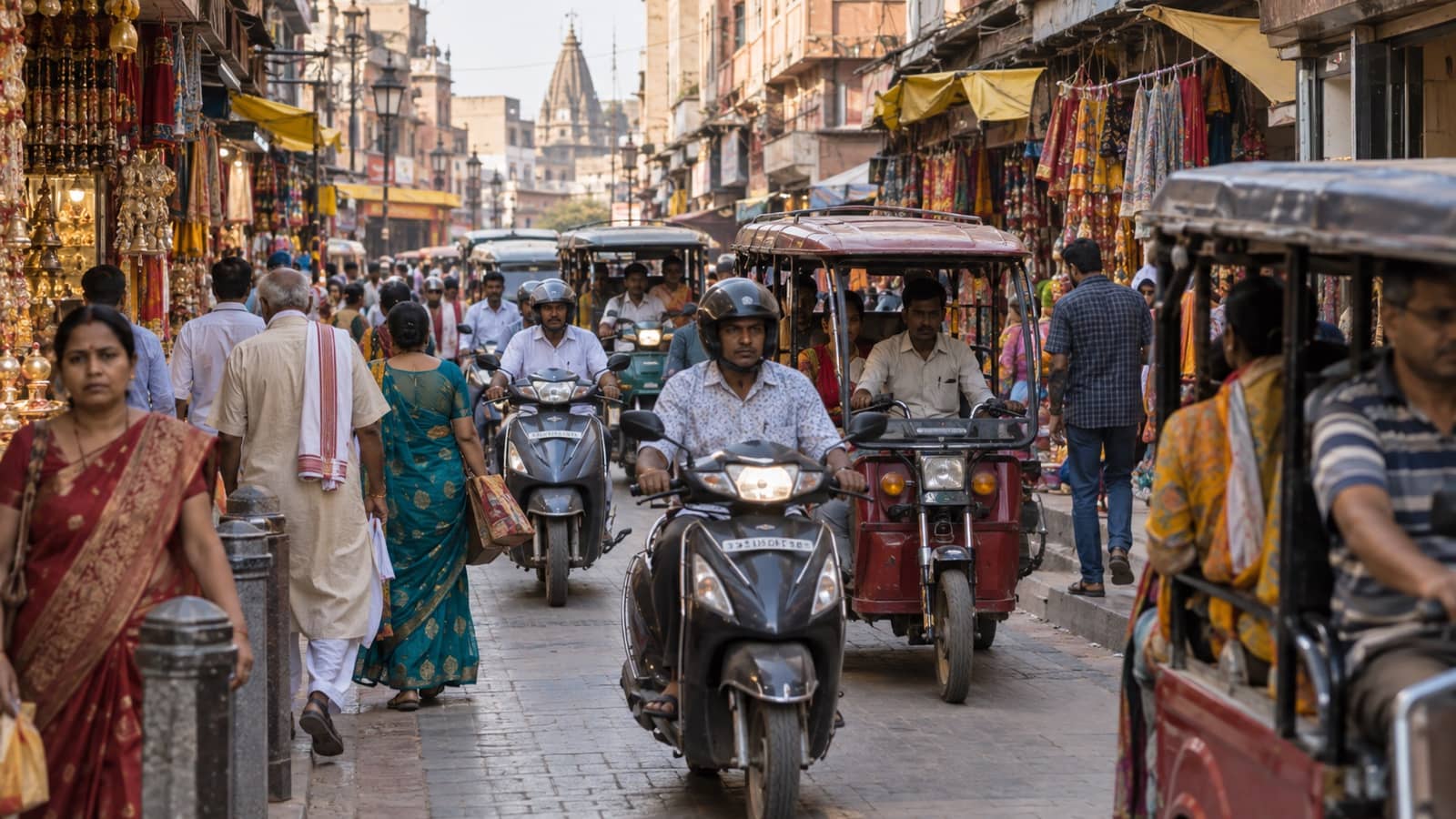
VARANASI: A short journey through central Varanasi is still stretching to half an hour on crowded days, as congestion returns across the approaches to Kashi Vishwanath, the wholesale markets and the old city's narrow commercial corridors.
Pressure is particularly visible around Maidagin, Nai Sadak, Girjaghar, Luxa, Ramapura and Jangambari, as well as Visheshwarganj and Machhodari. The Godowlia–Madagin route remains difficult where high vehicle volumes meet encroachment, e-rickshaws, autos and pedal rickshaws stopping or turning without a predictable pattern.
Enforcement has been extensive. Traffic police and the city's command-and-control system issued 567,605 challans between January and August, according to the report. Roughly 34,000 concerned wrong-side driving, while 11,354 covered mobile-phone use and red-light jumping. Passenger vehicles formed a large share of those penalised.
Yet the street experience suggests that challans alone are not redesigning behaviour. Enforcement often intensifies when senior officers are expected to inspect an area; vehicles and temporary encroachments are cleared, only for the old pattern to return within hours. A camera can record an offence, but it cannot create a legal pickup bay where none exists.
The old city needs route management at the scale of minutes and metres. E-rickshaw stands should be marked away from junction mouths, with limited dwell time and a queue that does not occupy the carriageway. Loading hours for wholesale areas need enforcement that reflects actual business needs. Pedestrian movement must be protected, because people forced off a blocked footpath reduce road capacity further.
Data from the challan system should guide physical changes. If the same junction produces thousands of wrong-side cases, officials should examine whether a missing median opening, confusing sign or distant turn is contributing. Deliberate violations still require penalties, but repetitive patterns can reveal a design problem.
Pilgrims face an additional information gap. Drivers unfamiliar with the core may follow navigation apps into lanes unsuitable for cars. Hotels, parking operators and temple-facing services should send guests a current drop-off point and the last walking segment before they arrive.
Residents and drivers also carry responsibility. A five-minute stop in a narrow lane can immobilise dozens of vehicles, and using the wrong side to bypass a queue makes the next junction worse. Rules must apply consistently to local and commercial vehicles.
Varanasi does not lack traffic orders; it lacks a street arrangement that survives after the inspection convoy leaves. The next improvement should be measured not in challans issued, but in reliable travel time on the routes where citizens and visitors lose the same half-hour every day.