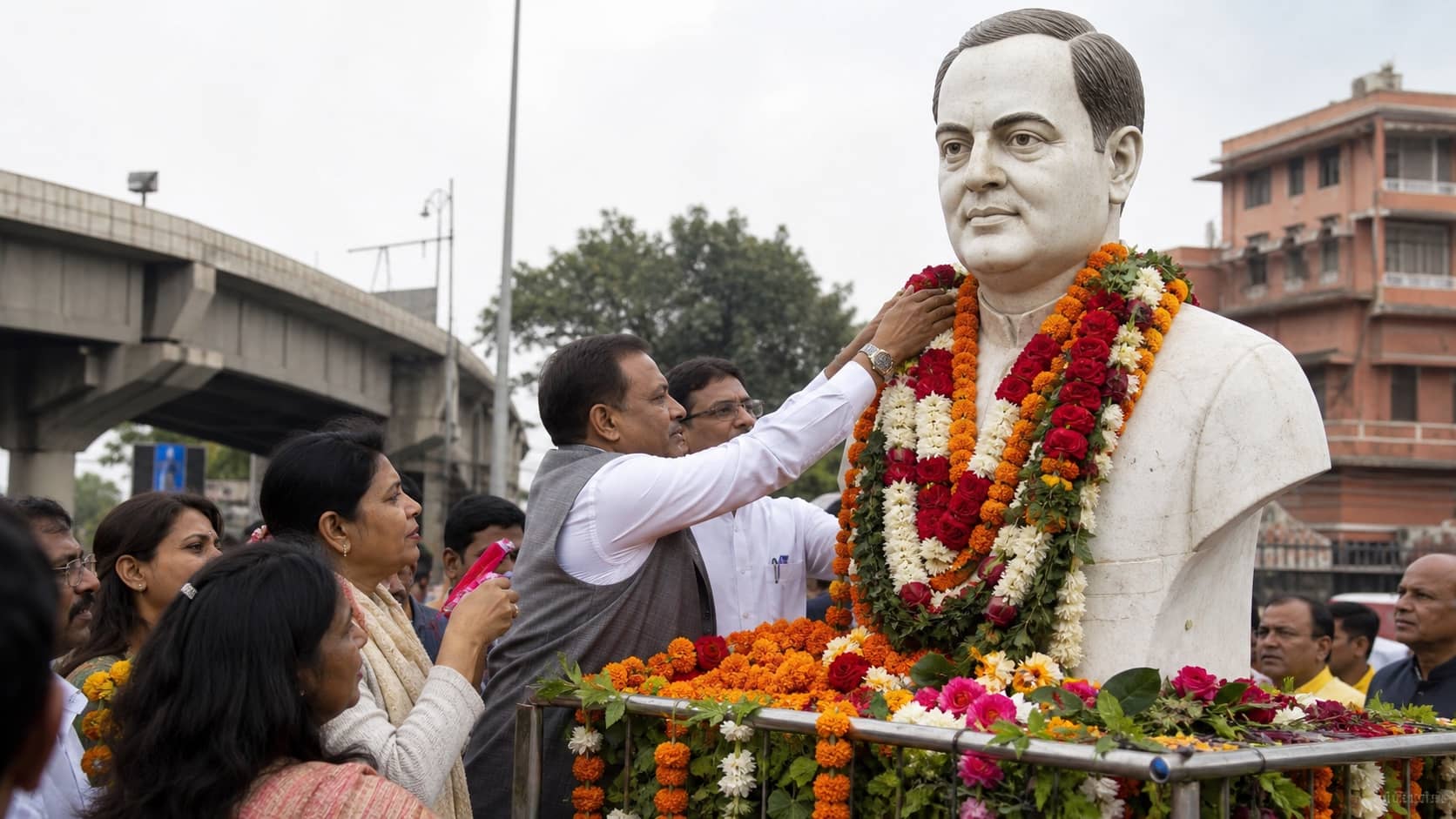
VARANASI: Congress workers in Varanasi observed former prime minister Rajiv Gandhi’s birth anniversary as Sadbhavana Diwas on Thursday, holding a public tribute at Maidagin and discussions about his political and technological legacy.
Party members placed garlands at the Rajiv Gandhi statue at Maidagin crossing and spoke about his life and role in modern India. District president Rajeshwar Singh Patel credited him with laying foundations for the country’s information and communications expansion, while city president Raghvendra Chaubey coordinated the programme. A separate tribute meeting was also held at a lawn in Naria.
The BHU unit of the National Students’ Union of India organised a discussion focused on Generation Z. Linking a leader identified with computerisation and telecom reform to today’s young adults is an obvious political frame, but it also invites a more useful question: how should a generation that has never known an India without mobile connectivity evaluate the choices that built the digital state?
Anniversary events are partisan occasions, and the assessments offered by Congress leaders reflect their party’s view. Rajiv Gandhi’s tenure remains part of a contested political history that includes technological change, administrative initiatives, electoral decisions and serious controversies. A responsible account should record the tribute without presenting every commemorative claim as an uncontested verdict.
The local relevance of communications policy is visible across Varanasi. Students attend online classes, small traders receive digital payments and residents submit municipal complaints from their phones. Yet access remains uneven. A strong signal, an affordable device and digital literacy cannot be assumed in every household. Celebrating a “communications revolution” is most meaningful when the remaining gaps are also acknowledged.
Sadbhavana Diwas places emphasis on goodwill and communal harmony. In a city of dense neighbourhoods and shared public spaces, that idea has value beyond party ritual. It can be judged through the language politicians use in ordinary campaigns, their response to local tensions and whether public programmes welcome disagreement without hostility.
The student discussion matters for another reason. Young voters are frequently discussed as a demographic block rather than invited into a serious conversation. Gen Z in Varanasi includes first-time jobseekers, researchers, gig workers, family-business successors and students preparing for examinations. Their priorities are not identical, and any party seeking their support will need more than nostalgia.
The Maidagin ceremony brought together several local office-bearers and workers, while the Naria programme extended the commemoration elsewhere in the city. Such gatherings maintain party memory and organisation, but their public value increases when they lead to open debate about policy rather than stopping at garlands and speeches.
Thursday’s events placed Rajiv Gandhi’s legacy before a new generation in Varanasi. The most credible tribute to modernisation and harmony would be to examine that legacy fully—and then address the present city’s concrete needs for accessible technology, dignified work and public dialogue that does not collapse into slogans.