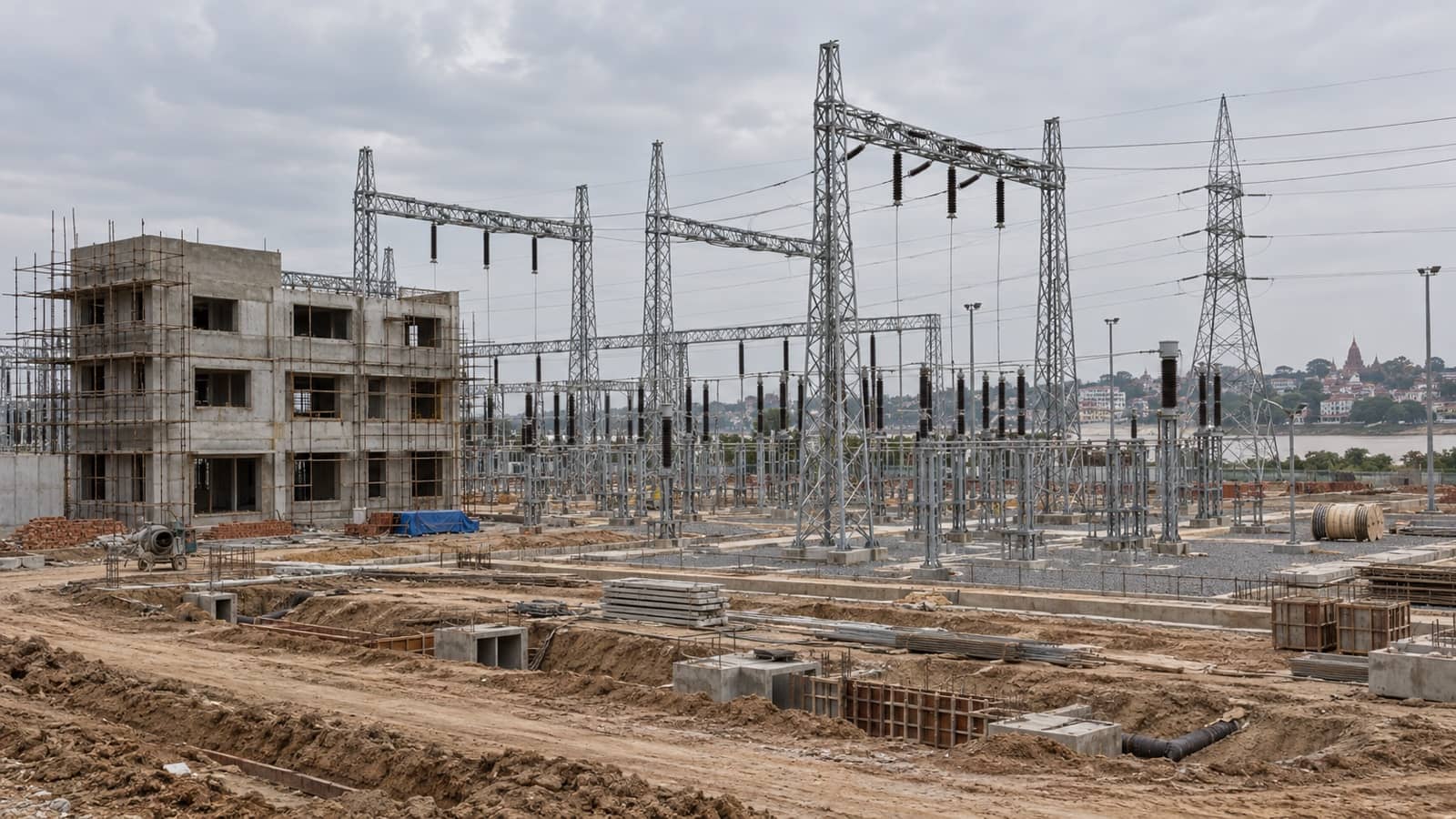
VARANASI: The 220 kV transmission substation under construction on the Sanskrit University grounds may require at least eight more months, extending a delay that has already taken the ₹200 crore project a year beyond its original completion date.
The facility was due to be ready by September 7, 2025. The executing agency, Megha Enterprises, has been penalised ₹12 crore over the delay, according to the report, but progress remains slow. Only the 220 kV control-room work is described as complete; the 33 kV control room is unfinished and earth filling continues.
The project requires about 35,000 cubic metres of fill, of which roughly 25,000 cubic metres has been placed. Earthing work has not started. More significantly, the transmission line from the Cantonment area has yet to begin even though permission has been obtained. A required payment of ₹23 crore remains to be deposited before that line work can proceed.
These are not decorative finishing items. Earthing is central to the safe operation of a high-voltage installation, while a completed control building is of little use without the incoming and outgoing lines that integrate the substation with the grid. Delays in sequential work can also multiply: civil areas must be ready before equipment installation, testing and energisation.
The transmission department has issued several notices, but notices and a financial penalty have not yet produced the planned pace. Officials should publish a revised milestone chart showing who is responsible for the Cantonment payment, when the remaining soil will arrive, when earthing begins and which equipment has already been procured. A broad promise of eight months is not enough.
Varanasi residents experience the project indirectly through network reliability. A new 220 kV node can improve capacity and reduce stress on existing routes, but only after it is commissioned. It will not eliminate every neighbourhood outage caused by a damaged cable or transformer, though stronger upstream infrastructure can give operators more flexibility during peak demand and maintenance.
Construction on institutional land also requires safe segregation. Heavy vehicles, open trenches and high-voltage components must be kept away from students and routine university movement. Monsoon water should not be allowed to compromise filled areas or future foundations.
Penalties protect public money only if they are enforceable and linked to performance. The authority should explain whether the ₹12 crore has been recovered, adjusted or merely assessed, and whether contract remedies beyond notices are being considered.
The substation is now defined by missed time. A credible recovery plan must replace that narrative with dated, visible steps—line payment, civil completion, earthing, equipment tests and energisation—so the city can see what remains between a construction site and a working piece of its power network.