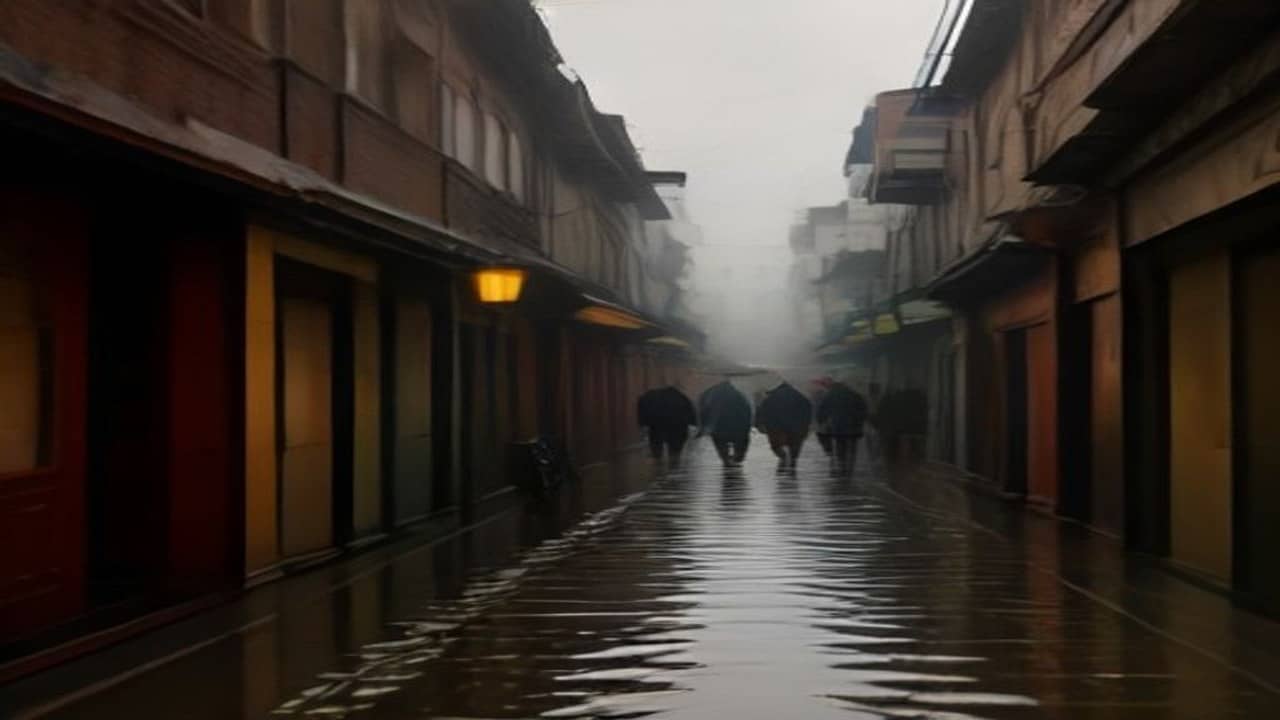
Varanasi recorded 160 millimetres of rain at Rajatalab on Tuesday, the third-highest single-day August total on the local record after 165 millimetres on 12 August 1987 and 161.8 millimetres on 23 August 2025, and the heaviest day of this year. The India Meteorological Department kept Thursday, 27 August 2026, in the wet column. Senior scientist Dr Atul Kumar Singh of the UP Regional Meteorological Centre said a monsoon trough lay over Banaras and Purvanchal, with a low-pressure area near Jharkhand, and that heavy rain was possible in the next 24 hours, with activity through 27 August.
The district average sat near 150 millimetres. Banaras Hindu University logged 145 millimetres. A north Banaras slice showed 123 millimetres from Monday night to 8:30 am Tuesday, plus 42.5 millimetres in the daytime hours of that 12-hour cut. Meteorological briefings also cited about 50 millimetres in one hour on Monday night, and a separate 24-hour total around 128 millimetres in another compilation. Those are different clocks on the same burst; Rajatalab’s 160 millimetres is the day-mark that now sits third on the August list.
Dr Atul Kumar Singh put the Thursday forecast on the record: trough over Banaras and Purvanchal, low pressure near Jharkhand, heavy rain possible in the next 24 hours, activity through 27 August. Maximum temperature was around 32°C, minimum around 24°C, evening near 25°C, winds 20–25 km/h.
The rain had already written a civic list before Thursday’s outlook. Classes 1 to 8 were given a holiday on Tuesday. Godowlia, Ravindrapuri, Assi, Mahmoorganj, the BHU hospital campus, Saket Nagar and Gandhi Nagar stood waterlogged. Traffic seized up at Cantt, Sunderpur, Lahartara, Manduadih, Chandpur and the Rath Yatra stretch, the district administration’s impact notes showed.
Rajatalab’s 160 millimetres beating this year’s previous days, and coming within a few millimetres of 23 August 2025’s 161.8 millimetres, is why the day enters the August table. Only 12 August 1987, at 165 millimetres, stands clearly above it in that month’s single-day list.
A 50-millimetre hour on Monday night explains why lanes went under before Tuesday’s full-day total was in. District average near 150 millimetres and BHU at 145 millimetres show the rain was not a single-gauge freak at Rajatalab; it was a district-scale August day that happened to peak at 160 millimetres on that gauge.
Winds of 20–25 km/h and an evening near 25°C kept the city in a close, wet band rather than a break of sky. District administration had already used the Tuesday holiday for Classes 1 to 8 as the school-side response. The named waterlogging and the named traffic jams had not been withdrawn by Thursday morning.
Dr Atul Kumar Singh’s Thursday window still held: trough over Banaras and Purvanchal, low pressure near Jharkhand, heavy rain possible in the next 24 hours, activity through 27 August. Rajatalab’s 160 millimetres already sat as this year’s heaviest day and the third-highest August mark on the Varanasi record after 12 August 1987 and 23 August 2025.