
VAR in football means video assistant referee: an official who uses replay footage to help the referee correct certain major mistakes. It does not give every disputed tackle a second hearing. Under the International Football Association Board's current protocol, the referee still makes the final decision, with intervention tied to defined categories and an error threshold.
For Indian viewers following different competitions, the important detail is that the current rules also distinguish a wrongly issued second yellow card from a missed second yellow card. They additionally allow competitions to adopt immediate corrections of clearly wrongly awarded corners. Those provisions make older descriptions of VAR as covering only goals, penalties, straight reds and mistaken identity incomplete.
| Question | Rule in brief |
|---|---|
| Who decides? | The referee on the field. |
| Must every check involve the monitor? | No. Some checks are silent and some reviews use information from VAR. |
| Can players demand a review? | No formal player or coach request is needed under this protocol. |
| Are corner reviews universal? | No. They are a competition option with strict timing limits. |
What decisions can VAR review in football?
The official IFAB VAR protocol sets out the reviewable situations. Goal decisions can involve an attacking foul, handball or offside in the build-up, whether the ball had already left the field, and whether a goal was scored. Penalty decisions can include an unpunished offence, an incorrectly awarded kick, or whether the incident happened inside or outside the penalty area.
Sending-off incidents include serious foul play, violent conduct and denying an obvious goalscoring opportunity. Mistaken identity allows the referee to correct which player received a yellow or red card. The current law-change explanation specifies that this can involve a player from either team, while preserving limits on reviewing the underlying offence.
Consider this illustrative distinction: if the referee awards a penalty for a trip but the footage shows that the contact happened outside the area, the location can be corrected. If a viewer dislikes an ordinary midfield free-kick decision, that disagreement alone does not create a reviewable incident. The category matters before the argument about the decision begins.
What does clear and obvious error mean?
The protocol requires the original decision to stand unless footage demonstrates a clear and obvious error, or officials identify a serious missed incident within the permitted scope. The referee must make an initial decision, including allowing play to continue. Officials cannot simply avoid deciding and ask the replay team to settle everything.
A check and a review are different stages. VAR examines relevant footage automatically. When a check finds no qualifying mistake, it can remain silent. When it suggests a probable qualifying mistake, VAR communicates with the referee, who decides whether to begin a review. Only the referee initiates that review; VAR recommends it.
Why does the referee sometimes use the monitor?
An on-field review suits subjective questions, such as the intensity of a challenge, interference from an offside position or handball considerations. A factual matter, such as the position of an offence, will usually suit a review based on information from VAR. The absence of a monitor visit therefore does not mean that officials ignored the footage.
Replay speed also matters. IFAB says slow motion should generally establish facts, including the point of contact or a player's position. Normal speed should assess the intensity of an offence or whether a handball offence occurred. A still image of contact can answer where a foot landed without answering how forceful the whole challenge was.
Can VAR check second yellow cards and corners?
A clearly incorrect second caution that produces a red card is reviewable under the current provisions. A potential second caution that the referee missed is different: IFAB's own FAQ says VAR cannot intervene to have that missed yellow issued. For the wider disciplinary framework, see our yellow and red card rules guide.
Competitions can choose to allow correction of clearly incorrectly awarded corners, provided the decision can be changed immediately without delaying the restart. If the corner is taken quickly, it cannot be changed. That option does not create a general entitlement to lengthy reviews of every corner decision in every league.
How long can a VAR review take?
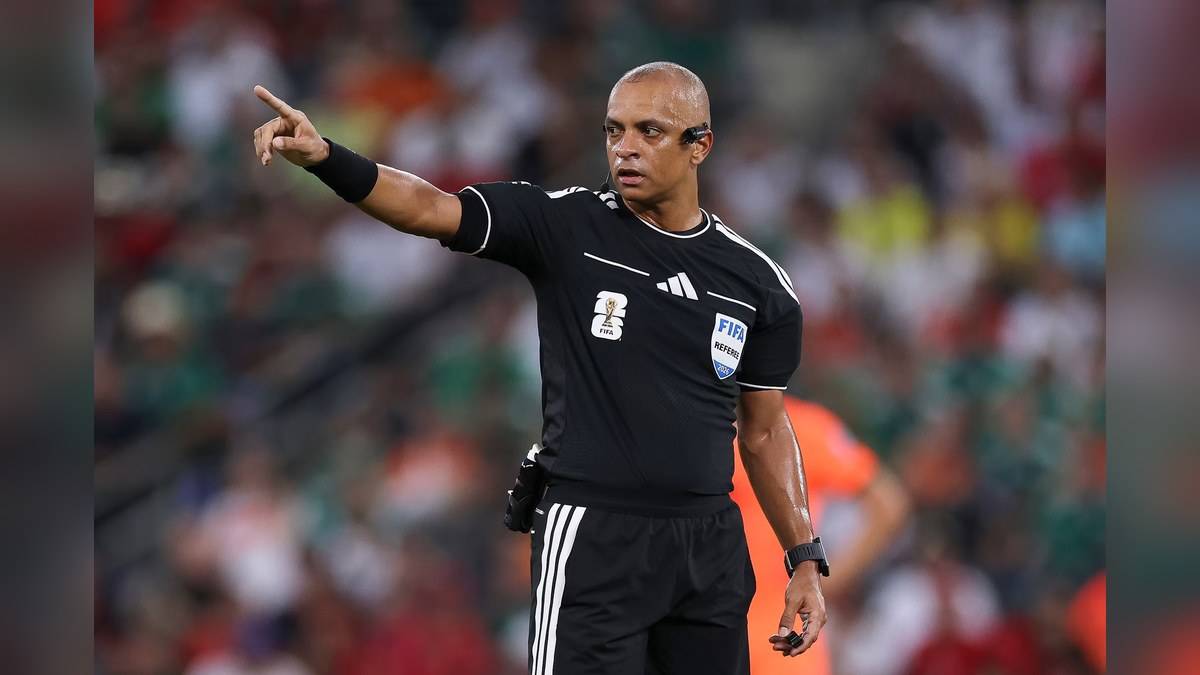
IFAB sets no maximum review time because accuracy takes priority over speed. When a check requires a delayed restart, the referee indicates communication by holding a finger to the earpiece and extending the other arm. The television-shaped signal accompanies the review procedure and final decision. Our added-time explainer covers how stoppages relate to the match clock.
After play has stopped and restarted, review possibilities narrow sharply, with exceptions for mistaken identity and specified serious sending-off conduct. An offside discussion can also involve a deliberately delayed flag in a clear attacking situation; our offside rule guide explains that separate judgement. The useful viewing habit is to identify the incident category, the original decision and the reason for intervention before assuming every pause means an overturned call.