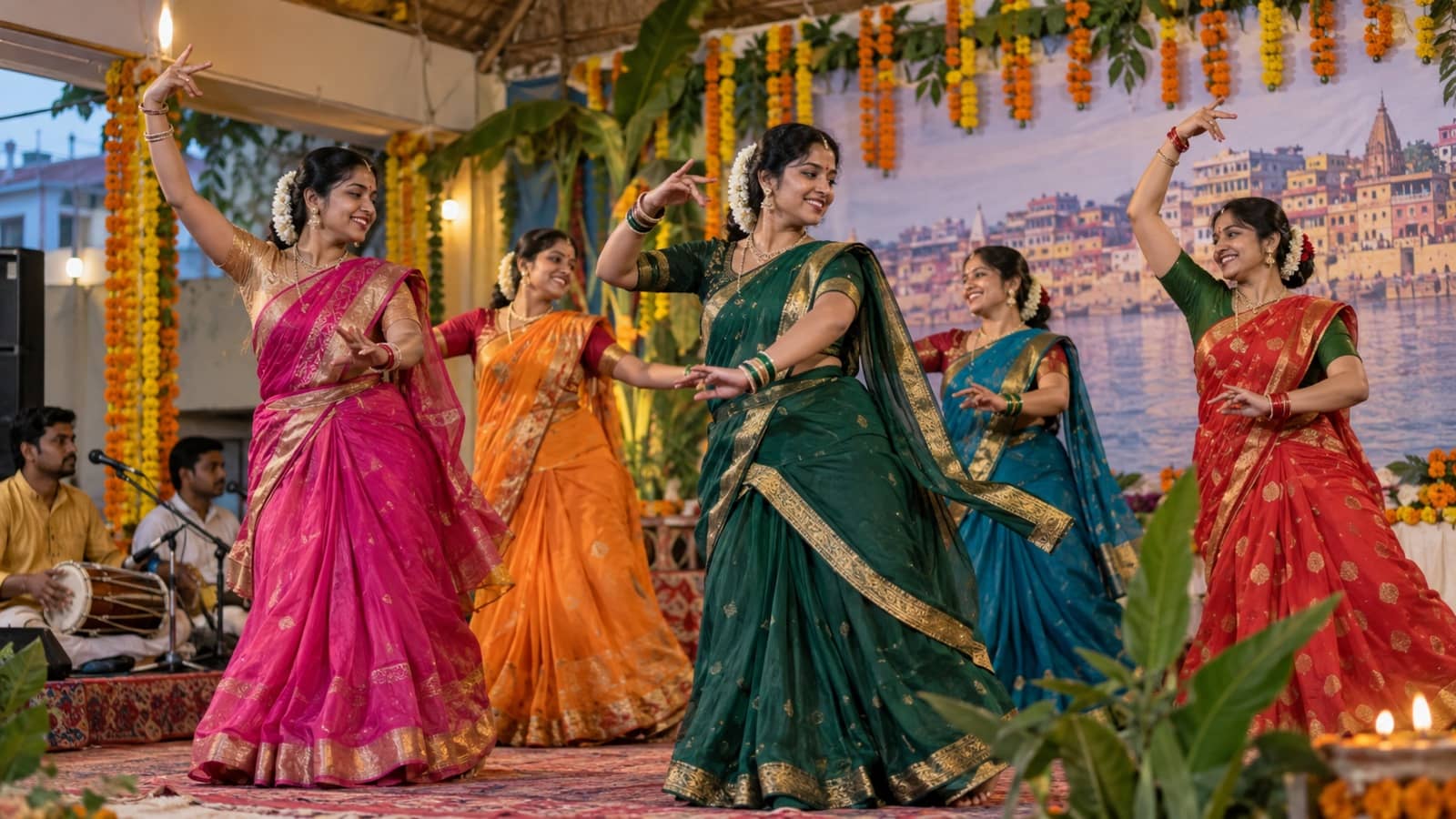
VARANASI: A stage in Mahmoorganj travelled through much of Kashi's monsoon festival calendar at Umangotsav, where members of Bharat Vikas Parishad's Kashi branch used short scenes, Kajri singing and dance to connect a series of observances usually experienced weeks apart.
The programme brought together references to Shiva's jalabhishek, Nag Panchami, Hariyali Teej, Raksha Bandhan, Kajri, Janmashtami, Hartalika Teej and Ganesh Chaturthi. Rather than treating them as a list of dates, participants recreated customs and stories associated with each occasion. Women presented solo and group Kajri performances, giving the evening a distinctly Purvanchali sound.
Alpana Agrawal, Barkha Jain, Roshni Agrawal, Vineeta Agrawal and Shalini Agrawal coordinated the event, while Saurabh Jain welcomed the gathering. Community programmes of this kind often depend on organisers doing several jobs at once—selecting material, arranging costumes, rehearsing performers and building a running order that keeps very different items coherent.
Kajri was the natural thread. The form is tied to the rains, separation, longing and everyday life across eastern Uttar Pradesh and neighbouring regions. On a modern indoor stage it can be shortened or choreographed, but its language and melodic character still carry the landscape from which it emerged. That is why a familiar folk song can do more cultural work than a long explanatory speech.
There is a risk in compressing festivals into decorative tableaus. Traditions can become a sequence of costumes without context, and regional variations may disappear. A stronger cultural programme tells the audience where a song comes from, who usually performs it and how the practice has changed. Younger participants then inherit more than a pose for photographs.
Umangotsav also showed how women's associations sustain neighbourhood culture. Their work is often described as participation while men receive the formal titles, even though women preserve songs, recipes, ritual sequences and performance memory within families. Naming the coordinators is therefore more than courtesy; it records who carried the programme.
Future editions could add a brief open workshop in Kajri or invite an elder performer to explain a less familiar verse. Recording complete performances with proper credits would create a small local archive. Accessibility matters too: clear aisles, modest sound levels and seating for older guests make community culture genuinely communal.
The Mahmoorganj event was celebratory rather than scholarly, and that was its strength. It did not try to freeze Kashi's traditions behind glass. It placed them back in the hands and voices of residents, allowing the city's festival year to unfold in one lively evening.