
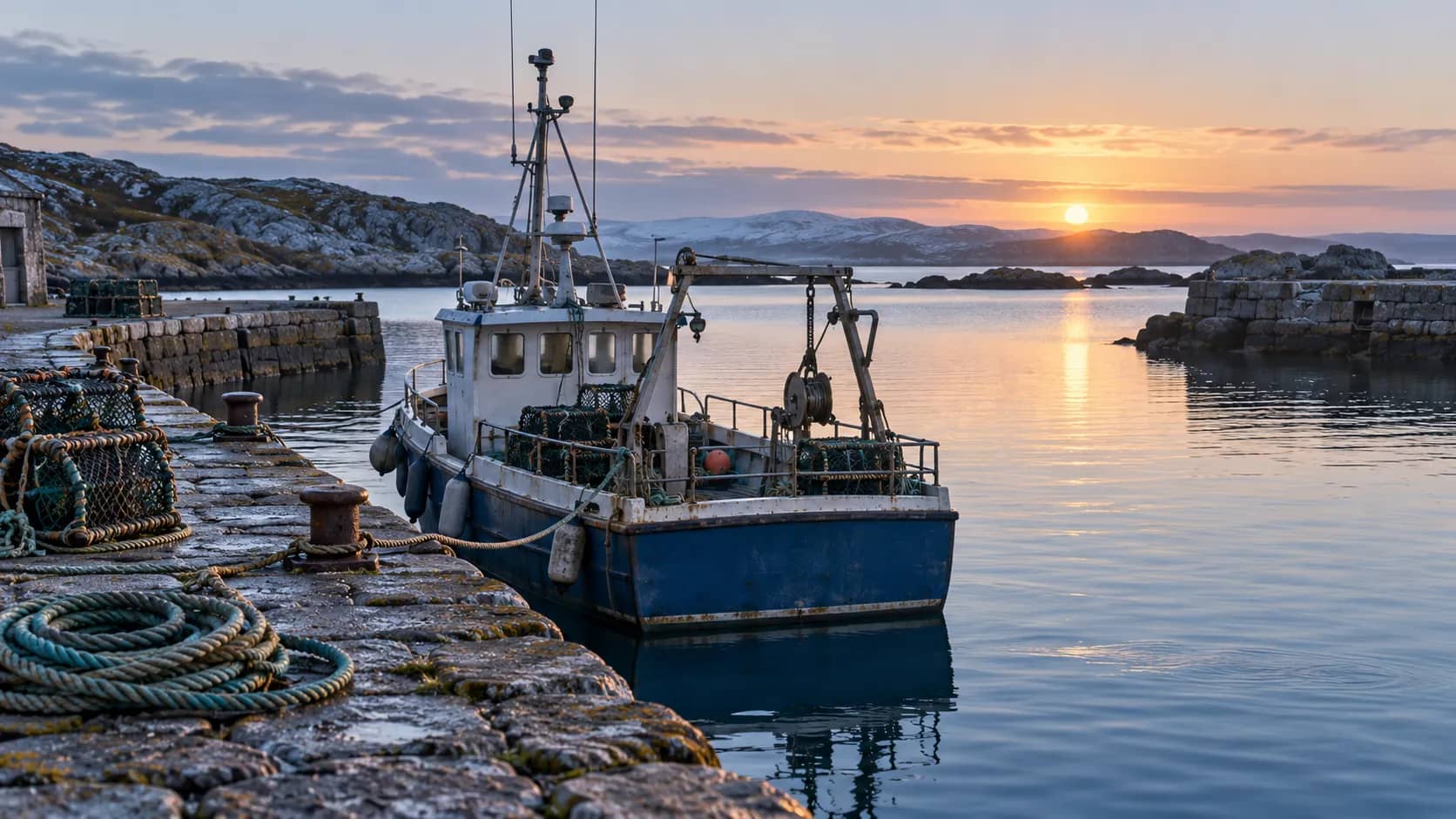
UK fishing vessel operators working in European Union waters have been advised to check how they mark equipment, record catches and transmit vessel positions, as the Marine Management Organisation sets out requirements already operating alongside further changes due in 2027 and 2028.
The MMO published its industry advisory on 21 October. It is guidance on phased EU fisheries controls, not an announcement that all the requirements have just become law. Some changes took effect on 10 January 2026, while later stages cover trawl markings, weighing fish landed in EU ports and more frequent position reports.
The distinction matters for vessels moving between UK and EU waters. The MMO says the measures arise from EU legislation rather than UK law and are enforced by EU countries, not its own marine enforcement officers. Its account reflects its current understanding, and operators should obtain definitive guidance from the relevant member state's authorities.
Different markings and catch records
For passive equipment such as nets, lines, pots and traps, the advisory describes permanent labels carrying the vessel's PLN identifier. The requirements cover equipment carried aboard as well as equipment being used. Labels must be durable, securely attached and readable, without being concealed, altered or erased.
Where those labels go can differ across the two jurisdictions. The MMO's comparison says nets in EU waters need labels on both the upper first row and the footrope. Lines need them on the mainline and every float. For pots, the comparison identifies the groundrope and each individual pot, rather than the groundrope alone under the UK requirements described in the notice.
The advisory also distinguishes label dimensions. The 65mm-wide and 75mm-long dimensions remain applicable in UK waters, it says, but EU waters no longer have a label-size requirement. Its passive-gear section describes the EU marking rules as applying outside the 12-nautical-mile baselines. Operators should not treat that geographical qualification as interchangeable with the separate reporting requirements.
From 10 January 2027, the notice says vessels fishing in EU waters will need their identification on specified parts of trawls and equipment carried or used in fishing operations. It identifies beam trawl assemblies where present, trawl doors where present and each selvedge of the codend's upper section. The beam requirement already has a UK counterpart, according to the advisory.
For vessels of 12 metres overall length or more, catch recording in EU waters requires an electronic logbook entry for each fishing operation. Fixed nets and pots can require separate haul entries for each net or string of pots. Deploying and recovering equipment as separate, non-continuous operations can also require separate Fishing Activity Reports.
The catch-recording threshold differs too. The MMO says these vessels must record the liveweight equivalent of all retained quantities of each species in EU waters. Its UK comparison uses a 50kg liveweight threshold for individual species. Estimated discards must also be recorded in kilograms liveweight.
More frequent position reports ahead
Recording an operation is not necessarily the same as immediately transmitting it. The advisory says operations can be entered individually and submitted together, with electronic submissions at least daily and after the final fishing operation before entering port or a landing site. If inspected, the master needs to update and submit the logbook, including the relevant EU-water operations.
Vessel position reporting is another phased change. In specified restricted fishing areas, including a five-mile buffer, the advisory describes transmission at least every 30 minutes rather than every two hours. The MMO monitoring centre is working with supplier AST on a geofenced software update, while discussions continue on identifying further restricted areas.
The notice says operators will bear additional transmission costs once the relevant coordinates have been installed in AST terminals. From 10 July 2027, the 30-minute frequency is due across all EU waters, with automatic switching when a vessel enters and a return to two-hour reporting when it leaves. The MMO says individual operators will not need to make that switch themselves.
Other details remain unsettled. Rules for weighing fish landed in EU ports take effect on 11 January 2027, but Defra is seeking clarification on transport to first sale and additional landing-declaration information. Further electronic logbook requirements for vessels under 12 metres follow on 10 January 2028. The advisory promises more information as implementation discussions progress.
Related coverage: India’s SIOFA accession and high-seas fishing controls, and the UK’s Arctic research and shipping safeguards. These concern separate frameworks.
Contains public sector information licensed under the Open Government Licence v3.0.