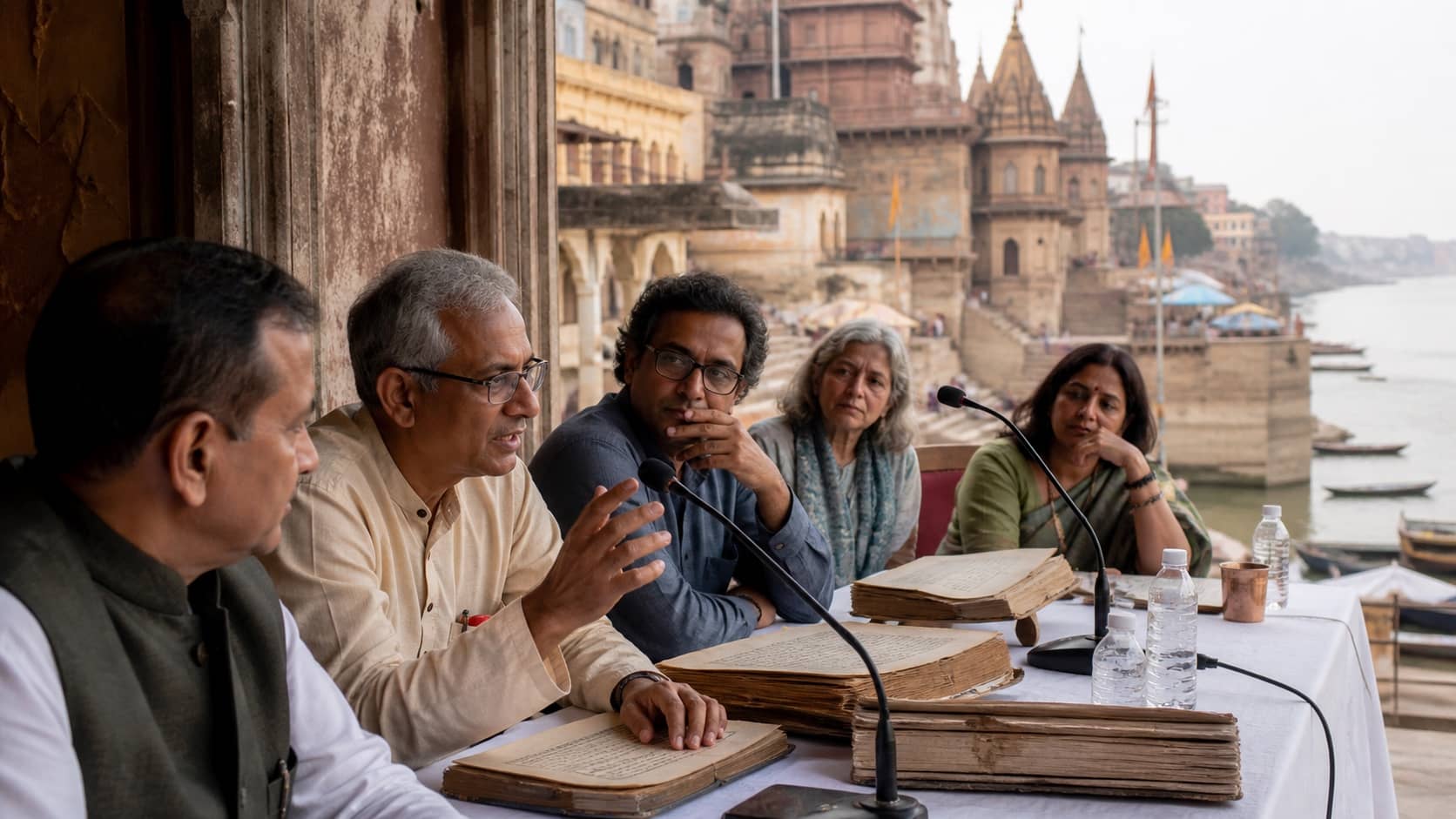
VARANASI: A two-day Tulsi Jayanti seminar concluded at Tulsi Ghat on Thursday with scholars returning to a difficult but enduring question: what can a centuries-old literary work offer a society whose language, institutions and conflicts have changed so dramatically?
Speakers argued that the writings of Tulsidas remain useful when human values, ethical conduct and social harmony are under pressure. Their discussions focused particularly on the Ramcharitmanas and its treatment of duties within families and communities. Participants also highlighted the poem’s ability to travel across linguistic and cultural boundaries, noting the long history of international scholarship around the text.
Those presenting views included Professor Nalin Shyam Kamil, Dr Bharatbhushan Pandey, Pandit Ramcheez Upadhyay, Pandit Yagnesh Mishra, Dr Dharmaprakash Mishra and several other scholars named by organisers. Professor Vishwambhar Nath Mishra, mahant of Akhara Goswami Tulsidas, honoured the speakers, while Pandit Raghavendra Pandey conducted the session.
Tulsi Ghat is an apt site for such a conversation. The neighbourhood connects textual memory, performance and living worship. Tulsidas is not encountered here only as a figure in a syllabus; his work is heard in recitation, music, Ramleela traditions and ordinary phrases that have entered everyday speech. That living presence gives the city a particular responsibility to discuss the work seriously rather than reduce it to reverence.
Relevance, however, cannot mean lifting a line from its setting and using it as a ready-made answer to every modern argument. Literature becomes useful through reading, interpretation and debate. Different audiences have raised questions about caste, gender, translation and authority in the Ramcharitmanas. A confident literary culture should be able to examine those questions alongside the text’s devotional and poetic importance.
The seminar’s emphasis on social harmony is timely in a city where sacred space and public life overlap every day. Tulsidas’s enormous influence means that discussions around his writing reach far beyond university departments. Clear explanations, accessible editions and conversations in Hindi and regional languages can invite younger readers who may otherwise know only a handful of famous verses.
Foreign scholarship mentioned by speakers is another reminder that major Indian works have never remained inside national boundaries. Translations can reveal new readings, though they can also flatten wordplay, rhythm and cultural reference. Comparative study is strongest when it acknowledges what a translation gains and what it cannot carry.
The event ended with honours for the participants, but the intellectual work cannot end with an anniversary. Libraries, schools and cultural institutions in Varanasi could build reading programmes that put the original text beside modern scholarship and multiple translations. That would allow respect to coexist with inquiry.
At Tulsi Ghat, the central conclusion was that Tulsidas still offers direction. The next step is to make that claim concrete: not by insisting that every reader reach the same interpretation, but by giving a new generation the language, context and freedom required to read him with both attention and honesty.