The Legend of “Muhnochwa”: Varanasi’s Mysterious Night Visitor
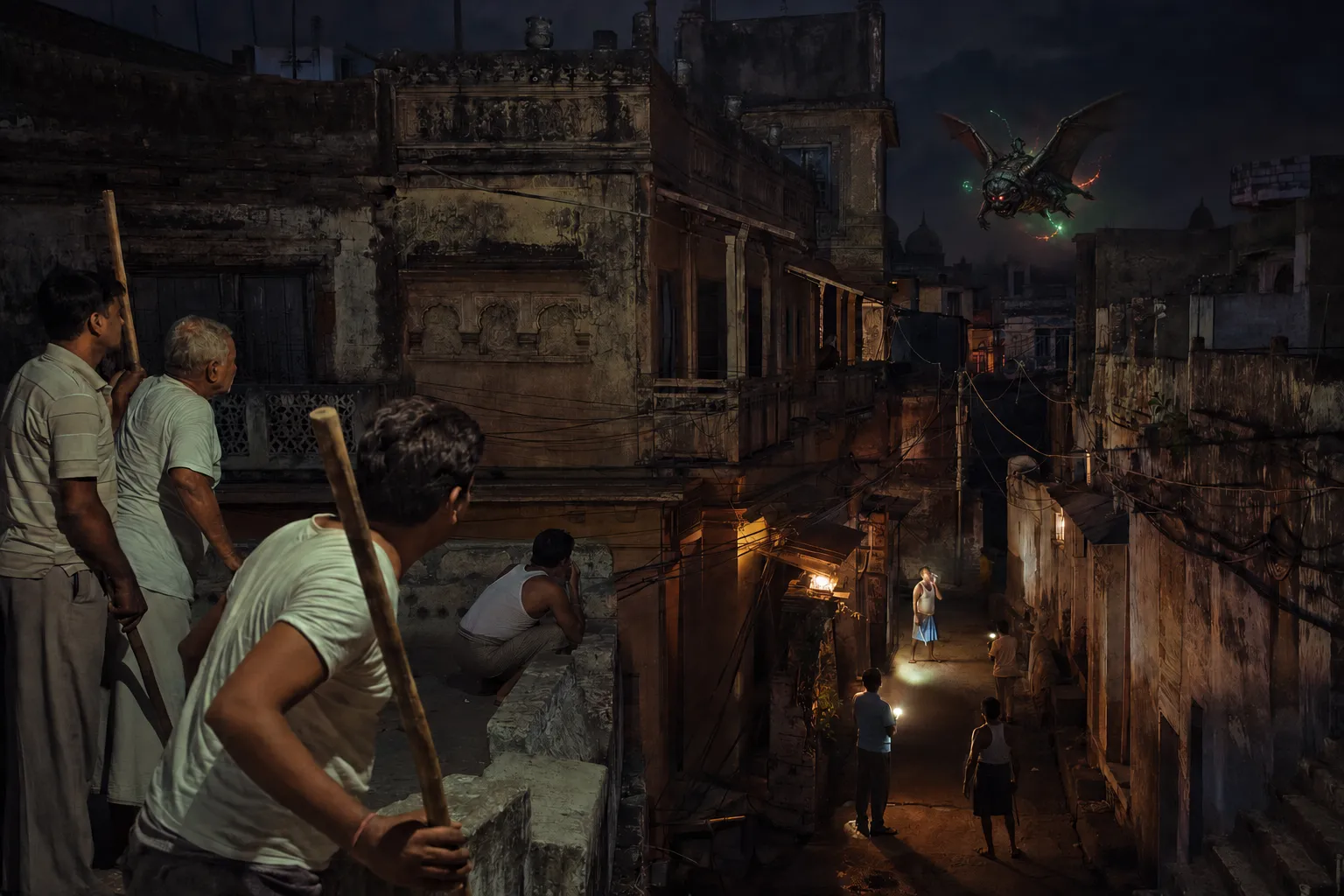
In the long, oppressive summer of 2002, when the monsoon refused to arrive on time and the nights in eastern Uttar Pradesh stretched thick with heat and darkness, a new fear took shape. It moved without clear form. People called it Muhnochwa—the face-scratcher. Witnesses claimed a glowing shape would appear suddenly, leave burning scratches across cheeks, necks and arms, and disappear before anyone could fix it in memory. What began as scattered reports from villages in Mirzapur, Chandauli and the Ballia-Ghazipur belt soon reached the edges of Varanasi. By mid-summer it had settled into the city’s collective unease, particularly in the dense old neighbourhoods of Chauk, Dalmandi and Madanpura, where rooftops and courtyards had always been the natural places to sleep when the power failed.
Contemporary newspaper accounts from July 2002, including those filed from Varanasi itself, described a flying object that emitted beams of red or green light and delivered something like an electric shock or a clawed strike. Injury marks resembled nail bites or superficial burns. In villages under the Ahraura police station in Mirzapur, five young men reported being struck on the same night. Children fell from terraces in panic. One man suffered a cardiac episode simply after hearing the rumour. Similar stories multiplied rapidly across eastern Uttar Pradesh—Sitapur, Barabanki, Lucknow, Kanpur, Allahabad—until nearly a hundred people were said to have been attacked. The creature’s appearance never stabilised. Some saw a football-sized sphere trailing light. Others described something bat-like, a flying cushion, a mechanical shape, or a figure with bloodshot eyes and tiger-like claws. A few insisted it was a remote-controlled device or even an insect engineered by hostile forces across the border.
In Varanasi’s old city the fear took on a particular texture. Summer nights in those tightly packed lanes have always meant sleeping outdoors or on rooftops. Power cuts were routine. When the rumour arrived, families who had long treated the open night as ordinary began pulling their charpoys indoors. Groups of men organised informal patrols with lathis, torches and, in some places, drums. Loudspeakers in certain areas carried warnings to stay inside after dark. Weddings were postponed. Ordinary sounds after midnight— the creak of a door, the movement of a cat, the distant flash of a vehicle—acquired new weight. Residents of Chauk, Dalmandi and Madanpura still speak of those weeks the way people speak of a fever that once ran through an entire household: not as a single dramatic event, but as a prolonged, shared state of alertness that altered the rhythm of ordinary life.
The panic extracted a measurable human cost. Villagers lynched strangers they mistook for the creature. People leapt from rooftops believing the Muhnochwa was approaching. In Barabanki, a crowd of several hundred stormed a police station demanding stronger protection; officers opened fire and one man was killed. Officials later spoke of at least a dozen deaths linked not to any supernatural attacker but to the terror itself—falls, heart attacks, mistaken violence. One man shot his own mother while aiming at what he thought was a light emanating from the creature. Another beat his father in the dark. A woman in one village thrashed her husband nearly senseless before the lights came on and revealed her mistake. Forest officials noted the killing of squirrels, foxes, bats and other animals by frightened villagers.
The political response reflected the scale of public anxiety. The scare unfolded during Mayawati’s government. Opposition parties, particularly the Samajwadi Party, accused the administration of failing to protect citizens and of allowing the panic to fester. The issue reached the floor of the state assembly. Mayawati, in turn, blamed political rivals for inflaming the situation and engineering violence in places like Barabanki. Senior police officers floated a range of explanations, some of them highly speculative: a technologically advanced insect released by anti-national elements, a laser-equipped device, even the possibility of an extra-terrestrial body in a small percentage of cases. None of these claims withstood scrutiny.
A clearer pattern emerged when the scare was set beside the Monkey Man panic that had gripped Delhi only a year earlier, in May 2001. There, too, a half-seen nocturnal attacker left scratches and burning sensations. Descriptions varied wildly. People jumped from rooftops. Mobs formed. Police deployed thousands of personnel. Medical examinations later found many injuries consistent with self-inflicted wounds or ordinary accidents reinterpreted through fear. Rationalists and psychiatrists described both episodes as mass sociogenic illness—real physical symptoms generated and amplified by collective anxiety, rumour, media coverage, heat, power cuts, and dense living conditions. The Indian Rationalist Association, led by Sanal Edamaruku, investigated the Muhnochwa reports in Sitapur, Varanasi, Mirzapur and other districts. They found that alleged wounds were often superficial and non-specific. Many “victims” had not actually seen anything. The simple mention of the word Muhnochwa was sometimes enough to trigger panic. Water, light and the presence of calm observers appeared to keep the creature away.
Scientific investigation pointed in a related direction. The state government asked experts from IIT Kanpur to examine the phenomenon. Professor Ravindra Arora of the electrical engineering department concluded that many of the luminous, fast-moving objects were consistent with ball lightning—a rare atmospheric event in which clusters of charged particles form glowing spheres that can travel near the ground, emit coloured light (often reddish, green or blue), and leave superficial burns or irritation on contact with skin. Almost all reported incidents, Arora noted, occurred during or after thunderstorms in drought conditions, when soil conductivity was altered. Widespread power theft in the region, which created irregular ground currents, may have further contributed. Ball lightning is a documented, if still imperfectly understood, natural phenomenon reported across the world for centuries. It dissipates quickly, leaves little lasting trace, and matches the fleeting, luminous quality of many Muhnochwa sightings. Other cases were later traced to pranks involving gas balloons fitted with battery lights, kites, or ordinary insects. A few injuries appeared deliberately self-inflicted in the atmosphere of heightened fear.
No clear photograph or video ever captured the creature in a form that could be independently verified. Air Force radar detected nothing. The rains eventually arrived, the nights cooled, and the reports tapered off. By autumn the Muhnochwa had withdrawn into memory. What remained was a vivid chapter in the long list of mass panics that have periodically swept parts of north India—from the Monkey Man to later braid-cutting scares and other rumour-driven frenzies.
Twenty-four years later, the story lives on as urban folklore in Varanasi. Older residents of the old city still recall the altered nights, the patrols, the closed doors. Younger generations know it mostly as a curious local legend, one more entry in the city’s vast store of stories about the unseen. The Muhnochwa never left physical evidence of a new species or an otherworldly visitor. What it left instead was a clear record of how quickly heat, darkness, rumour, media amplification and collective anxiety can reshape the experience of ordinary nights in a densely lived place. The scratches healed. The deaths, most of them caused by panic rather than any claw, remain harder to set aside. And in the narrow lanes of Chauk, Dalmandi and Madanpura, where history settles in layers and oral memory travels easily, the recollection of those weeks still surfaces now and then—an uneasy reminder that the most persistent visitors are sometimes the ones no one ever truly saw.
Related Stories

Railways Orders Weekly Puja Special 09465 via Varanasi Through November
Hindi Diwas Marked Across BHU, Sanskrit University and Kashi Vidyapith
Lohta Police Register FIR After Bhitari Villager Alleges Hostage Beating
Baragaon Police Book Named Youths After Kazisaray Tea-Stall Assault and ₹1,900 Loot
Ganeshotsav Opens Across Varanasi Pandals With Modak Bhog and Pran Pratishtha