Second Sawan Monday Draws Long Queues to Kashi Vishwanath Temple
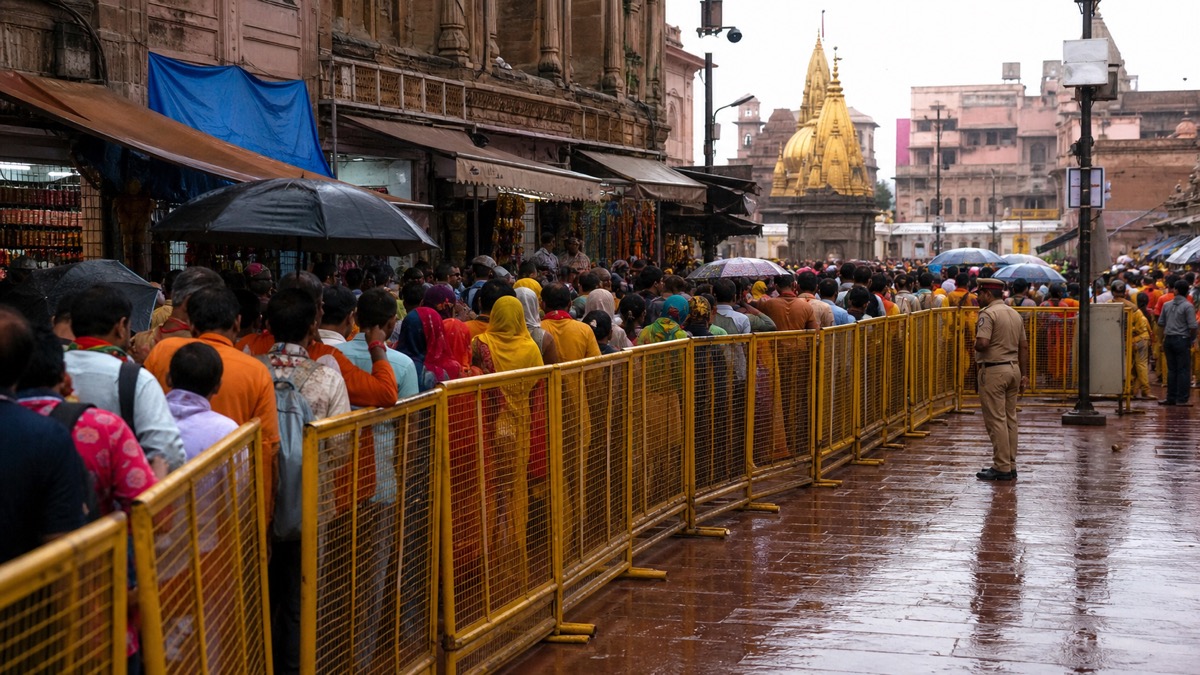
The second Monday of Sawan began before sunrise in central Varanasi, with long lines of devotees forming on the approaches to Kashi Vishwanath Temple. Pilgrims from several states moved through barricaded lanes, many carrying water and chanting as they waited for darshan. The crowd was substantial but, in the verified morning footage, movement remained channelled through the designated approach system rather than spilling without direction across every adjoining lane.
Sawan Mondays place unusual pressure on a compact part of the old city. The temple corridor can absorb large numbers, but the routes feeding it still pass through busy neighbourhoods where residents, traders, emergency vehicles and pilgrims share limited space. Crowd management therefore begins far from the sanctum. Holding areas, entry gates, footwear points, drinking water and the timing of diversions all decide whether a queue remains tiring but orderly or becomes a dangerous compression.
For devotees, the practical advice remains basic: follow the marked route, carry minimal belongings, stay with children and elderly relatives, and do not stop for photographs in a moving line. Anyone feeling faint should alert volunteers or police before reaching a dense section. The combination of humidity, rain and hours of standing can exhaust people who felt well when they joined the queue. Water points and medical desks are most effective when visitors use them early rather than after a condition worsens.
The second Monday also brings a different rhythm to shops and homes around the temple. Deliveries are pushed to quieter windows, two-wheelers are kept out of restricted stretches and local workers often walk farther than usual. These costs are easy to overlook in an aerial image of devotion. Clear, predictable traffic instructions help residents plan around the pilgrimage and reduce the temptation to create unofficial shortcuts through lanes that were not designed for a mass queue.
Security teams face a dual responsibility: keep people moving and treat them with patience. A barricade is useful only when the next section has space; pushing a line forward to clear one point can create pressure at another. CCTV and drone monitoring can support decisions, but officers on the ground still need real-time authority to pause entry, open a relief lane or call medical support. Good crowd management is visible mostly in what does not happen.
By late morning, the defining image was not a single celebrity visitor or ceremonial moment, but the persistence of ordinary worshippers waiting their turn. The test for the remaining Sawan Mondays will be whether Varanasi can preserve that devotional energy while keeping the route humane, legible and safe for everyone who enters it.
Sources and reporting
Dalimss News Banaras verified visual report from 10 August 2026; crowd descriptions are based on footage from the temple approaches.
Related Stories
Festive Special to Gorakhpur Gets Gurugram Halt
Fifth Accused Held in Rs 25 Lakh Sector 47 Robbery
Courier Staffer Booked Over 105 Missing One8 Returns
HC Sets Rs 50 Lakh Costs for Accused's Return to India

Gurugram Swimmer, 20, Crosses English Channel