
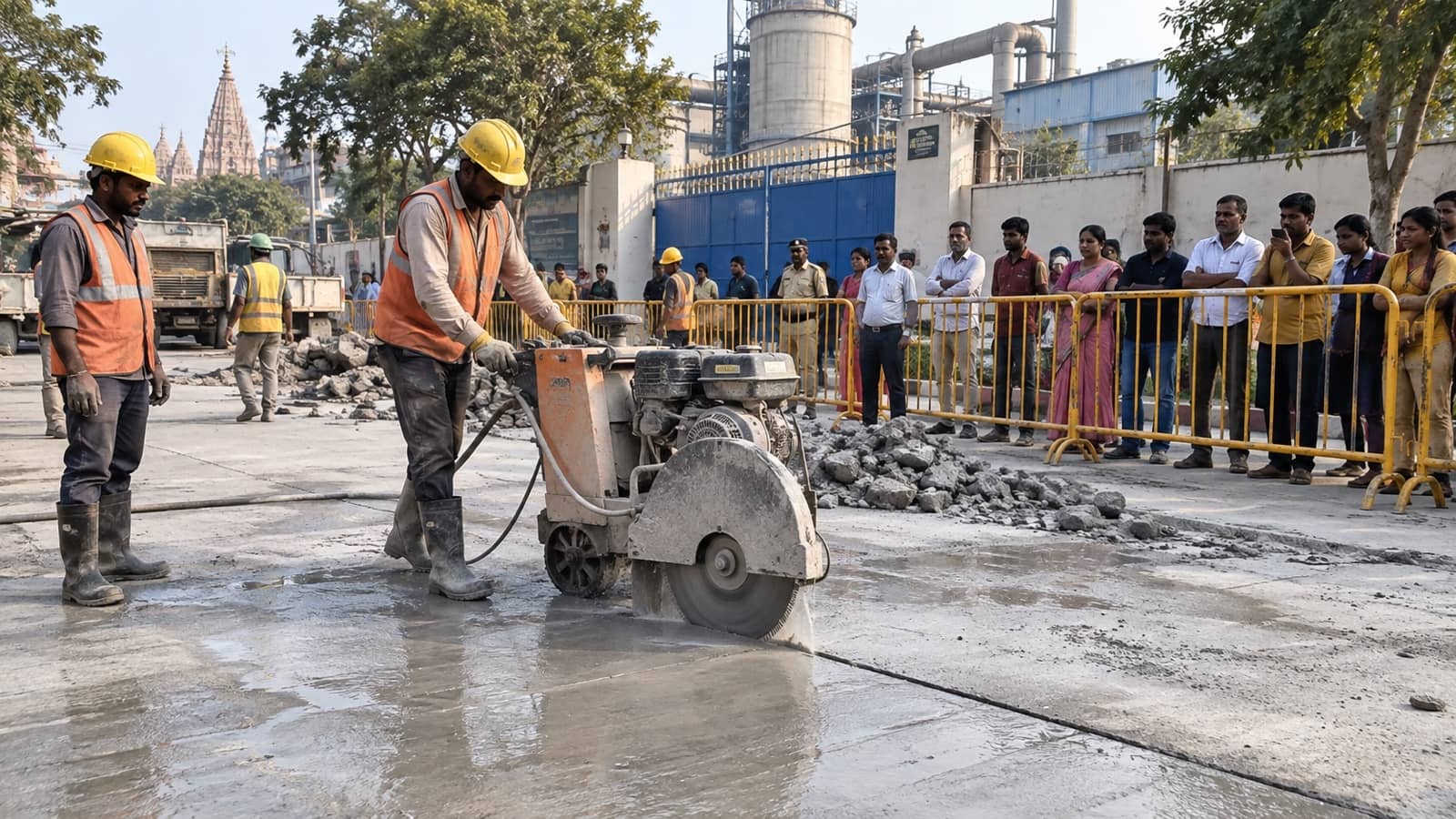
VARANASI: Residents near Banaras Locomotive Works' Pahari Gate protested after workers began breaking an RCC road that had been laid only three days earlier, raising a basic coordination question: why was permanent concrete placed before the utility work beneath it was settled?
Local people said the road appeared sound and should not have been cut. Workers at the site reportedly told them the wrong location had been broken and that construction was intended elsewhere. Residents telephoned junior engineer Poonam Singh, and a recording of the conversation later circulated on social media.
The source publication said it could not independently verify the video. In the recorded exchange as described, the engineer said RCC would be laid after the sewer pipeline was completed. That sequence would be normal; the dispute is whether the recent road was constructed prematurely or whether the new cutting was itself an error.
People present included Aman Yadav, Pushpakala Jha, Sadhna Jaiswal, Saurabh Kumar, Rakesh, Arun and Yogendra. Their objection is not only about temporary inconvenience. Concrete roads represent public money and embodied material. Breaking a new slab adds demolition, disposal and reconstruction costs while leaving residents with dust and restricted access.
The responsible agencies should publish the work order, approved drawing and measurement book entries for both operations. Those records can show where the RCC road was authorised, where the sewer line is meant to run and which contractor acted at the wrong location. If an error occurred, officials should state whether the cost will be recovered rather than absorbed by the public.
Engineering coordination needs a permit-to-cut system. Before concrete is poured, water, sewer, electricity, telecom and gas agencies should confirm planned work in that corridor. Once a road is completed, any cutting should carry a traceable permission number, restoration deadline and responsible officer. A small sign at the site can provide those facts to residents.
The exposed area must now be made safe. Open trenches require barricades and night reflectors, and homes or shops cut off by the work need temporary access. Restoration should match the thickness and curing standard of the original slab; a thin patch along the cut will crack under traffic.
Social-media video drew attention to the scene, but the decisive evidence lies in project documents and the physical alignment. Officials should inspect before either side's account hardens into accepted fact.
Residents were right to ask why a three-day-old road was being destroyed. The credible answer is not a verbal assurance. It is a documented explanation, responsibility fixed where the mistake occurred and one properly sequenced reconstruction after the sewer work is complete.