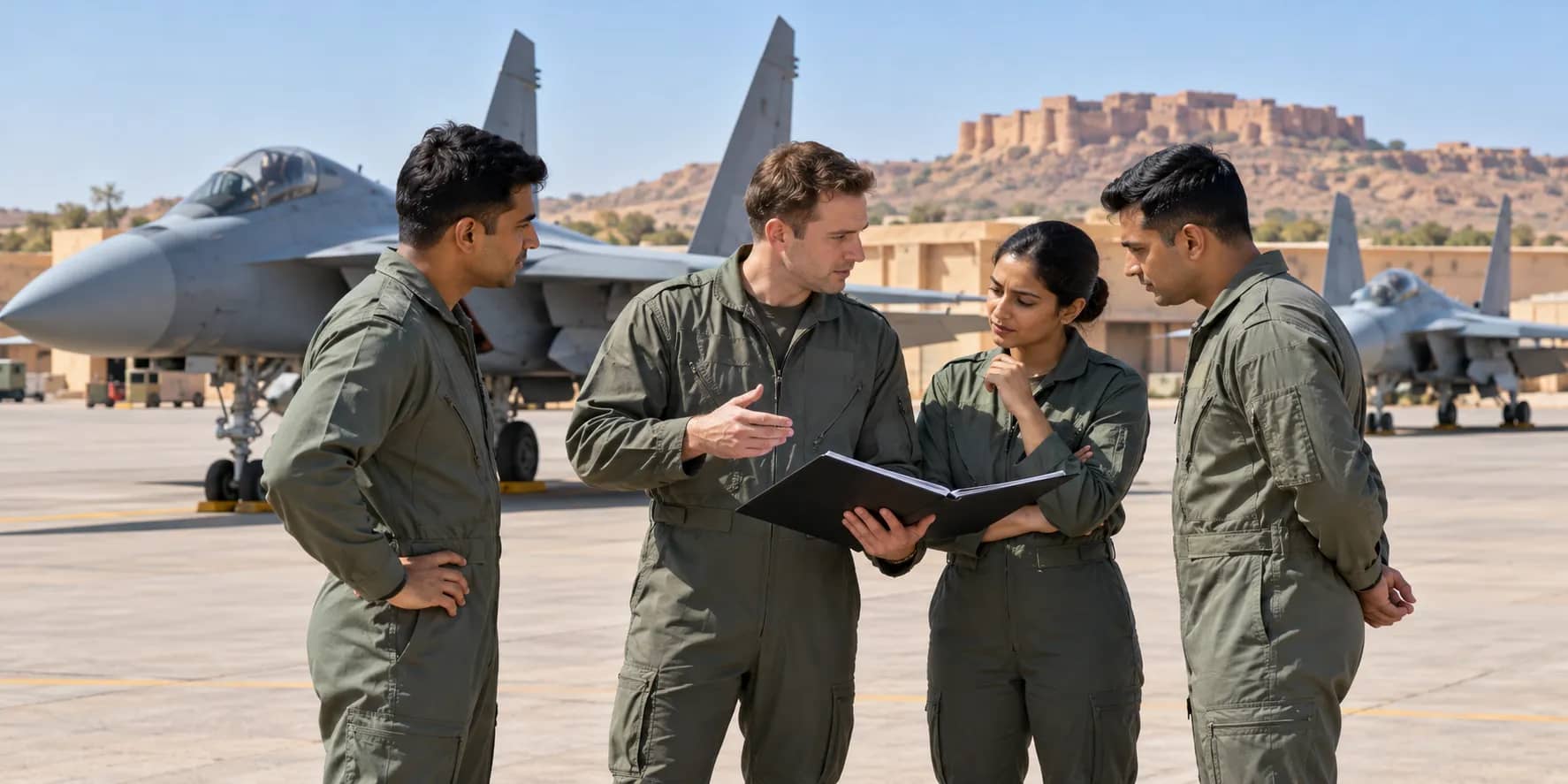
Defence Minister Rajnath Singh has called for closer technology partnerships with foreign air forces and asked the Indian Air Force to carry lessons from Exercise Tarang Shakti into its training and future capability plans. He made the remarks at Air Force Station Jodhpur on 10 October, as the multinational exercise entered its final days.
Singh said India wanted to work with like-minded countries on defence research and joint development, including co-production and maintenance. His address put domestic manufacturing and cooperation with overseas partners alongside each other, with the ability to sustain military operations during a prolonged conflict as a central concern.
The Defence Ministry's account of the address, released on Saturday afternoon, said air forces from seven foreign countries were taking part, alongside 32 observer nations. The exercise runs from 26 September to 12 October and is the second edition after the inaugural event in 2024.
Co-development and domestic capability
The minister argued that military strength increasingly depends on how quickly forces detect a situation, understand it and act. He pointed to the growing role of drones, artificial intelligence and electronic warfare, as well as long-range precision weapons. Operations now reach into space, cyberspace and the information domain, he said.
For India, Singh linked that assessment to the need to design and manufacture defence equipment at home and to maintain and upgrade it over its service life. He said domestic capability was necessary to endure long periods of conflict and uncertainty. The ministry's release presents these remarks as the minister's policy priorities; it does not announce a new procurement contract or a spending allocation.
He cited the Tejas fighter and Indian helicopter programmes, including Dhruv, Rudra, Prachand and the Light Utility Helicopter, while discussing the country's aerospace manufacturing base. The Akash air-defence system and radar and electronic programmes also featured in his address. Singh referred to the Advanced Medium Combat Aircraft programme in the context of developing fifth-generation stealth capability.
Advanced aero-engines and their development with partners were another area of emphasis. The stated approach is to improve India's ability to act independently while retaining the capacity to operate with other countries when interests align. Separate defence talks planned with Cyprus and Greece also place industrial cooperation and military engagement on India's diplomatic calendar this month.
What the participating air forces are practising
Australia, Bangladesh, France, Germany, Sri Lanka, the United Arab Emirates and the United States are the seven foreign participants identified by the ministry. Its 27 September operational briefing listed aircraft including the F-35 Lightning II, Rafale and F-16, as well as transport and aerial-refuelling aircraft. That earlier briefing establishes the exercise's background, rather than a new deployment announcement.
The programme brings aircrew and mission planners together to compare procedures and work through missions with different aircraft and support systems. The ministry describes this as improving interoperability, meaning the ability of forces to work together. Its account covers joint planning and professional exchanges; it does not publish a scorecard ranking participating aircraft or national contingents.
Indian-built Tejas fighters and Prachand helicopters are among the platforms involved. Beyond flying, the programme has included industrial visits and other professional engagements. These give visiting contingents a way to examine India's aerospace industry alongside the practical work of operating with the IAF.
The defence leadership present at the event included Chief of Defence Staff General N. S. Raja Subramani, Air Chief Marshal A. P. Singh and Chief of the Naval Staff Admiral Krishna Swaminathan, according to the ministry.
Lessons to carry beyond the exercise
Singh asked the IAF to use what it had learned in future training, tactics and doctrine. The value of the exercise, in the ministry's account, lies partly in the relationships formed between crews and commanders and in their ability to communicate and coordinate after returning to their own units.
The Jodhpur engagement follows this week's Air Force Day observances at Hindan. It is a separate event, focused on operational exchanges with overseas forces. Tarang Shakti is scheduled to finish on 12 October. The ministry has not announced a timetable for implementing the lessons or a list of follow-on projects arising from this address.