Opposition Alleges Selective Removal of Congress and SP Posters in Varanasi
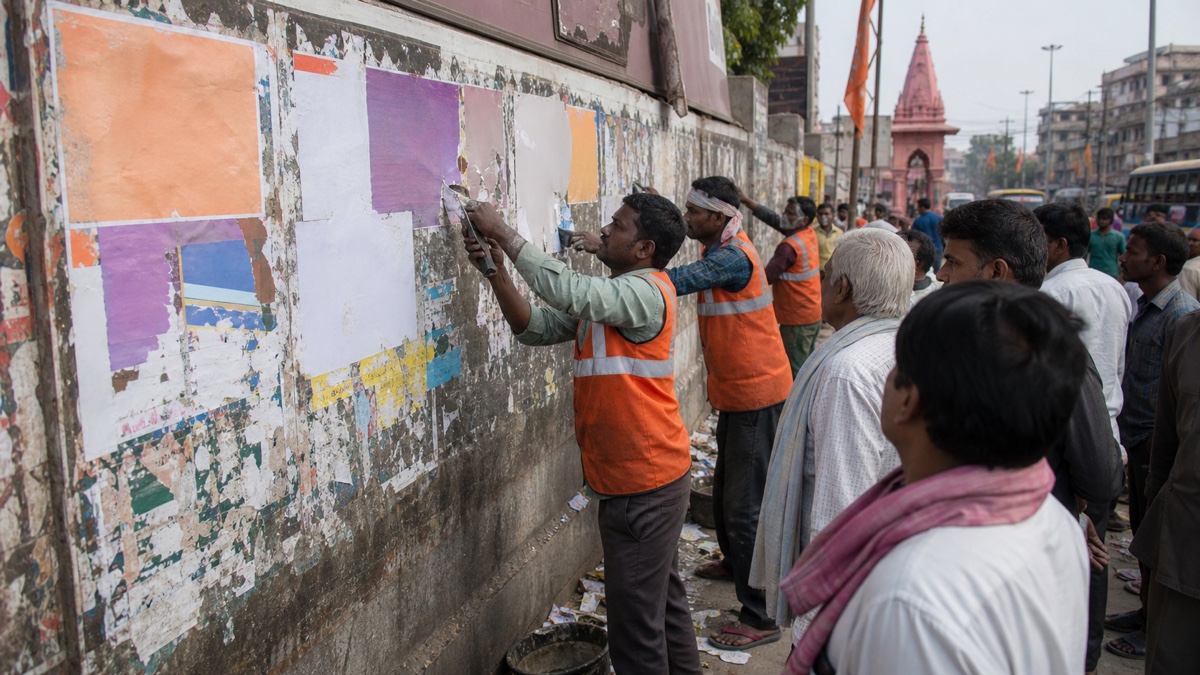
VARANASI: A civic drive against posters in public spaces has turned into a political argument after Congress and Samajwadi Party representatives alleged that material linked to opposition groups was being removed selectively across Varanasi.
Opposition leaders and supporters said municipal teams had identified and taken down posters associated with the two parties in several parts of the city. They questioned whether the operation was being applied through one neutral rule or whether party affiliation was influencing which displays were targeted.
The allegation has not yet been established through an independent comparison of enforcement data. At the time of publication, the Varanasi Municipal Corporation had not placed a detailed ward-wise list of removed posters, notices or penalties in the public domain in response to the criticism.
What the opposition is asking
The central demand is straightforward: if unauthorised posters on public property violate civic rules, action should cover every party, organisation and commercial advertiser on the same terms. Opposition representatives have asked why they are not seeing comparable removal of material belonging to all political formations.
That question can be answered with records. A transparent enforcement note should identify the legal provision used, locations inspected, number and type of displays removed, notices issued and recovery of removal costs. Publishing that information would help separate a routine cleanliness operation from claims of political discrimination.
Public walls are not a free-for-all
Varanasi regularly struggles with posters fixed to flyovers, electricity poles, heritage-facing walls and traffic infrastructure. Beyond visual clutter, badly placed banners can block signs and create hazards during high winds. Civic authorities therefore have a legitimate public-interest reason to remove unauthorised material.
But consistent enforcement matters as much as the rule itself. A city administration cannot credibly ask residents and parties to respect public space if action appears unpredictable or partisan. Clear advance notices, photographic records and equal penalties are the simplest safeguards.
The dispute also arrives during a period of heightened political activity ahead of the 2027 Uttar Pradesh Assembly election. In that environment, even an ordinary sanitation operation can acquire electoral meaning unless decisions are documented carefully.
For now, the opposition’s charge remains an allegation awaiting a substantive municipal response. The quickest way to lower the temperature would be for the corporation to release the scope of its campaign and demonstrate that every unauthorised poster—government, opposition, commercial or private—is being assessed under the same standard.
Political parties can also reduce the problem by seeking designated display spaces and removing their own material after an event. Voluntary compliance would save public money and make it harder for any administration to enforce selectively. The immediate burden, however, remains on the civic body: show its records and make equal treatment visible street by street.
Sources and reporting
Based on a verified Dalimss News Banaras report published within the past 24 hours. Selective targeting is an opposition allegation; the municipal corporation’s detailed response was awaited at publication.
Related Stories
Kashi Marks Baba Lat Bhairav’s Wedding Day After Tilak and Haldi Rituals

Over 800 Doctors Converge as API UP Chapter Conference Opens in Rohania
Chitaipur Arrests Two After Homeguard Anuradha Tiwari’s Alleged Suicide
Lanka Registers Assault Case After Narottampur Youth Dies During Treatment
Storm Uproots Electric Pole in Cholapur’s Jagdishpur; Local Supply Cut