
Mustabad–Amba Feeder Faults Leave Varanasi Farmers Struggling to Irrigate Crops
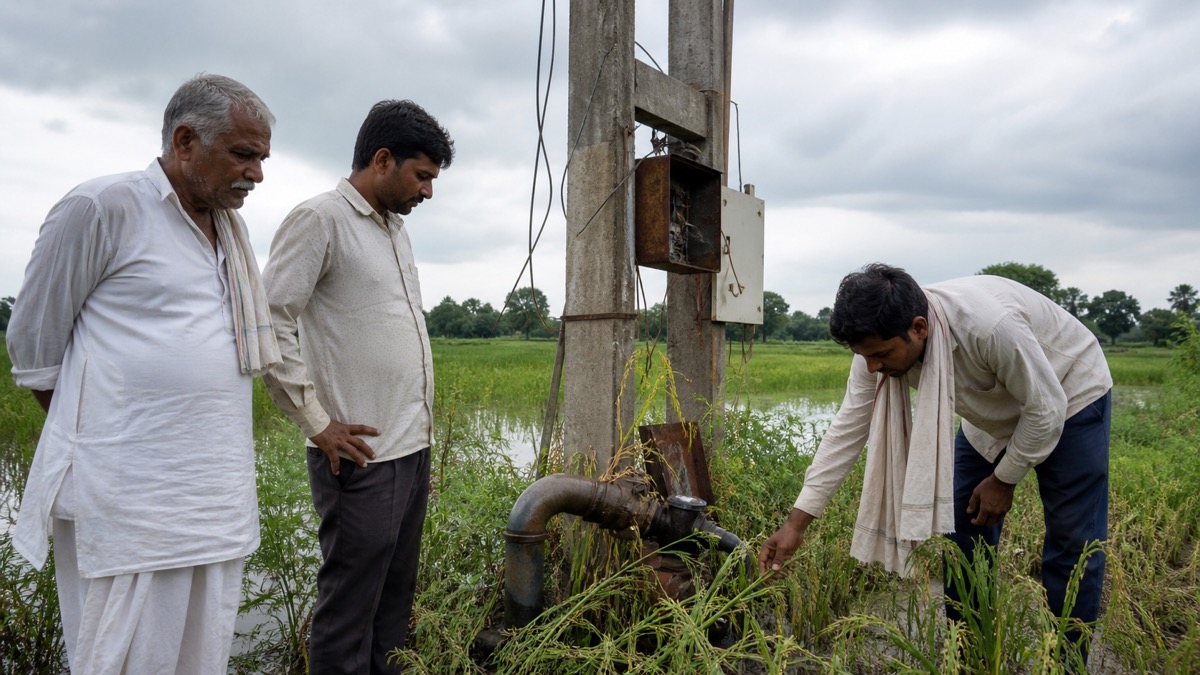
Varanasi: Farmers supplied by the Mustabad–Amba electricity feeder are facing repeated interruptions that have made it difficult to run irrigation pumps during a crucial period for standing crops. Residents say faults and uncertain restoration times are forcing them to wait for power, often reorganising field work around a supply window that may disappear without warning.
In a city-centred conversation about electricity, an outage is usually measured in dark rooms or stalled shops. In farming villages, the same interruption can mean a missed irrigation cycle. Pumps need continuous supply long enough to move water across a field. If power returns only briefly or at very low voltage, farmers may spend money starting equipment without delivering enough water to the crop.
The current monsoon does not remove that pressure. Rainfall can be uneven between villages and across weeks, while paddy and other seasonal crops require water at specific stages. Fields that look wet after one shower can dry quickly under humid heat. Where canals or private diesel pumps are limited, the electricity feeder becomes the practical backbone of cultivation.
Repeated faults may have several causes: overloaded lines, damaged insulators, vegetation touching conductors, local transformer problems or water entering equipment. A lasting response requires more than resetting the same fault. The distribution utility should identify the weak point, publish a realistic repair window and inspect whether the feeder’s capacity still matches the number of agricultural connections it carries.
Farmers also need communication. A scheduled shutdown can be planned around; an unexplained outage cannot. A feeder-level message service, a complaint number that produces a ticket and an escalation contact for prolonged failures would reduce uncertainty. Restoration data should include voltage quality, because a line technically marked “on” may still be unusable for a motor.
The reported crop stress has not yet been quantified, and any compensation question would require official assessment. The immediate priority is preventing avoidable damage. Rural supply is sometimes treated as flexible because household demand peaks elsewhere, but agricultural power is tied to biological deadlines. The Mustabad–Amba complaints are therefore not merely about convenience. They are about whether public infrastructure allows farmers to protect the crop on which their income—and part of Varanasi’s food supply—depends.
Agricultural associations can help document the disruption by recording outage times, affected pumps and crop stages across villages. Consistent logs are more persuasive than scattered phone calls and can reveal whether the same technical fault is recurring. They also give the utility a basis for prioritising repairs before individual losses become a wider production problem.
Sources and reporting
Based on rural Varanasi reporting published on 14 August 2026 about repeated faults and supply disruption on the Mustabad–Amba feeder. Crop impact is described as farmers’ reported concern, not a quantified loss assessment.
Related Stories

Ramnagar Day Three Follows Vishwamitra Into the Forest and Mithila

Shivpur Ramlila Stages Narad Moh and Kshirsagar Tableau Through Rain
VMC Puts City on Alert for Navratri and Durga Puja Civic Arrangements
Chowk Becomes Varanasi's First Police Station With ISO 9001 Certificate

World Tourism Day: Guides Welcome Visitors; Namami Gange Cleans Namo Ghat