Mechanised Road Sweeper Seen Operating in Varanasi as Dust-Control Questions Move to Centre Stage
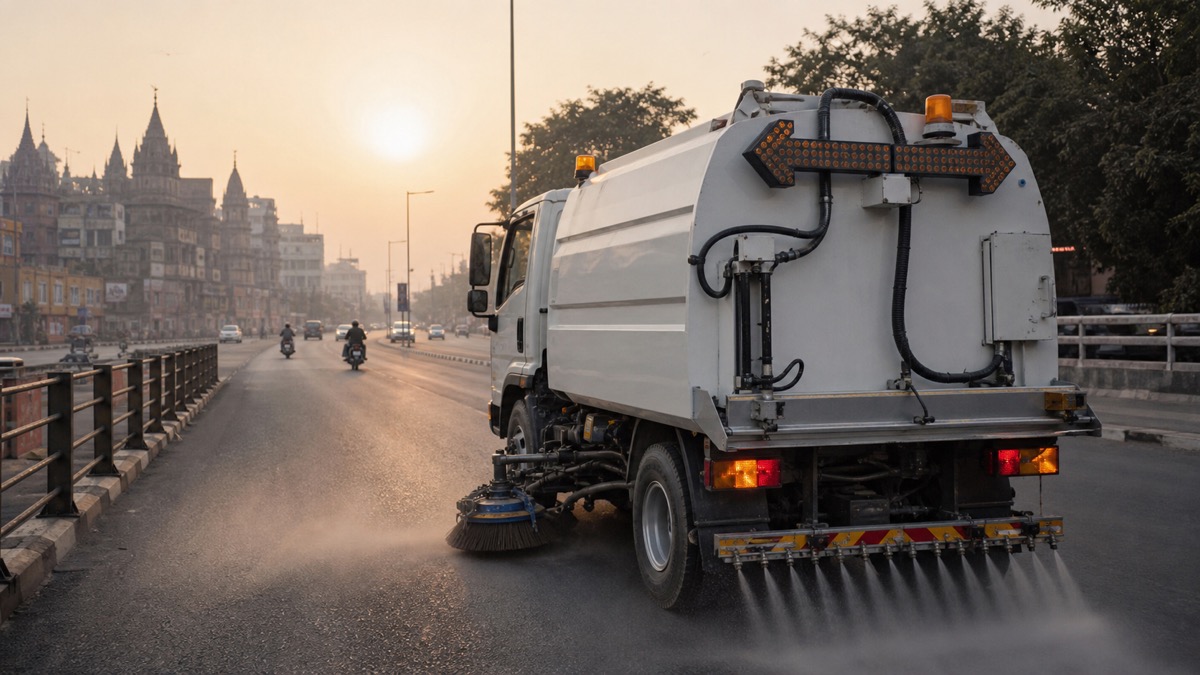
A mechanised road-sweeping vehicle has been filmed operating on a Varanasi road, using rotating brushes and a water spray to collect surface dust. The verified footage is a small but useful window into how the city is trying to clean wider carriageways without relying only on manual sweeping. It does not, however, identify the route, machine model, contractor or daily coverage. Those details matter because the value of mechanisation lies less in a single appearance than in consistent deployment.
Road dust is one of the least dramatic parts of urban air pollution and one of the most visible. Dry silt collects near dividers and kerbs, is crushed by tyres and returns to the air each time traffic passes. Manual dry sweeping can move that material without fully containing it. A well-operated mechanical sweeper combines suction or collection brushes with controlled moisture, reducing the plume and removing grit from the road instead of pushing it from one edge to another.
The machine in the footage appears to spray water as it works, a method intended to keep fine particles down. That is only effective if the nozzles, brushes and collection chamber are maintained and if the vehicle moves at an appropriate speed. Too little water leaves dust airborne; too much creates slurry that can clog drains. Operators also need routes free of long rows of parked vehicles, because the dirtiest strip is often the kerb line that machinery cannot reach.
For Varanasi Municipal Corporation, the next step should be basic transparency. A public route roster, the number of functional machines, kilometres covered per shift and downtime for repairs would let residents judge whether mechanised cleaning is a system or an occasional demonstration. High-dust corridors, construction zones and approaches used by large crowds should be prioritised. Ward teams still remain essential for lanes and corners that a truck-sized sweeper cannot enter.
There is also a worker-safety argument. Mechanisation can reduce the amount of time sanitation workers spend standing in moving traffic and inhaling dust. It should not be used to erase jobs or shift workers into riskier informal tasks. The sensible model combines trained machine crews, protected manual teams and clear responsibility for disposal of the collected material. Dust lifted from a road has not been managed if it is dumped loosely beside another road.
The video shows a promising tool, not proof of citywide performance. Residents should expect to see the same standard repeated, especially after rain dries and leaves silt on major roads. If the corporation publishes where and when the machines operate, Varanasi can turn a short clip into something more meaningful: a service that is visible, measurable and easier to hold accountable.
Sources and reporting
Dalimss News Banaras verified video published on 10 August 2026; the exact route, machine model and deployment schedule were not stated and are not inferred.
Related Stories
Festive Special to Gorakhpur Gets Gurugram Halt
Fifth Accused Held in Rs 25 Lakh Sector 47 Robbery

Courier Staffer Booked Over 105 Missing One8 Returns

HC Sets Rs 50 Lakh Costs for Accused's Return to India

Gurugram Swimmer, 20, Crosses English Channel