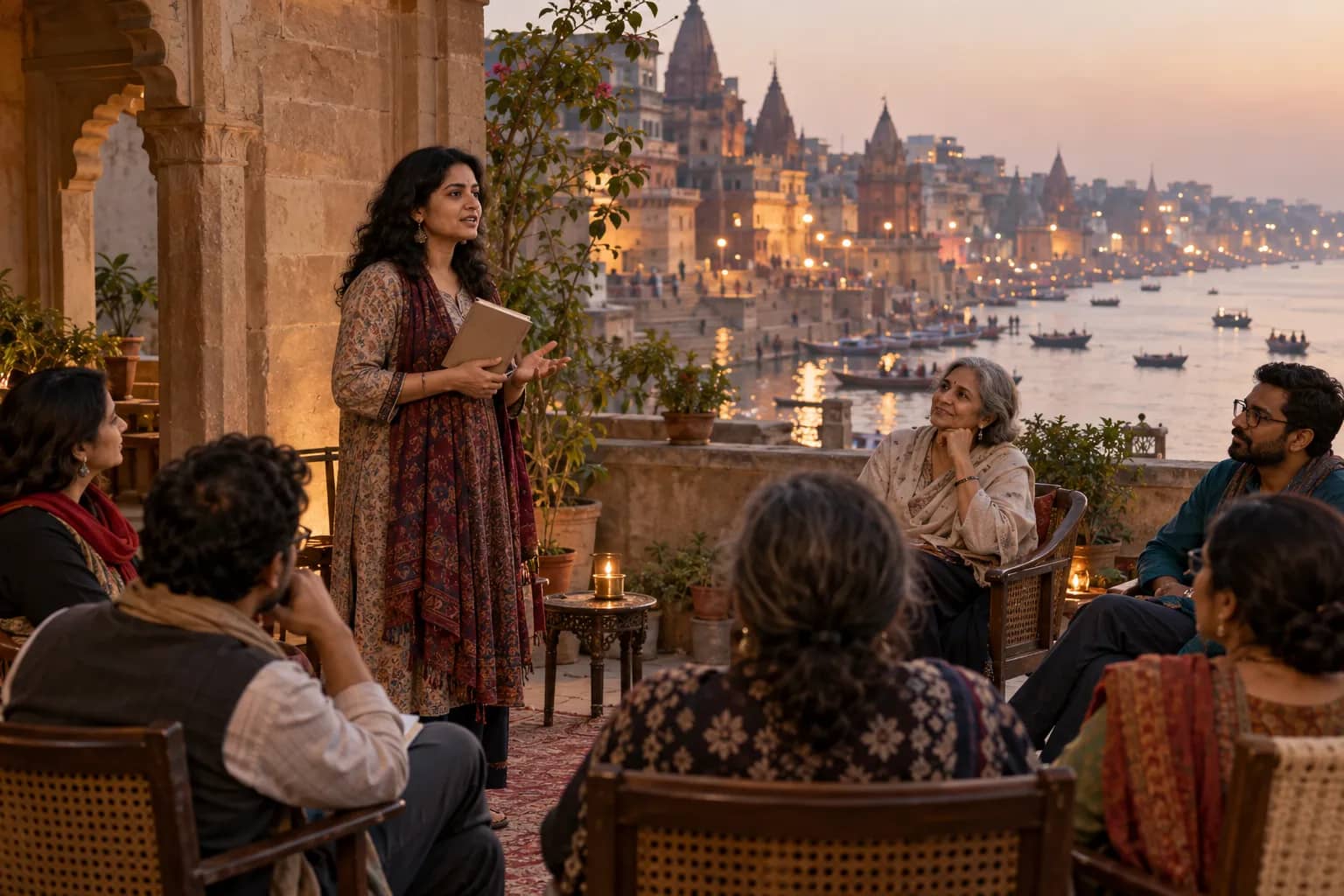
VARANASI: Polish writer and reporter Małgorzata Margo Rejmer will participate in the Long Night of Literatures at the Alice Boner Institute on 26 and 27 October. The Polish Institute in New Delhi announced her participation on 19 October.
The two-day Varanasi stop was already listed in a Swiss Embassy announcement published on 23 September. That earlier programme also names Swiss-Italian poet and performer Marko Miladinović. The latest Polish announcement adds details about Rejmer and her writing; it does not mark the first announcement of the festival itself.
Rejmer moves between reportage and fiction, with books centred on memory, political upheaval and individual lives in Eastern Europe and the Balkans. The Polish Institute describes her festival appearance as a conversational encounter with readers, although it has not published an hour-by-hour schedule for her Varanasi sessions.
From fiction to reported histories
For readers encountering her work for the first time, the Book Institute’s author profile offers a useful chronology. Rejmer published her debut novel, Toksymia, in 2009. Bucharest: Dust and Blood followed in 2013, marking her move into literary nonfiction, before the Polish publication of Mud Sweeter than Honey in 2018.
Her work later returned to fiction with the short-story collection Ciężar skóry, listed in the institute’s bibliography as a 2023 publication. Across those books, her work spans invented characters and reported testimony, rather than belonging to a single literary form.
The same profile records translations of Bucharest: Dust and Blood into several languages, including Romanian, Czech, Italian and Spanish. It also lists an English edition of Mud Sweeter than Honey. These bibliographic details offer a starting point for readers looking beyond the author’s name on the festival programme.
An English-language starting point
Publisher Restless Books describes Mud Sweeter than Honey as an oral history built from interviews Rejmer gathered during years in Albania. The book follows people who lived under Enver Hoxha’s dictatorship, bringing together testimony from different occupations and circumstances rather than relying on one narrator to tell the country’s story.
The publisher’s account includes teachers, writers, factory workers and people who were imprisoned or exiled. Alongside political repression, the book follows daily life: family relationships, reading, work and attempts to survive. The programme does not say which passages she will read.
The Restless edition credits Zosia Krasodomska-Jones and Antonia Lloyd-Jones as its translators from Polish and lists publication on 16 November 2021. It is an existing English-language edition readers can identify by title and translators, not a new book being launched at this month’s festival.
Dates confirmed, local visitor details still awaited
Miladinović brings a different form of writing to the same festival. The Swiss announcement describes his poetry as experimental and performance-led, and presents the gathering as readings and conversations. It identifies EU National Institutes for Culture India and participating European embassies as organisers, with Swiss support in partnership with Pro Helvetia New Delhi.
The Italian Cultural Institute’s separate calendar lists Varanasi on 26 October within the wider Delhi, Varanasi and Kolkata tour. Its page also names Antonio Franchini as a festival participant, but does not supply his Varanasi session details. The Swiss and Polish announcements are the sources for the two-day local dates, 26 and 27 October.
The Swiss programme says advance registration is compulsory. However, the pages inspected do not provide a working Varanasi-specific registration route, session starting times or local admission charges. Readers should obtain those details from the organisers before making travel plans; the published dates alone do not establish entry arrangements for an individual session.
There is a specific booking distinction to watch. The registration link on the Italian institute’s page opens a form for the Delhi event at Sunder Nursery on 23 October. That form was closed to responses when checked. Its closure does not establish whether Varanasi registrations are open, closed or full.
For more on the city’s cultural venues and plans, read Dalimss News’ earlier coverage of the Nagari Pracharini Sabha heritage galleries and the proposed Kashi Biennale. Both are separate from the Alice Boner Institute programme.