Before 1857, Kashi’s Five-Day Uprising in 1852 Challenged Colonial Rule
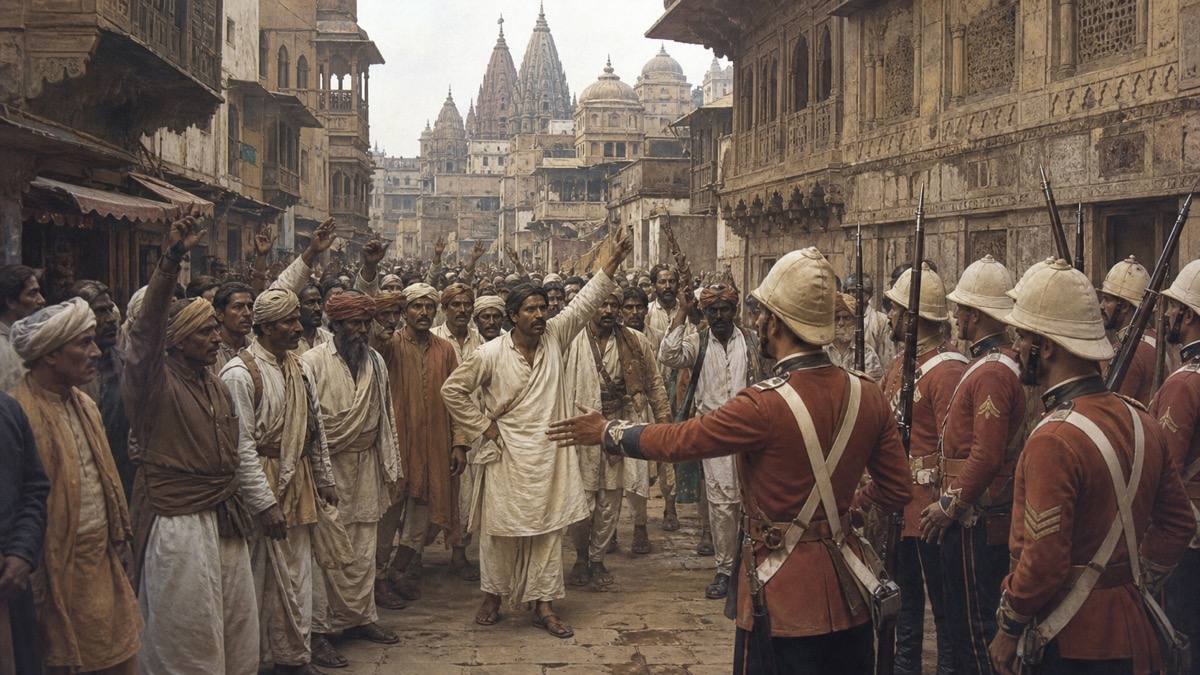
Five years before the revolt of 1857 became the defining shorthand for resistance to East India Company rule, Kashi had already witnessed a sustained public confrontation with colonial authority. Historical accounts recalled on Independence Day describe residents taking to the streets in 1852 and keeping the city unsettled for five days—an episode that complicates the neat timeline often taught in textbooks.
The disturbance emerged in a city where religious authority, commercial networks, artisans, scholars and pilgrims were tightly connected. Colonial interventions did not land as abstract policy. A tax, administrative order or perceived insult could travel quickly through bazaars, neighbourhood shrines and occupational communities. When anger crossed those networks, Kashi’s dense lanes made it difficult for officials to treat protest as an isolated gathering.
Accounts of the 1852 episode vary in detail, and the event has not received the volume of scholarship devoted to 1857. That is precisely why careful local history matters. A dramatic anniversary retelling can turn every participant into a named revolutionary or impose later nationalist language on an earlier moment. The stronger approach is to read contemporary records alongside family histories and Hindi accounts, noting where evidence agrees and where interpretation begins.
What the five-day duration does indicate is that discontent in Kashi did not suddenly appear when sepoys rebelled in Meerut in May 1857. The city already had experience of collective mobilisation and confrontation. By the time the larger uprising spread across north India, administrators understood that Banaras was politically sensitive, strategically located and capable of influencing the eastern districts.
Remembering 1852 also broadens the social frame of resistance. Anti-colonial action included more than battlefield engagements. Crowds contested authority in streets; merchants could withhold cooperation; religious and civic leaders shaped opinion; messages moved along river and road. These actions did not always share a single ideology, but they eroded the image of uncontested colonial control.
For Varanasi, the episode deserves a place in museums, school walks and public archives. Dates and original documents should be displayed with translations, allowing residents to evaluate the evidence themselves. Linking 1852 with later movements would show continuity without pretending that every protest was identical.
Independence Day history is most useful when it unsettles a familiar script. Kashi’s 1852 uprising reminds the city that resistance had local rhythms and earlier rehearsals. The task now is not to inflate the episode for pride, but to document it well enough that a five-day challenge to colonial rule is no longer a footnote in the place where it happened.
Sources and reporting
A historical explainer based on archival accounts and local historical reporting republished for Independence Day. Interpretations are identified as such.
Related Stories
Sarnath Police Bring Two From Punjab in Fake GST Firm Case
Lohta Hit-and-Run: Hardoi Truck Driver Ankit Pal Arrested
Magic Van Hit-and-Run Kills Security Guard Near Mohansarai
DGP Flags 15-20 Overseas Gangsters, Opens New PS
Puja Specials via Varanasi: Amritsar, Ahmedabad and Kolkata Paths Listed