
Kapsethi Police Take Women’s Safety and Cyber Awareness to Local Beat Areas
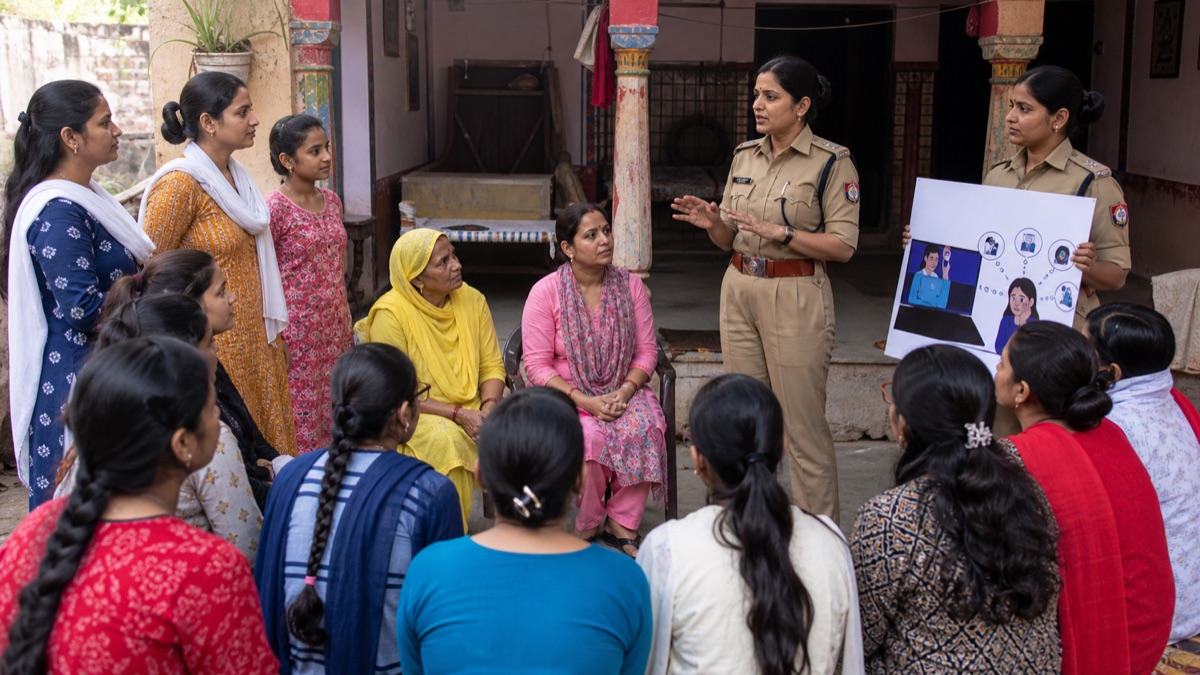
Women and girls in Kapsethi’s beat areas received a local safety and cyber-awareness briefing from the police station’s Mission Shakti Phase 5.0 team on Sunday. Officers discussed women’s helplines, ways to seek assistance, common online fraud tactics and government welfare schemes. The value of taking the session into neighbourhoods is that questions can surface where residents actually encounter the problem.
Cyber safety deserves equal billing with physical safety. Fraudsters increasingly use urgent payment requests, fake customer-care identities, malicious application files and threats built around stolen personal information. A short rule—do not install an unknown app or share an OTP—can prevent loss, but people also need to know what to do after a mistake: contact the bank quickly, preserve messages and report through the official cybercrime channel.
Helpline awareness works only if the number is remembered and the response inspires confidence. Officers should explain which service handles an emergency, which accepts a non-urgent complaint and what information a caller may be asked to provide. Women may hesitate when they fear being blamed, exposed or sent repeatedly between offices. Respectful first contact is therefore part of prevention, not a public-relations extra.
The next useful step would be repeat sessions with practical examples and local-language handouts, followed by a simple audit of whether residents can recall the channels later. Schools, self-help groups and bank correspondents can widen the reach. Outreach should also include men and boys, because safety cannot be framed as a burden women must manage alone.
A special deployment can reduce immediate risk, but the quality of public safety is visible in small details: a clear walking lane, a junction that does not choke, an officer who can explain a diversion and an emergency vehicle that can still pass. Varanasi’s pilgrimage routes combine religious movement with everyday commerce, so enforcement has to be firm without becoming confusing or needlessly punitive for residents and traders.
Numbers such as seizures, challans or patrols show the scale of action, not automatically its fairness or success. Authorities should publish the rules being enforced, provide a practical route map and maintain a process to correct mistaken penalties. Pilgrims also carry responsibility: staying inside marked corridors, following traffic instructions and avoiding risky stops protects both the procession and people who live along the route.
The coming hours will test whether the arrangement holds during peak movement and changing weather. Police should keep diversion information current and coordinate with medical, fire and municipal teams. Residents should rely on official traffic advisories and call emergency services for immediate danger rather than crowding an incident scene. The report will update only when new figures or verified route changes are issued.
Sources and reporting
Reported on 9 August 2026 from the official Kapsethi police Mission Shakti Phase 5.0 update.
Related Stories

VMC Launches Doorstep E-Waste Pickup With On-the-Spot Payment

Family Alleges Youths Chased Car, Assaulted Women and Children Near V-2 Mall in Lanka

Sigra-Trained Shooter Kamaljeet Wins Asian Games Gold in Mixed Air Pistol

Sarnath Police Arrest Three Over Locked-House Burglaries, Claim ₹7 Lakh Recovery

NER Varanasi Division Runs 2,915 Chlorine Tests on Station and Colony Water