India's Education System: A Conveyor Belt from Gurukul to Google
Editor’s note: This is an opinion article based on the author’s general research and analysis. It does not present original reporting or interviews.
The Conveyor Belt
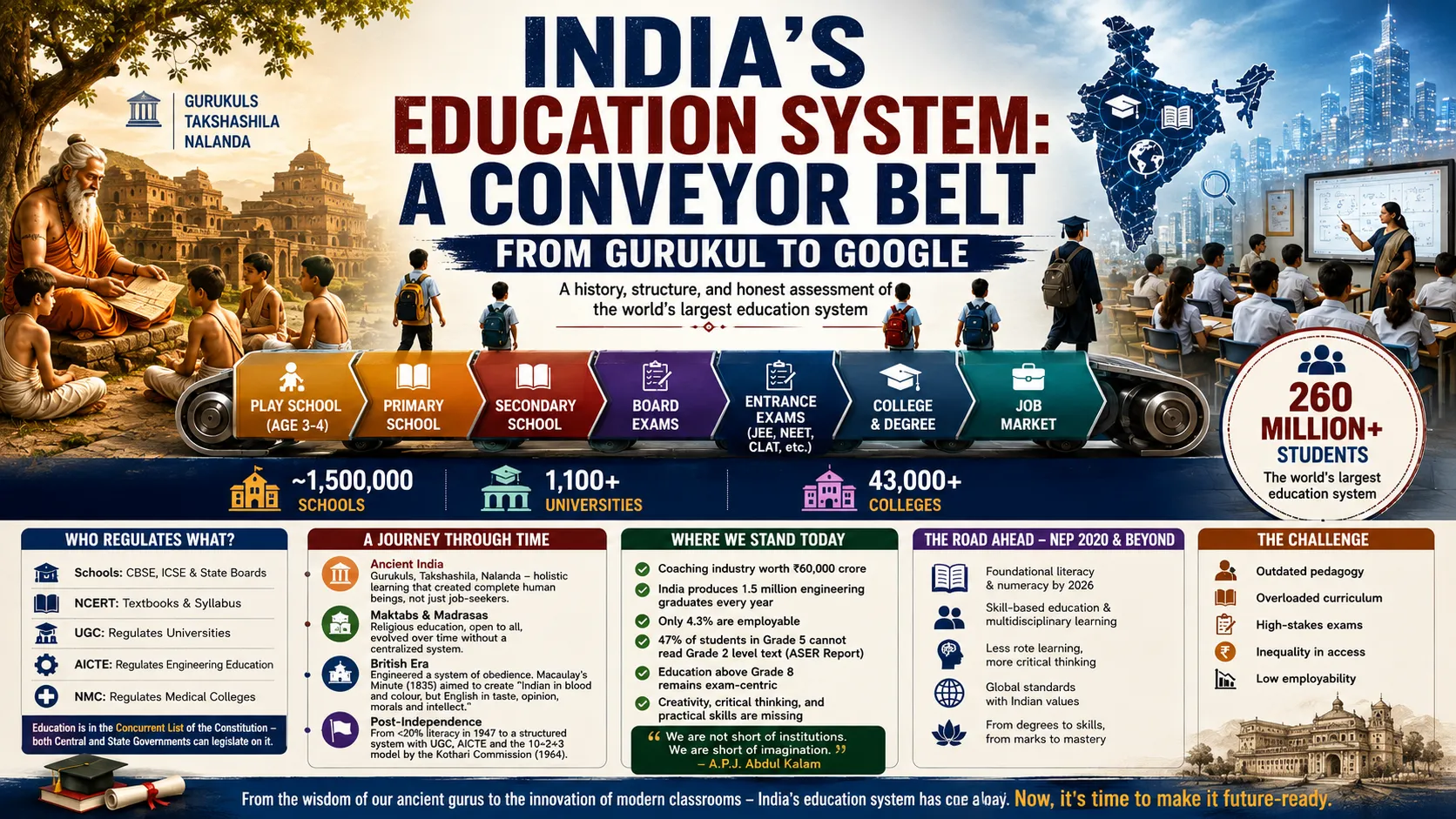
The Indian education system works like a conveyor belt. It begins at age three or four with play school, the child's first step into formal education. From there, the belt moves through primary school, secondary school, and board exams. Next come entrance exams such as JEE, NEET, and CLAT, followed by college and a degree, and finally, entry into the job market.
The Scale of the System
India has around 1,500,000 schools, more than 1,100 universities, and over 43,000 colleges. In terms of student numbers, it is the largest education system in the world, with 260 million students enrolled across schools and colleges.
Who Regulates What
At the school level, education is controlled by CBSE, ICSE, and the respective state boards of each state. NCERT prepares the textbooks and syllabus. For higher education, the UGC regulates universities, AICTE regulates engineering education, and the NMC (National Medical Commission) regulates medical colleges.
One interesting feature of this structure is that education falls under the Concurrent List of the Constitution, meaning both the central and state governments can legislate on it. This is why every state has its own board and a separate syllabus.
Ancient Roots: Gurukuls, Takshashila, and Nalanda
This structure was not built in a single day; it took thousands of years to form. In ancient Greece, Plato founded the Academy, from which we get the word "academia." But while Europe was still developing its education system, India was already far ahead.
India had the ancient tradition of the gurukul system, where children lived in ashrams, far from home. Education there was not limited to memorization. Students learned the Vedas and scriptures alongside mathematics, science, Ayurveda, archery, music, astronomy, and animal care. The system was designed to create a complete human being, not merely someone fit for a job.
The world's oldest university-type institutions also emerged in India. Takshashila, located in present-day Pakistan, is where scholars like Chanakya are said to have studied. Nalanda, in Bihar, at its peak hosted thousands of students and hundreds of teachers, drawing scholars from as far as China and Korea. Nalanda was destroyed by Khilji in the twelfth century; it is said that its library burned for a month.
After this, the era of maktabs and madrasas began, with education focused primarily on religious teaching. It evolved over time but remained open to all, though there was still no centralized system. This arrangement persisted for a long time.
The British Era and the Birth of the Modern Classroom
India's modern school system was not born in India; it was born in Europe. In 1806, Napoleon's army defeated Prussia. Following this defeat, Prussia created the world's first compulsory education system, a state-controlled model with a fixed syllabus and standard dress, rigid and uniform, designed to produce obedience rather than creativity.
When the Industrial Revolution arrived, factories needed workers who could move quietly, arrive on time, follow orders, and not ask questions, and this model of schooling spread across the world. Some present this as a conspiracy, asking whether schools were designed to make people fail. The more accurate reading is that the original goal of that era was obedience, not creativity, and that standardized classroom became the global standard. This same standardized approach reached India through the British.
In 1835, British official Thomas Babington Macaulay wrote a document strongly recommending English-medium education for India. In his own words, the objective was to create a class of people "Indian in blood and colour, but English in taste, opinion, morals, and intellect." That same year, Governor-General William Bentinck passed the Education Act of 1835, mandating English-medium education to prepare a workforce that could pass exams and serve as English-knowing clerks.
In 1854, Wood's Despatch was introduced, and under this framework, India's first three modern universities were established in Calcutta, Bombay, and Madras between 1856 and 1857. This system achieved two things for the British: a degree meant a government job, and a government job meant social respect. That mindset remains so deeply rooted that even today, when a child is born, family members often say, "They will grow up to become an officer."
Independence and the Rebuilding Effort
When the British left in 1947, the literacy rate stood at under 20 percent; the 1951 census recorded it at 18.33 percent, meaning more than 80 out of every 100 people could not write their own names. Higher education was similarly limited, with only 20 universities and around 500 colleges nationwide, serving approximately 250,000 students.
To address this, the new government began reforms. In 1948, the Radhakrishnan Commission was established for university education. The UGC (University Grants Commission) was set up in 1953, and the Secondary Education Commission followed in 1956. The biggest turning point came in 1964 with the Kothari Commission, which introduced the 10+2+3 structure: ten years of schooling, two years of higher secondary education, and three years of undergraduate study. The Kothari Commission laid the foundation for India's modern classroom system and strongly recommended spending 6 percent of GDP on education. Even 60 years later, India still has not reached that target; actual spending remains around 4 percent.
In 1968, the first National Policy on Education was introduced, under which Navodaya Vidyalayas were opened and Operation Blackboard was launched. The policy was revised in 1992. The Sarva Shiksha Abhiyan followed in 2001, and in 2009, the Right to Education (RTE) Act was passed, making free and compulsory education a legal right for children aged 6 to 14.
As a result, the gross enrollment ratio at the primary level has reached nearly 100 percent, and the literacy rate has risen from 18 percent to around 74 percent, a genuinely significant achievement. In higher education, the number of colleges grew from about 500 to over 43,000, and enrollment rose from 250,000 to over 4.33 crore (43 million) students. India's higher education system is now the third largest in the world, after China and the United States.
The IIT and IIM Wave
After independence, Nehru envisioned building institutions that could power the country's industries. The first IIT opened in Kharagpur in 1951, inside a former Hijli detention camp where the British had once imprisoned freedom fighters, a place of punishment that became a place shaping the country's future. IITs were subsequently established in Bombay, Madras, Kanpur, and Delhi. The first two IIMs opened in Calcutta and Ahmedabad in 1961. Nehru called these institutions the "Temples of Modern India," and today, graduates of these colleges run companies like Google and Microsoft.
Privatization and the Rise of Private Universities
The second wave came in 1980, when the government realized it could not manage the entire higher-education sector alone and opened the door to private players. Engineering and medical colleges then flooded the southern states, particularly Karnataka, Maharashtra, and Tamil Nadu.
The third wave arrived after 2000, ushering in the era of private universities, with new campuses opening in almost every city. Between 2017 and 2020 alone, the number of universities grew to 1,113. But today's reality is one of quantity without quality: colleges are opening everywhere, yet most fail to provide adequate facilities or placement opportunities. According to a FICCI report, only 45 percent of graduates are employable, while 55 percent lack the required skills. Institutions have expanded in size, but quality has not kept pace, arguably the biggest irony of the system.
The Learning Crisis
Children reaching school and college raises a deeper question: what is the actual value of what they are learning? The Annual Status of Education Report (ASER) is published every year after a village-to-village assessment of children, evaluating two core parameters: basic reading skills and foundational arithmetic. The results are troubling: only one in four children can properly read a book in their own native language, and many struggle with simple addition or division.
Children are physically present in class, and their attendance is marked, but genuine learning is not happening. This is known as the learning crisis.
A System Divided by Wealth
This feeds directly into another major issue: the divide between education for the rich and the poor. On one side are private schools with air-conditioned classrooms and smart boards; on the other are government schools where even the roofs are broken. Strangely, government school teachers receive good salaries, yet mostly underprivileged children study there, while private schools are filled with children from affluent families but pay their teachers very low salaries. Money and quality end up misaligned.
In countries like Singapore, rich and poor students study together in the same schools. In India, by contrast, the quality of a student's education is often determined by whether their family is rich or poor.
The Coaching Industry and Kota
When schools cannot be trusted to prepare students, parents turn to coaching centers, giving rise to a parallel education system and a massive coaching industry. Kota is the clearest example: a city whose entire economy runs on entrance exam preparation. At its peak, around 150,000 children lived there, away from home, studying up to 16 hours a day on a punishing schedule.
The scale of competition is staggering. In 2026, 2.4 million students registered for NEET, but there are only about 130,000 MBBS seats nationwide, of which roughly 64,000 are in government colleges, meaning approximately 35 students compete for a single affordable government seat. In JEE Main, more than 1.5 million (15 lakh) students registered, while only about 18,000 IIT seats exist. The students who don't make it are often labeled failures by the system, but the reality is simply that there are not enough seats for everyone.
The pressure of this system shows itself in the most tragic way: every year, news of student suicides emerges from Kota, involving children aged 16 to 25 who left home hoping to become doctors or engineers. Adding to this is the trauma of paper leaks: national exams like NEET have repeatedly been dragged into controversy, sometimes requiring re-exams. For a student who has spent two years preparing, a leaked paper or a scrapped result can be devastating, shattering trust in the system entirely.
The Job Market Reality
Suppose a student clears every stage: the entrance exam, college, and a degree. Getting a job is where the harsh realities of India's current job market set in. The unemployment rate among graduates under the age of 25 is as high as 40 percent. After 16 years of study, many graduates still find themselves without adequate opportunities, and most then compete for the relative security of a government job.
From 2014 to 2022, the government received 22 crore applications for government jobs, of which only 7.2 lakh people were selected, meaning roughly 1 in 300 applicants got a job. It's worth asking what happens to the rest.
It is easy to blame schools and colleges alone, but the responsibility is shared across the whole system:
● Media and cultural narrative: films and family conversations reinforce a narrow set of "acceptable" careers, doctor, engineer, government officer, while other paths such as analytics or software design are rarely presented as equally valid.
● Parenting style: research suggests that overly strict parenting can weaken a child's self-confidence and independent decision-making.
● Psychological patterns: people often gravitate toward choices whose outcomes they can already predict, reinforcing familiar but limited paths.
NEP 2020: A New Blueprint
In 2020, after 34 years, India introduced a new education policy, the National Education Policy (NEP) 2020. On paper, it addresses many of these underlying problems. It replaces the old 10+2 structure with a 5+3+3+4 model. Under this system, education for children as young as three focuses on early learning; arts, science, and commerce are studied together rather than in separate streams; and vocational skills like coding and carpentry are introduced from Class 6 onward.
Multiple entry and exit options are now available in higher education: one year of study earns a certificate, two years a diploma, and if a student leaves midway, their credits are not lost but stored in an Academic Bank of Credits. The policy also emphasizes early education in the mother tongue and repeats the long-standing promise to spend 6 percent of GDP on education. The policy's real test, however, lies in implementation, and it has still not been fully adopted by many states.
Conclusion: An Epic, Unfinished Journey
The journey that began at Takshashila and Nalanda reached a point where Macaulay's 1835 minute turned education into a machine for producing clerks. After independence came a period of struggle, followed by the 10+2+3 system and, eventually, the Right to Education Act. Kota turned into a coaching factory alongside a system now serving 260 million students in schools and colleges, and today NEP 2020 and YouTube classes are reshaping access to learning, making it easier for children even in remote areas to study and build a future.
India's education journey, full of ups and downs, is nothing short of an epic saga. Even though the system is sometimes portrayed as a complete villain, it remains a system worth engaging with and improving, not abandoning.
Sources and reporting
Opinion article drawing on the author’s general research and commentary on India’s education system and NEP 2020. No original interview or named primary source is documented in the article record.
Related Stories
Four Held for Stone Attack on Manesar Drive
GMDA Plans Rs 20 Cr Dwarka Sector Road Works
Metro Phase-2 Tender Delay Puts 2029 at Risk
SC Flags IAF Depot Buffer Encroachments

DTCP Seals 17 Sites in Sushant Lok Drive