How Varanasi’s Students Carried the Quit India Call After the 1942 Arrests
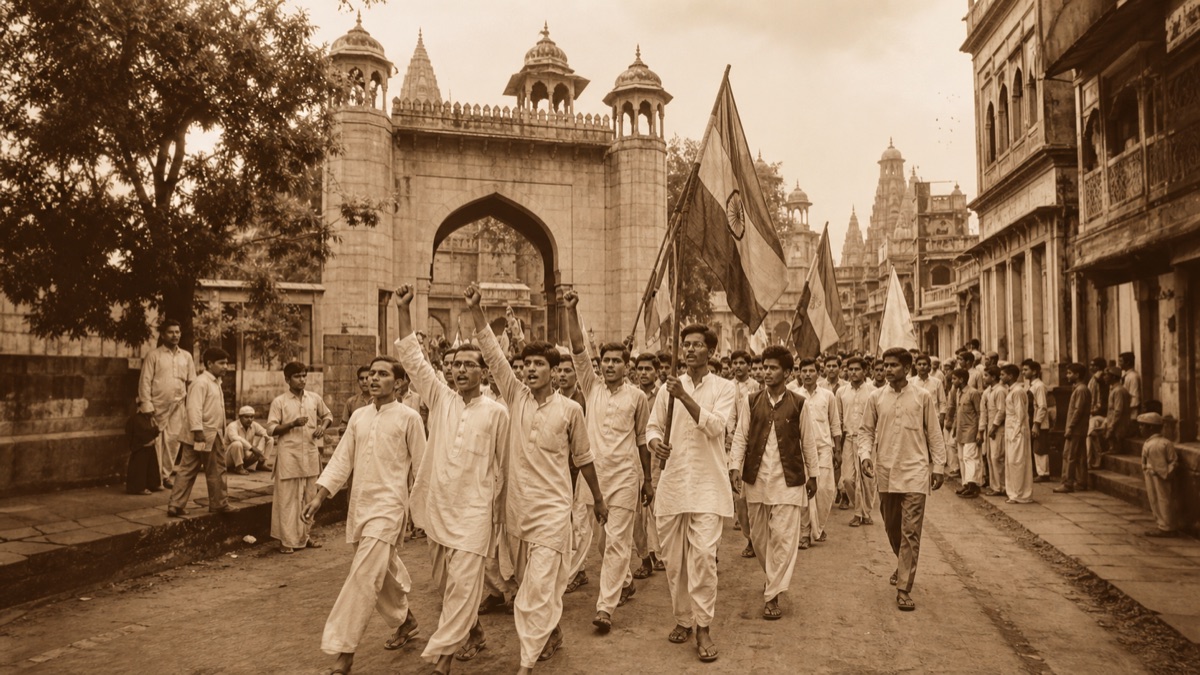
Varanasi’s place in the Quit India Movement was not confined to a commemorative footnote. After the British administration arrested Mahatma Gandhi and other senior Congress leaders in the early hours of August 9, 1942, the attempt to decapitate the movement left local students and organisers with a stark choice: wait for instructions that might never arrive, or carry the call forward themselves. In Kashi, many chose the second path.
Students associated with Banaras Hindu University and Kashi Vidyapith helped turn the national appeal into local action. Contemporary accounts and later institutional histories describe meetings, marches, circulated messages and confrontations with colonial authority across the city and the wider region. The movement was uneven and often improvised, but that decentralised character was precisely what made the mass arrests ineffective as a complete shutdown strategy.
The anniversary is also a reminder that the story was larger than famous names. Messengers, hostel residents, teachers, printers and neighbourhood volunteers all helped information move when public leadership was under detention and censorship was intense. Some participants faced imprisonment, academic disruption or police violence. Their work linked Varanasi’s educational institutions to a wider uprising that spread across the United Provinces and other parts of India.
For today’s city, the history lands differently when it is traced through real places rather than slogans. Campuses now associated with admissions, research and daily student politics were once spaces in which young people debated the cost of defiance under colonial rule. Remembering that record is not an invitation to romanticise every action; it is a reason to study how political responsibility shifted to ordinary citizens when established leaders were removed.
In Varanasi, heritage is not a static backdrop. It survives through students, artisans, neighbourhood institutions and families who keep ideas and skills in circulation. That makes contemporary reporting essential: nostalgia can flatten complicated histories, while a careful account shows who did the work, what pressures they faced and why the legacy still speaks to the city. The strongest local stories connect memory with the lives and livelihoods that carry it forward.
Public institutions have a particular responsibility when they present the past. Dates, names and claims should be sourced; community voices should not be reduced to decoration; and celebration should leave room for debate about preservation, access and economic survival. For younger readers, this approach makes heritage more credible. It also guards against social-media retellings in which dramatic captions travel faster than evidence and nuance disappears first.
The next step is to keep the conversation open beyond an anniversary or one-day programme. Archives, museums, universities and civic bodies can publish primary material, record oral histories and make collections easier to study. A city with Varanasi’s cultural weight does not need exaggerated claims to hold attention. It needs precise storytelling, patient verification and space for the people who inherited these traditions to explain what continuity looks like now.
Sources and reporting
Historical report prepared on 9 August 2026 from Dalimss News Banaras' verified anniversary material and institutional histories of BHU and Kashi Vidyapith.
Related Stories
VMC Launches Doorstep E-Waste Pickup With On-the-Spot Payment
Family Alleges Youths Chased Car, Assaulted Women and Children Near V-2 Mall in Lanka

Sigra-Trained Shooter Kamaljeet Wins Asian Games Gold in Mixed Air Pistol
Sarnath Police Arrest Three Over Locked-House Burglaries, Claim ₹7 Lakh Recovery

NER Varanasi Division Runs 2,915 Chlorine Tests on Station and Colony Water