GURUGRAM: The Haryana Human Rights Commission has taken suo motu cognisance of recurring waterlogging in the city and ordered a citywide civic infrastructure audit, saying monsoon flooding cannot be treated as an unavoidable feature of urban life.
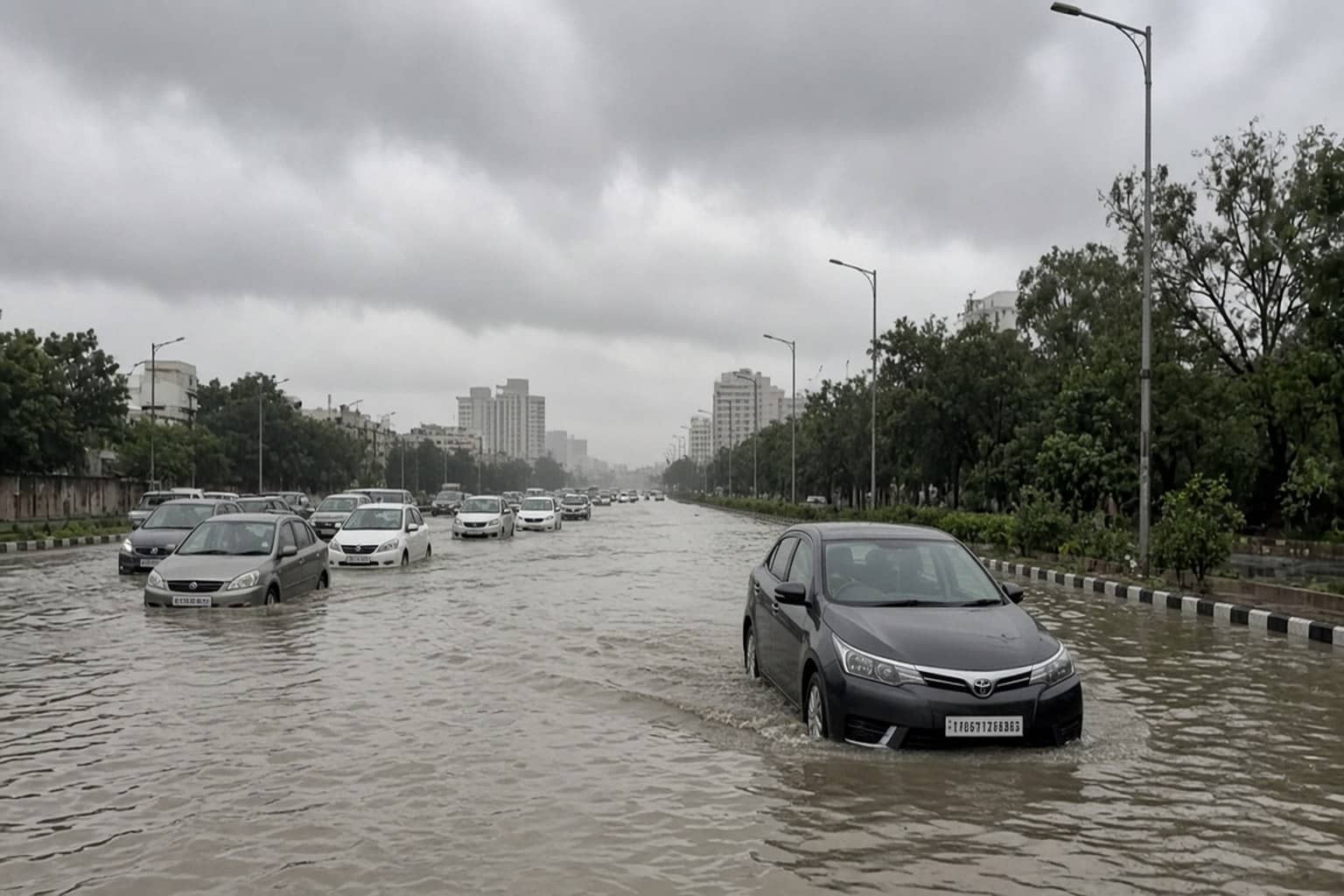
In a 17-page order dated 8 September, a three-member Bench led by Chairperson Lalit Batra, with members Kuldip Jain and Deep Bhatia, examined reports of the 24 August downpour, when the district administration recorded around 75 mm of rain. Major arteries including Subhash Chowk, Rajiv Chowk, Narsinghpur, IFFCO Chowk, Sohna Road, Sheetla Mata Road and the NH-48 Delhi-Gurugram Expressway went under water, leaving hours of gridlock.
The Commission singled out the impact on schoolchildren. Buses were stranded for hours at Subhash Chowk and other flooded stretches. Parents waded through deep water after school vans broke down. It also flagged disrupted ambulance movement, a road cave-in near IFFCO Chowk, and damage to a major water-supply pipeline that cut supply to several sectors, even as households used private pumps to fight backflow from choked storm-water and sewer lines.
Drawing a parallel with flooding in 2018, the Bench said the return of near-identical scenes pointed to civic works failing to keep pace with rapid urbanisation. Invoking Articles 21, 47 and 48A of the Constitution, it held that the state's duty to ensure dignified and healthy living conditions would become meaningless if drainage failures were allowed to continue.
The order sits against an estimated annual drainage spend of about Rs 450 crore to Rs 500 crore and a 155-hotspot flood roster maintained by the Municipal Corporation of Gurugram, with Zone VI accounting for 30 of the worst-hit sites. The Commission has directed the Gurugram Metropolitan Development Authority chief executive officer, in coordination with the Deputy Commissioner, the MCG Commissioner, the HSVP Administrator and senior engineers from the Public Works Department, the Public Health Engineering Department, irrigation and DHBVN, to identify all 99 chronic waterlogging points, map natural drainage obstructions and assess vulnerable underground utilities.
It has also sought a time-bound Integrated Urban Drainage and Civic Infrastructure Revamping Plan, GIS-based mapping of drainage channels, and an independent technical review by an IIT or NIT. On child safety, the panel asked for a report on the standard operating procedure for school transport during heavy rainfall, including real-time bus tracking, pre-identified safe holding points and restrictions on bus movement through high-risk zones in extreme weather.
The Commission clarified that it was not, at this stage, recording a final finding of violation and that the proceedings were aimed at ascertaining the factual position. It observed that persistent and foreseeable failure of essential civic infrastructure, if attributable to neglect or inadequate planning, could bear directly on the enjoyment of human rights.
A conjoint compliance report is due from the GMDA CEO and other authorities a week ahead of the next hearing, listed for 15 December. Public reports of the order on 11 and 12 September brought the directions into wider circulation for city agencies already managing post-monsoon drainage complaints.