
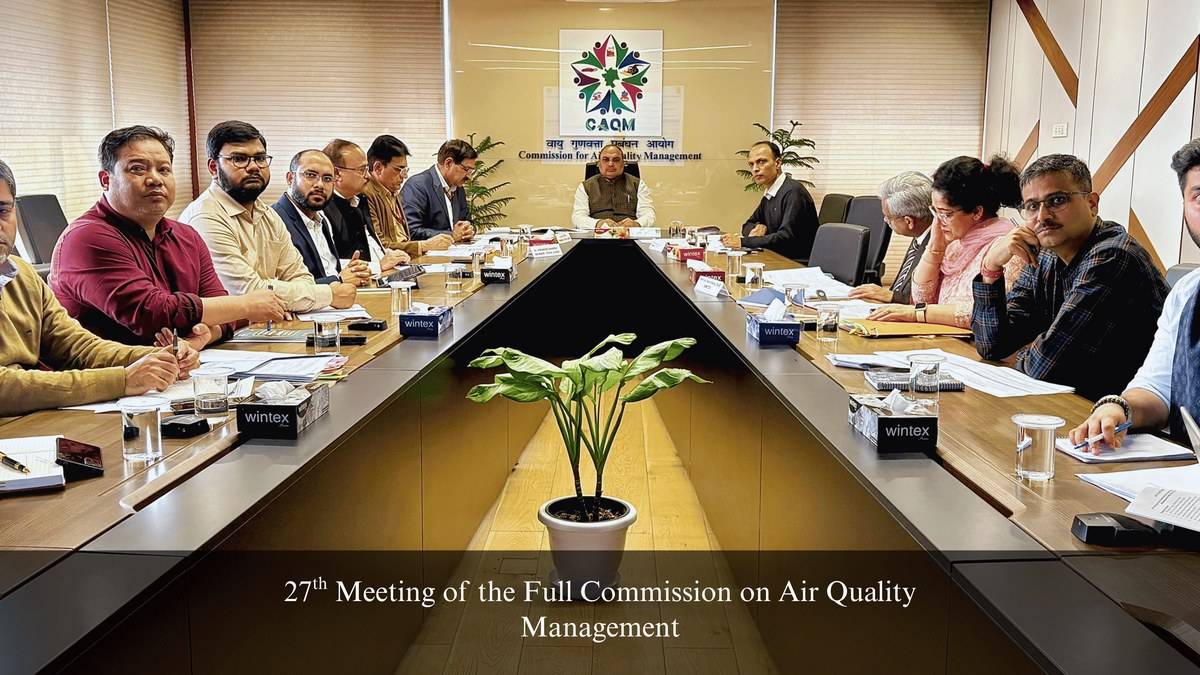
GURUGRAM: Sohna, Pataudi Jatauli Mandi and Farrukhnagar were directed to strengthen household waste collection, road dust control and night surveillance at a pollution review held in Gurugram late on Thursday, November 26, 2026. A November 27 release from the Commission for Air Quality Management says chairperson Rajesh Verma reviewed six municipal bodies across Gurugram and Jhajjar districts, bringing smaller towns into the implementation checks under the Winter Action Plan.
The three Gurugram district towns were reviewed alongside Jhajjar, Bahadurgarh and Beri. The commission describes this as a second meeting, following an earlier review with the municipal corporations of Gurugram and Manesar, the Gurugram Metropolitan Development Authority and other authorities. The focus of this session was whether existing directions and advisories were being carried out at municipality level, with closer field monitoring and responsibility assigned to the relevant civic authorities.
Waste must reach the designated facilities
The commission's November 27 release calls for regular collection of municipal solid waste from households and strict implementation of waste collection directions. It also requires the collected material to be transported to designated processing and disposal facilities. For the municipal bodies under review, the task therefore covers both the collection round in a neighbourhood and where the waste goes afterwards.
Verma also sought faster remediation of pending legacy waste and stronger arrangements for processing fresh waste. These are separate parts of the review: clearing accumulated old waste does not replace the requirement to handle material collected from households. The release additionally records follow-up on a cluster-based processing proposal for Jhajjar and Beri. It does not describe that proposal as a new facility for the three Gurugram district towns.
- Gurugram district bodies reviewed: Sohna, Pataudi Jatauli Mandi and Farrukhnagar.
- Meeting: late evening on November 26, 2026, in Gurugram.
- Official release: November 27, 2026.
- Main implementation areas: waste collection and processing, road and construction dust, open burning and winter shelter arrangements.
Road repairs and construction dust face closer checks
Road redevelopment must follow the CAQM framework, the release says, while pending pothole repairs should be completed. The dust-control measures listed include more mechanised sweeping, water sprinkling and anti-smog guns. Road shoulders are also part of the direction, with paving, greening and stabilisation identified as measures to control dust beyond the main carriageway.
For construction activity, the chairperson advised registration of sites on the dust monitoring portal and stronger camera-based surveillance. The release calls for enforcement against construction and demolition sites and ready-mix concrete plants that do not comply with the applicable requirements. It also identifies uncovered transport of construction and demolition waste as an enforcement concern.
The review separately calls for action at eight identified pollution hotspots in Jhajjar district. Road repairs, traffic signals, deployment of traffic personnel and dust suppression are listed for those locations. That figure belongs to Jhajjar district in this release; it is not a count of hotspots in Sohna, Pataudi Jatauli Mandi or Farrukhnagar.
Night patrols, household fuel and winter shelters
Coordinated night patrolling is intended to prevent burning of waste, plastic, PVC-coated wires, electrical cable scrap and other materials. The agencies named for surveillance are the district administration, Haryana Police, fire services, the Haryana State Pollution Control Board and gram panchayats. The chairperson also stressed enforcement of the Graded Response Action Plan and action against vehicles without valid pollution control certificates.
Sohna and Pataudi Jatauli Mandi received specific advice to intensify patrols and use drones and low-cost sensors to assess biomass-burning incidents. The release presents these as monitoring measures to strengthen prevention and detection. It gives no installation total, streetwise deployment schedule or completion date for these two towns, so residents should not read the advice as confirmation that every proposed device is already operating.
The district administrations were advised to use the Pradhan Mantri Ujjwala Yojana to facilitate household LPG cylinder refills and discourage reliance on biomass for cooking fuel. Winter preparedness also includes maintaining electric heating arrangements at night shelters, described in the release as Raain Baseras, to discourage open bonfires for warmth.
Enforcement is to be accompanied by public outreach. Taking note of challans and registered cases, the commission advised sustained information, education and communication to prevent violations and encourage voluntary compliance. It also emphasised capacity building for sanitation workers. The closing direction asks the authorities to sustain municipal implementation through coordinated field action and regular monitoring, rather than treating the review itself as completion of the work.
Related local background includes the earlier pollution planning requirements, the sanitation worker safety review and checks on municipal development works.