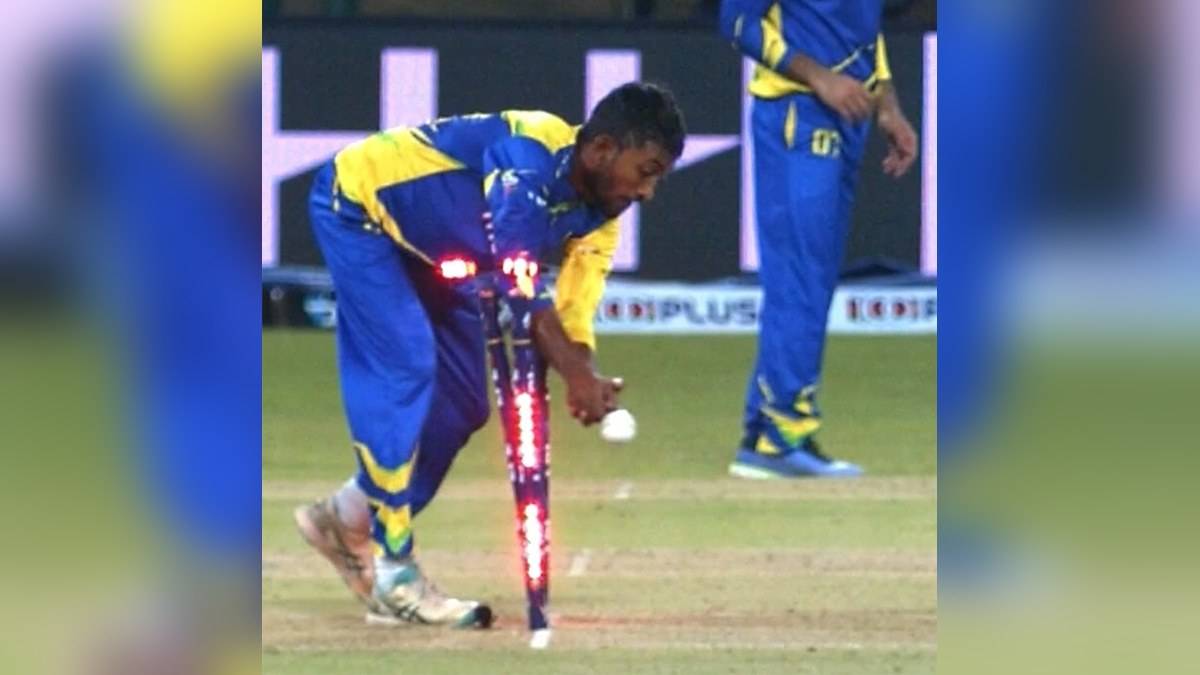
Cricket run out rules require a batter to be outside their ground while the ball is in play and their wicket is fairly broken through a fielder's action or a rebound from a fielder. A run need not be attempted. The 2026 rules also distinguish between a ball hitting the stumps and a fielder breaking the wicket with a hand or arm while holding the ball.
That distinction matters when watching a close replay. MCC's 8 October 2026 clarification says the complete-control requirement concerns the latter situation. It does not prohibit a bowler deflecting a drive onto the stumps or a ball rebounding from a wicketkeeper's pads.
| Question | MCC rule |
|---|---|
| Must a run be attempted? | No, subject to the stated exceptions |
| Is a bat on the crease enough? | Some bat or person must be grounded behind it |
| Can a no ball produce a run out? | Yes, with a specific wicketkeeper exception |
| Does the bowler receive the wicket? | No |
Cricket run out rules on the line and after a dive
Law 30.1.1 in MCC's 2017 Code, fourth edition, 2026 requires some part of the batter's person or bat to be grounded behind the popping crease. Merely reaching the painted line is insufficient. An airborne bat stretched beyond the line also does not, by itself, satisfy the grounding requirement.
There is an important protection for a batter running or diving towards their ground and beyond. Under Law 30.1.2, once the person or bat has been grounded beyond the popping crease, a subsequent loss of contact with the ground, or between bat and person, does not automatically put that batter outside their ground again. The sequence matters: first establishing ground and then bouncing is different from never grounding the bat.
Consider a hypothetical dive in which the bat slides safely beyond the crease and then lifts as the batter continues forward. The rule protects that subsequent loss of contact. By contrast, a bat that remains in the air throughout the approach has not established the required ground. A single still image can hide this difference, so the earlier frames can be decisive.
What changed about holding the ball in 2026?
MCC published its clarification after the changes took effect on 1 October 2026. When a fielder uses their hand or arm to break the wicket while holding the ball, complete control in the palm or fingers is required. The clarification also covers a wicketkeeper holding the ball in the palm or fingers of a glove.
If the ball itself hits the stumps and removes a bail, that holding requirement is not the relevant test. MCC specifically separates such incidents from hand or arm contact. A direct throw, a deflection or a rebound can therefore fairly break the wicket even though nobody is holding the ball at that instant.
Law 29 adds another detail: a bail must be completely removed from the top of the stumps, or a stump must be struck out of the ground. A bail simply wobbling is insufficient. If one bail is already off, removing the remaining bail or fairly removing a stump can complete the act. Where umpires have agreed to play without bails, the law provides a separate test.
Can a batter be run out on a no ball?
Yes. Law 38 generally allows a run out despite a no ball. However, the striker is protected where all these conditions occur together: a no ball is called, the striker is outside their ground without attempting a run, and the wicketkeeper fairly breaks the wicket without another fielder's intervention. That specific situation cannot simply be relabelled a run out.
On a legal delivery, a keeper breaking the striker's wicket without another fielder's intervention, when the striker is outside their ground and has not attempted a run, can instead meet the stumping conditions. Readers comparing the two dismissals should focus on the delivery, the attempted run and who intervened, rather than the keeper's position alone.
For the delivery restrictions surrounding those incidents, see our guides to no ball rules and wide ball rules. The free hit guide explains another situation in which viewers need to distinguish different dismissal methods.
Non-strikers leaving early and runs already completed
Law 38.3 allows the bowler to run out a non-striker who leaves early, but its window ends when the bowling arm reaches the highest point of the normal delivery swing. Once that point has been reached, an earlier departure does not extend the bowler's opportunity under this provision.
For an ordinary run out, completed runs stand, while the run in progress when the wicket is broken does not count. Applicable penalty runs also stand. The dismissed batter is the one whose ground belongs at the broken wicket, and the bowler receives no wicket credit. These are the MCC baseline rules; the competition's playing conditions should also be checked where a particular match is concerned.