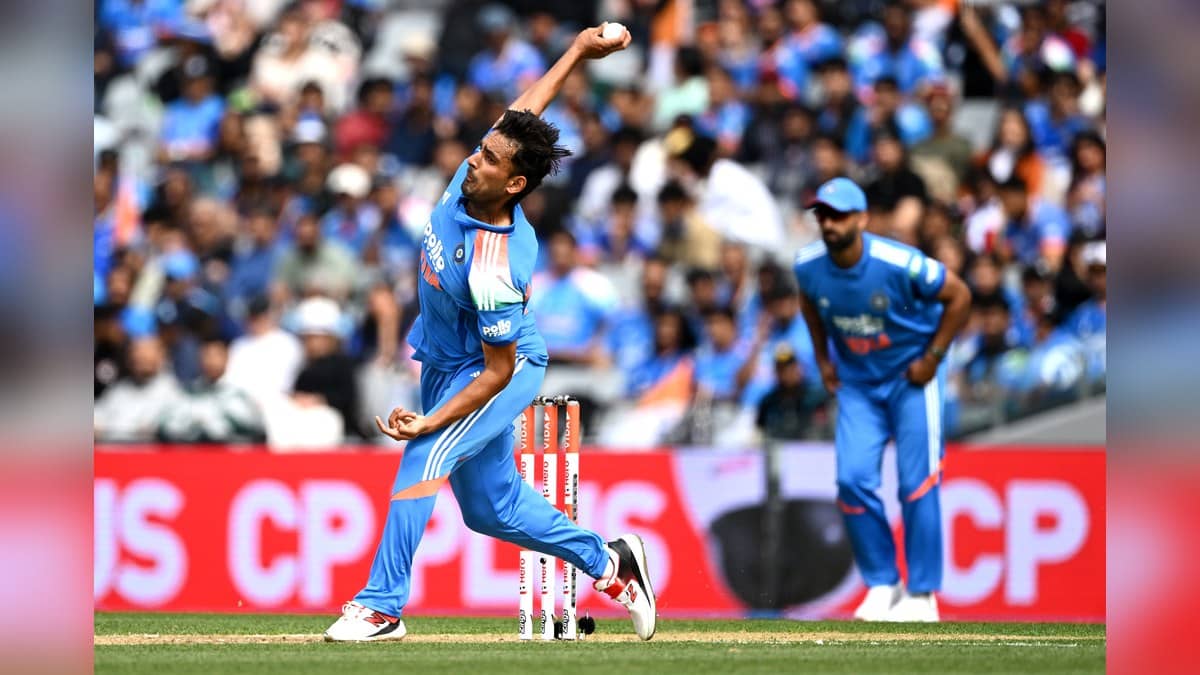

A no ball in cricket is an illegal delivery that gives the batting side one penalty run and does not count towards the over. Overstepping is only one cause: the back foot, a high full toss and certain other delivery infringements can also trigger the call. This guide explains the ICC men's T20I playing conditions effective from October 2026, including exactly where each foot must land.
| Question | ICC men's T20I rule |
|---|---|
| Front foot | Some part must land behind the popping crease, grounded or raised |
| Back foot | Must land within and must not touch the relevant return crease |
| High full toss | Above the waist of a striker standing upright at the popping crease is a no ball |
| Penalty | One run, plus any other valid runs |
| Over count | The delivery does not count |
The wording matters because the two feet are judged differently. A bowler can look close to a line without infringing, while a less obvious back foot error can make an otherwise ordinary delivery illegal. The governing text is clause 21 of the official ICC men's T20I conditions, read alongside clause 41.7 for high full tosses.
What is the front foot no ball rule?
Clause 21.5.2 requires the front foot to land with some part behind the popping crease. That part may be on the ground or raised. The rule therefore does not require the entire shoe to stay behind the line, and a toe projecting beyond it does not settle the decision by itself.
The relevant instant is the landing in the delivery stride. Consider a hypothetical bowler whose front toe is beyond the crease but whose raised heel remains behind it at landing. That can satisfy the behind-the-crease requirement. If no part of the foot is behind the popping crease, it fails that requirement. A heel that is only over the painted line should not be confused with one behind it.
There is also a second front foot condition: some part must land on the same side of the imaginary line joining the middle stumps as the return crease relevant to the bowler's stated delivery mode. Checking only the front line leaves out this part of the rule. Under these international conditions, the third umpire reviews the feet landing and advises the bowler's end umpire of an infringement.
What is the back foot no ball rule?
The back foot must land within, and must not touch, the return crease corresponding to the declared bowling mode. Unlike the front foot rule, this wording does not allow touching the relevant line. This is why a delivery can be called a no ball even when the front foot appears comfortably legal.
A change between bowling over and round the wicket also needs attention. Clause 21.1 requires the umpire to establish whether the bowler is right or left handed and bowling over or round the wicket, and to inform the striker. Failing to notify a change in delivery mode leads to a no ball. It is a separate issue from how far the front foot travels.
What height makes a full toss a no ball?
Under clause 41.7.1, a delivery passing, or projected to pass, above waist height without bouncing is unfair when judged against the striker standing upright at the popping crease. The reference is that defined position, rather than the batter's waist wherever they happen to be crouching or advancing.
The no ball call does not depend on whether that delivery would cause injury. Dangerous bowling brings an additional assessment involving speed and direction, with its own warning and suspension provisions. Calling a high full toss illegal and deciding what further action to take against the bowler are therefore separate decisions.
Other causes appear in clause 21. A ball bouncing more than once before reaching the popping crease, or rolling along the ground before reaching it, is a no ball if it has not previously touched the striker's bat or person. A delivery landing or subsequently bouncing wholly or partly off the pitch before reaching the striker's wicket line can also qualify.
How many runs are awarded for a no ball?
The one-run penalty is added to other valid scoring. In a hypothetical example, a no ball struck for four produces five runs for the team: four credited to the batter and one no ball extra. Other runs from a delivery that has not hit the bat are recorded as byes or leg byes where appropriate. The call alone does not make the ball dead.
A no ball overrides a wide, so the same delivery does not attract both calls. It also does not count as a ball of the over. Dismissal protection has limits: the permitted exceptions are hitting the ball twice, obstructing the field and run out. In these T20I conditions the next delivery is a free hit. For that separate situation, read our free hit rules guide.
For neighbouring decisions, see how wide balls are judged and the LBW pitching and impact rules. When applying this guide to another competition, first check its playing conditions on the ICC rules index; this article's specific scope is men's T20 internationals.