
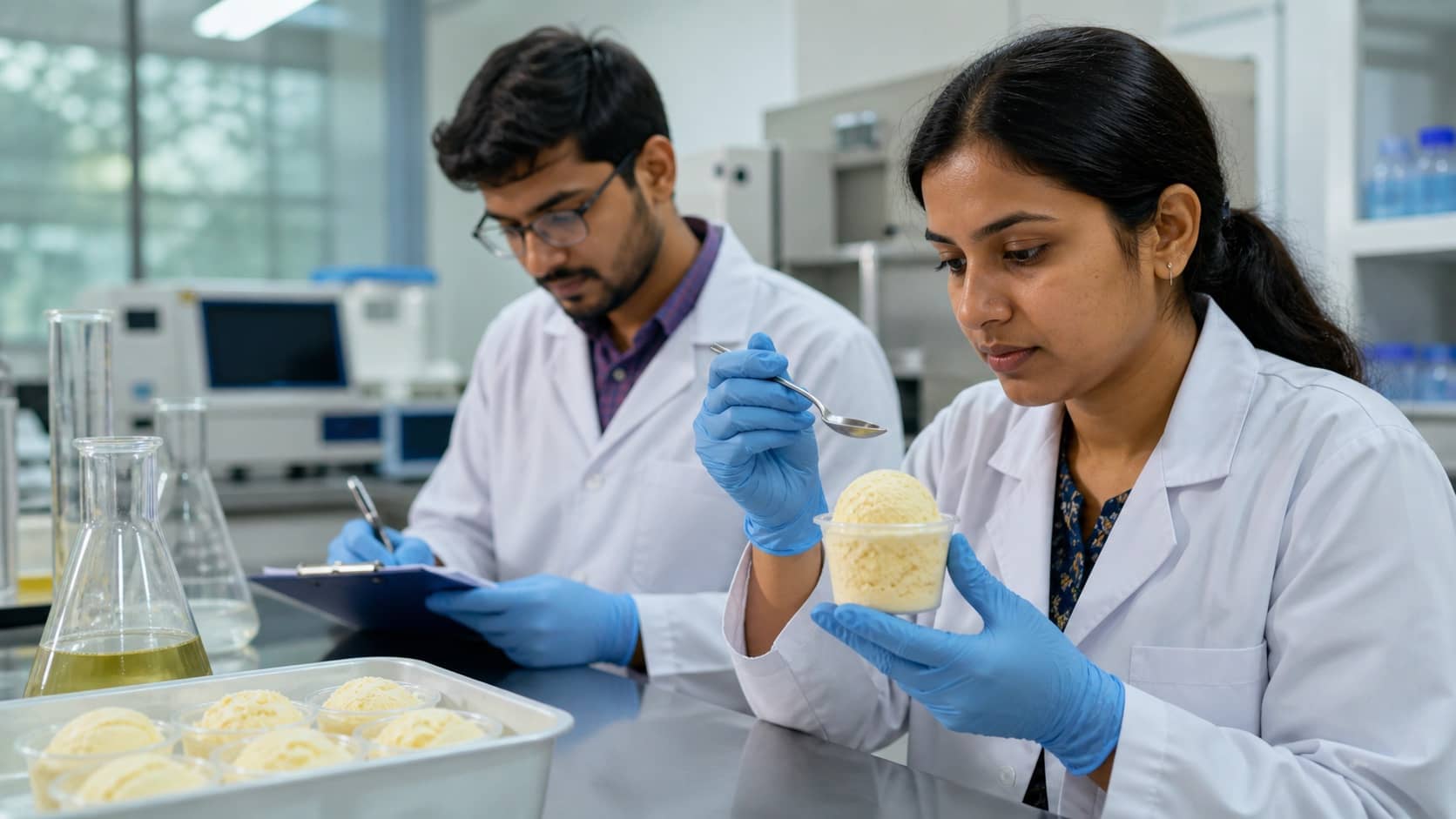
VARANASI: A research team with members from Banaras Hindu University and partner institutions has developed a high-protein ice cream formulation containing curcumin, the best-known active component associated with turmeric.
The work addresses a less obvious food-science problem. Curcumin is poorly soluble in water and can be unstable under some processing and storage conditions, so simply stirring turmeric-derived material into a dairy product does not guarantee an even, acceptable or useful formulation. The researchers studied how to incorporate it while preserving the texture and quality expected from ice cream.
The team was led by Professor Dinesh Chandra Rai, currently vice-chancellor of B R A Bihar University. Named contributors include BHU researchers Shivansh Suman, Dr Sunil Meena and Professor Raj Kumar Duari, along with Dr Shalini Singh of Banda University of Agriculture and Technology and Priya Brat Gautam of the National Dairy Research Institute in Karnal. The study was reported as published in the Journal of Food Process Engineering.
Describing the product as high-protein and antioxidant-rich does not make it a medicine. Curcumin is the subject of extensive research, but a frozen dessert cannot be assumed to prevent or treat disease without specific clinical evidence. Nutrition claims must be tied to measured composition, serving size and applicable food regulations.
The practical appeal lies in food design. Consumers increasingly look for products that offer more protein without abandoning familiar tastes. Manufacturers, meanwhile, need ingredients that remain stable, distribute evenly and do not produce an unpleasant graininess, bitterness or colour change. A laboratory formulation is the first step in answering those questions.
Before any commercial launch, researchers or industry partners would need to assess shelf life, sensory acceptance, microbial safety, cost and performance during large-scale production. What works in a controlled batch may change when mixed, frozen, transported and stored through a commercial cold chain. Labelling would also need to clearly state ingredients and allergens.
For BHU, the study shows how food engineering can connect chemistry with an everyday product. It also brings several institutions into one project, combining expertise in dairy science, processing and material behaviour. That interdisciplinary structure is often essential when a useful idea must pass from a measured compound to something people can actually eat.
The next useful publication would include the precise protein content, curcumin retention over time and results from blinded taste testing. Those data would tell consumers and food companies more than the novelty of “turmeric ice cream” alone.
For now, the achievement is a research formulation, not a product announcement. Its significance is that the team has taken a difficult ingredient and worked through the engineering needed to place it in a familiar food. Whether it reaches shops will depend on evidence, economics and regulation beyond the laboratory.