
At BHU, Banarasi Brocade Debate Turns to Survival, Sustainability and Young Weavers
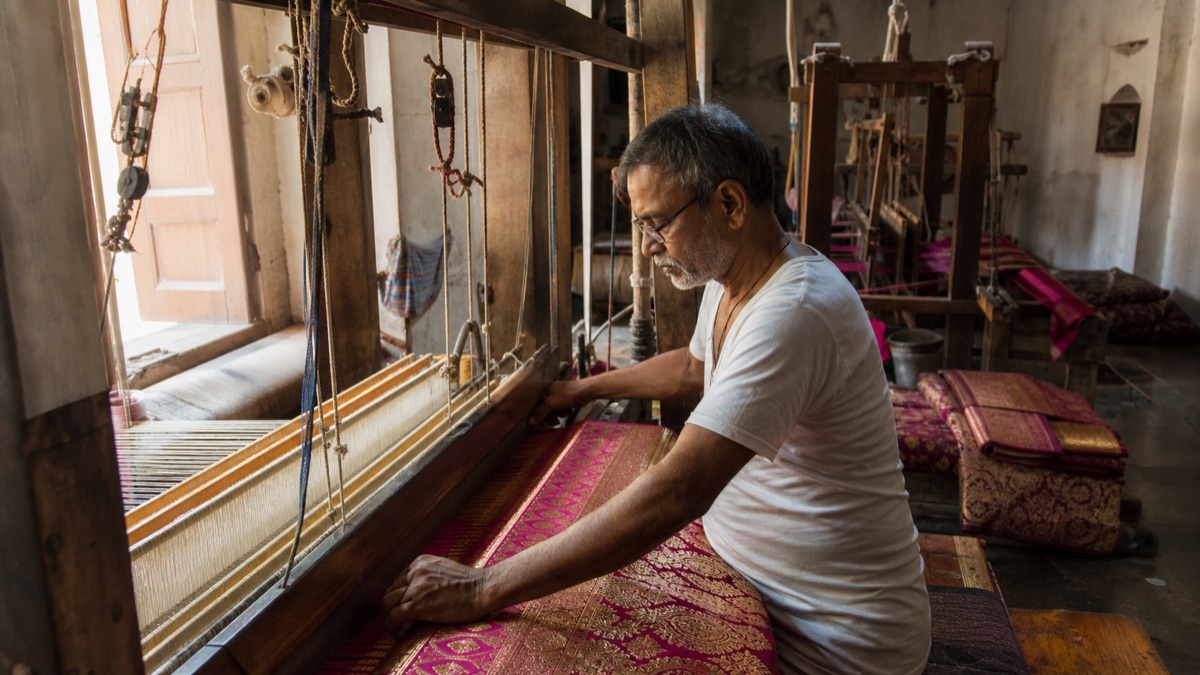
The conversation at Bharat Kala Bhavan began with beauty but did not stay there. At a National Handloom Day talk titled ‘From Threads to Finery’, speakers placed Banarasi brocade inside the pressures of the present: powerloom copies, expensive raw material, uncertain earnings and the steady pull of other work on young members of weaving families.
National and Sant Kabir awardee Kamaluddin Ansari and young artist Mohammad Muzzammil spoke about handloom as both a sustainable fashion choice and a carrier of technical memory. Every woven motif contains decisions about yarn, tension, colour and rhythm that cannot be reduced to a label on a showroom shelf. When the economic chain weakens, the city risks losing not only products but the accumulated judgement needed to make them.
Bharat Kala Bhavan director Prof Sreerup Raychoudhuri linked the discussion to the museum’s textile collection, which preserves historic Banarasi masterpieces. Such collections can serve as working references for contemporary weavers and researchers, but access is crucial. Archives matter most when artisans, designers and students can study construction and context rather than encounter heritage only through display cases.
The difficult question is whether admiration converts into viable livelihoods. Consumers may celebrate Banarasi silk while struggling to distinguish handloom work from cheaper imitation. Clear provenance, fairer margins and serious design support can help, but so can reporting that follows the money from buyer to loom. Sustainability here is social as much as environmental: a craft survives when skilled people see a future in practising it.
In Varanasi, heritage is not a static backdrop. It survives through students, artisans, neighbourhood institutions and families who keep ideas and skills in circulation. That makes contemporary reporting essential: nostalgia can flatten complicated histories, while a careful account shows who did the work, what pressures they faced and why the legacy still speaks to the city. The strongest local stories connect memory with the lives and livelihoods that carry it forward.
Public institutions have a particular responsibility when they present the past. Dates, names and claims should be sourced; community voices should not be reduced to decoration; and celebration should leave room for debate about preservation, access and economic survival. For younger readers, this approach makes heritage more credible. It also guards against social-media retellings in which dramatic captions travel faster than evidence and nuance disappears first.
The next step is to keep the conversation open beyond an anniversary or one-day programme. Archives, museums, universities and civic bodies can publish primary material, record oral histories and make collections easier to study. A city with Varanasi’s cultural weight does not need exaggerated claims to hold attention. It needs precise storytelling, patient verification and space for the people who inherited these traditions to explain what continuity looks like now.
Sources and reporting
Reported on 8-9 August 2026 from the National Handloom Day programme held at Bharat Kala Bhavan, BHU.
Related Stories
VMC Launches Doorstep E-Waste Pickup With On-the-Spot Payment
Family Alleges Youths Chased Car, Assaulted Women and Children Near V-2 Mall in Lanka
Sigra-Trained Shooter Kamaljeet Wins Asian Games Gold in Mixed Air Pistol

Sarnath Police Arrest Three Over Locked-House Burglaries, Claim ₹7 Lakh Recovery

NER Varanasi Division Runs 2,915 Chlorine Tests on Station and Colony Water