
Why Gurugram Underpasses Flood Unevenly: Pumps Alone Cannot Fix Full Drains
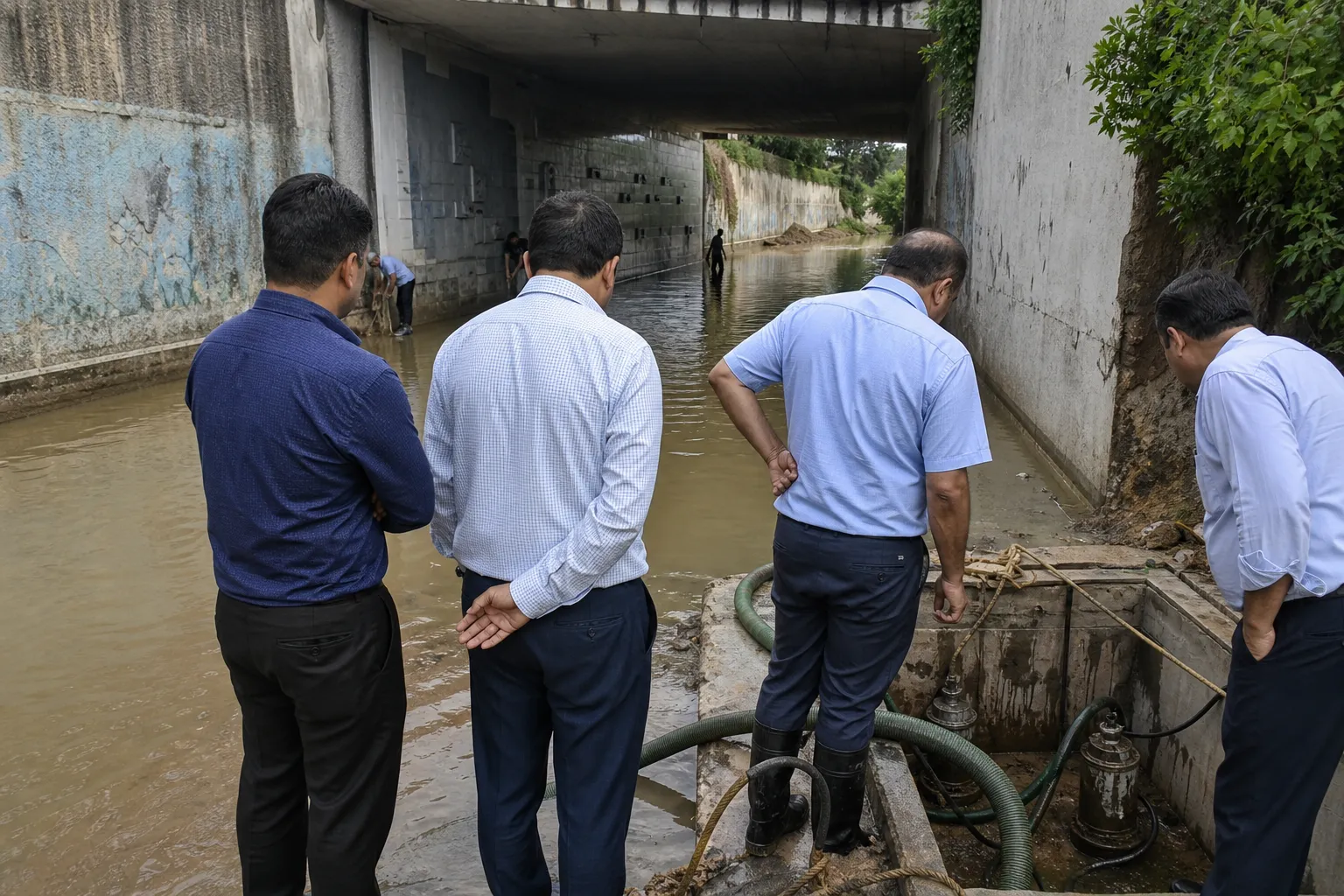
GURUGRAM: The city's underpasses produced two very different pictures during the latest downpour. Medanta Road, Bajghera and IFFCO Chowk had to be restricted or closed, while several structures along Golf Course Road continued carrying traffic. The contrast shows why rainfall totals alone cannot explain whether an underpass floods.
Gurugram has about 24 underpasses spread across national highways, expressways and arterial roads. They are maintained by different agencies and sit in different catchments. Each structure depends on a chain: surface water must be intercepted, the sump must hold it, pumps must lift it and the receiving drain must have capacity to carry it away.
Three failures, three different causes
At Medanta Road, the highway authority attributed flooding to surface-drain water flowing back through a faulty sump-pump arrangement. A non-return valve is proposed to stop that reverse flow. If the diagnosis is correct, simply adding another pump would not address the direction in which water is entering the system.
Bajghera faces a topography problem. Runoff travels downhill from the railway-overbridge side and surrounding developed land towards the underpass. Eight sump pumps are installed, including one rated at 35 horsepower, but the master drain was already carrying a heavy load and there was no adequate inlet for additional road runoff. Water therefore accumulated outside despite pumping equipment being present.
At IFFCO Chowk, water entered through the vehicular approach, forcing a temporary closure. Mahavir Chowk also needed pumping after runoff from the Police Lines side reached the carriageway. These examples underline that entry points and road gradients can be as important as equipment inside the lowest part of a structure.
Golf Course Road offers a different model
Parts of Golf Course Road remained relatively functional after earlier interventions diverted fast-moving runoff from the Aravalli side. Channels, revived creeks, depressed holding areas, ponds and check dams were used to slow or store water before it reached the road network. An additional drain in Sector 54 and a channel near the AIT roundabout also created alternative paths.
This green-blue approach does not eliminate maintenance. Sumps still need drills, pumps need backup power and creeks must remain free of waste. Its advantage is that it reduces the volume arriving at the underpass at the same moment instead of trying to eject every litre after it has reached the lowest point.
No single fix fits all 24 sites
Larger pumps can help where lift capacity is the bottleneck. They do little when the receiving drain is full, a valve allows backflow or nearby development funnels more runoff into the approach road. Covered drains can also lose capacity when sewage and solid waste enter a system intended for rainwater.
The next useful step is a public, site-specific diagnosis for each underpass: catchment map, design capacity, pump status, backup power, drainage time and the receiving outfall. Gurugram does not need one generic underpass solution repeated 24 times. It needs 24 verified drainage chains, each designed around the water that actually reaches that location.
Sources and reporting
Original Dalimss News explainer based on verified agency assessments, underpass inventories and engineering details available on 9 August 2026.
Related Stories
Festive Special to Gorakhpur Gets Gurugram Halt
Fifth Accused Held in Rs 25 Lakh Sector 47 Robbery

Courier Staffer Booked Over 105 Missing One8 Returns
HC Sets Rs 50 Lakh Costs for Accused's Return to India

Gurugram Swimmer, 20, Crosses English Channel