
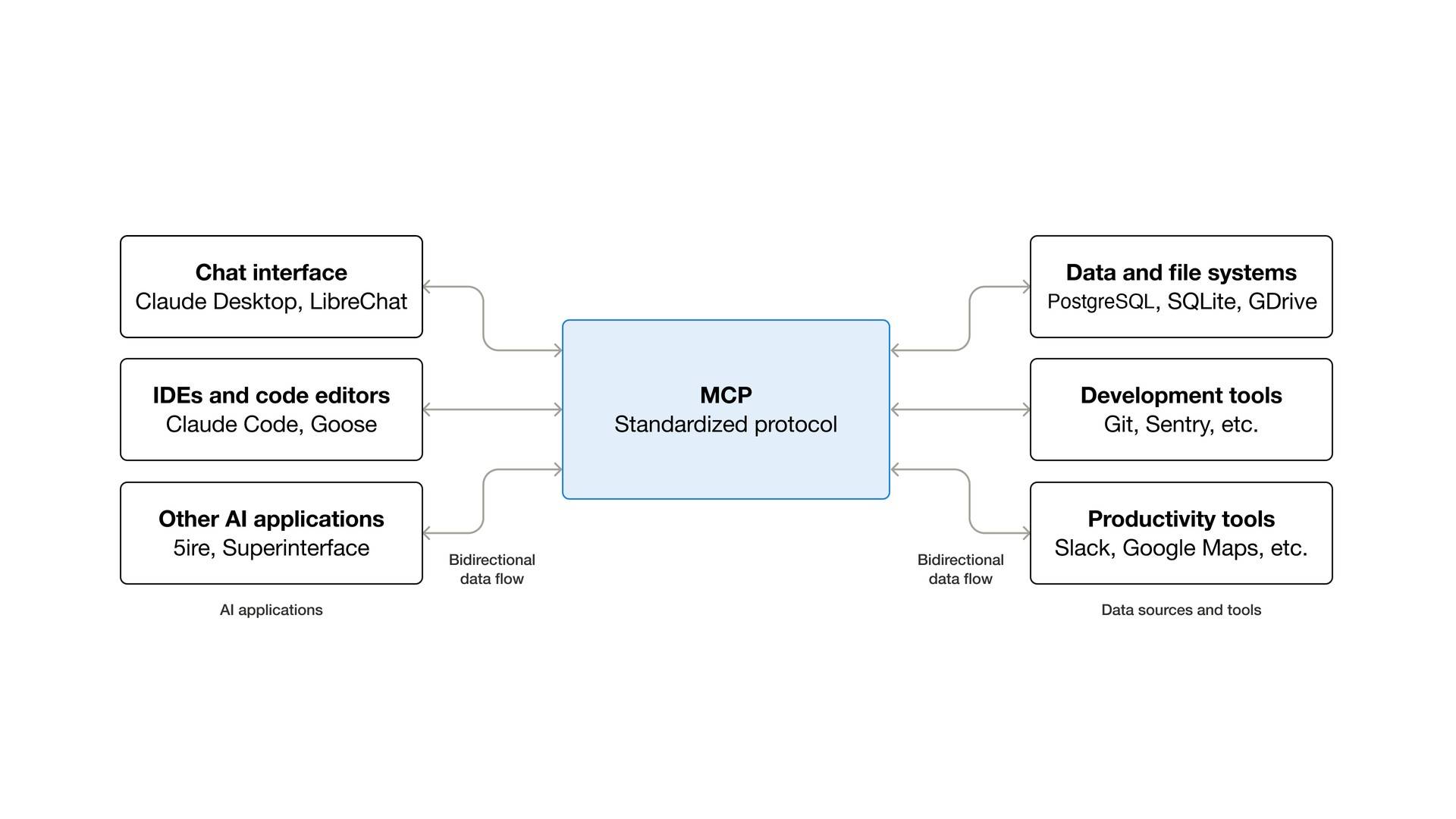
MCP stands for Model Context Protocol, an open standard that lets AI applications connect to external data sources, tools and reusable workflows. An MCP server is a program that makes particular capabilities available through that standard. The AI application uses a client to communicate with the server, so a conversation can work with information or actions beyond the model's own generated text.
A simple example is an assistant that can look up documents in a company's knowledge base. The assistant needs a way to discover the available search function, request a search and receive the result. MCP standardises that exchange. Whether the assistant uses the result correctly remains a separate question about the application and the model.
| Term | Plain meaning |
|---|---|
| MCP | Model Context Protocol, a standard for connecting AI applications to external systems |
| Host | The AI application managing the connections |
| Client | The component communicating with a particular MCP server |
| Server | The program exposing tools, resources or prompts |
| Tool | An operation the application can invoke |
| Resource | Information the application can read for context |
What is MCP in AI, and why was it introduced?
Anthropic introduced MCP in an announcement dated 25 November 2024. Its original announcement described the difficulty of building separate integrations for every data source. The proposed alternative was a common protocol through which AI applications and external systems could exchange information. The announcement credits David Soria Parra and Justin Spahr-Summers with creating MCP at Anthropic.
The current official introduction describes an open-source standard connecting AI applications with systems such as files, databases and tools. The important distinction is between having a model and giving an application an external capability. A model can generate an answer about a document; a connected application can first retrieve the document through an available interface.
MCP is therefore relevant when an assistant needs to work with something outside the conversation. It can provide the connection used by an agent, but it does not define the agent's entire decision-making process. Our AI agent explainer covers that broader idea. This guide focuses on how the connected components communicate.
How do an MCP host, client and server work?
The official architecture overview separates three participants. The host is the AI application. It manages clients, with a client maintaining the connection to its corresponding server. The server provides capabilities or context through the protocol. One host can work with multiple servers, rather than treating every external system as one undifferentiated connection.
In an illustrative office workflow, the host might be an assistant application, one client might communicate with a document-search server, and another might communicate with a calendar server. Searching a policy document and checking a calendar are separate capabilities. This example explains the architecture; it does not mean every assistant includes those integrations or that every calendar service supports the same functions.
A server can run locally or remotely. The architecture documentation describes standard input and output for local process communication and Streamable HTTP for remote communication. These are transport mechanisms: they carry the messages. The protocol's data layer describes the exchange, including how capabilities are discovered and how requests and results are represented.
What does an MCP server expose?
The official server concepts guide identifies three building blocks: tools, resources and prompts. A tool defines an operation with inputs and outputs. A resource supplies information for context. A prompt is a reusable instruction template. They can work together, but they serve different purposes.
For example, a document service could expose a search tool, provide a policy document as a resource and offer a template for summarising it. The protocol includes methods such as tools/list to discover tools and tools/call to execute a tool. Resources and prompts have their own discovery and retrieval methods. The application still determines how the returned material reaches the model.
That distinction also helps explain why connecting a service is not the same as copying all its contents into every conversation. The application may select a resource, search for relevant portions or choose another processing approach. For the separate question of finding useful document passages, see our RAG and retrieval explainer.
Does an MCP connection automatically allow actions?
The server guide says tools can perform operations including modifying files or calling external APIs. Resources, by contrast, provide read-only information. A calendar connection might therefore offer reading availability, creating an event or both, depending on what its server exposes and what the application permits. The name of the connected service alone does not describe the full capability.
The same guide describes human oversight mechanisms that applications can implement, including tool visibility, approval dialogs, permission settings and activity logs. Those are implementation choices to inspect in the application you use. A protocol-compatible connection should not be interpreted as a guarantee that every operation asks for confirmation or that every available server is trustworthy.
Is MCP the same as an AI model or a context window?
MCP's architecture documentation explicitly limits its scope to context exchange. It does not dictate how applications use language models or manage the context they receive. That means MCP does not itself choose the answer, verify its contents or define the model's memory capacity. Our context window guide explains the separate issue of how much material a model can work with.
When comparing descriptions of an MCP integration, ask which host supports it, who operates the server and which tools or resources it exposes. Then distinguish access to information from permission to act. Those concrete questions explain more about the integration than a claim that an assistant simply “supports MCP”.