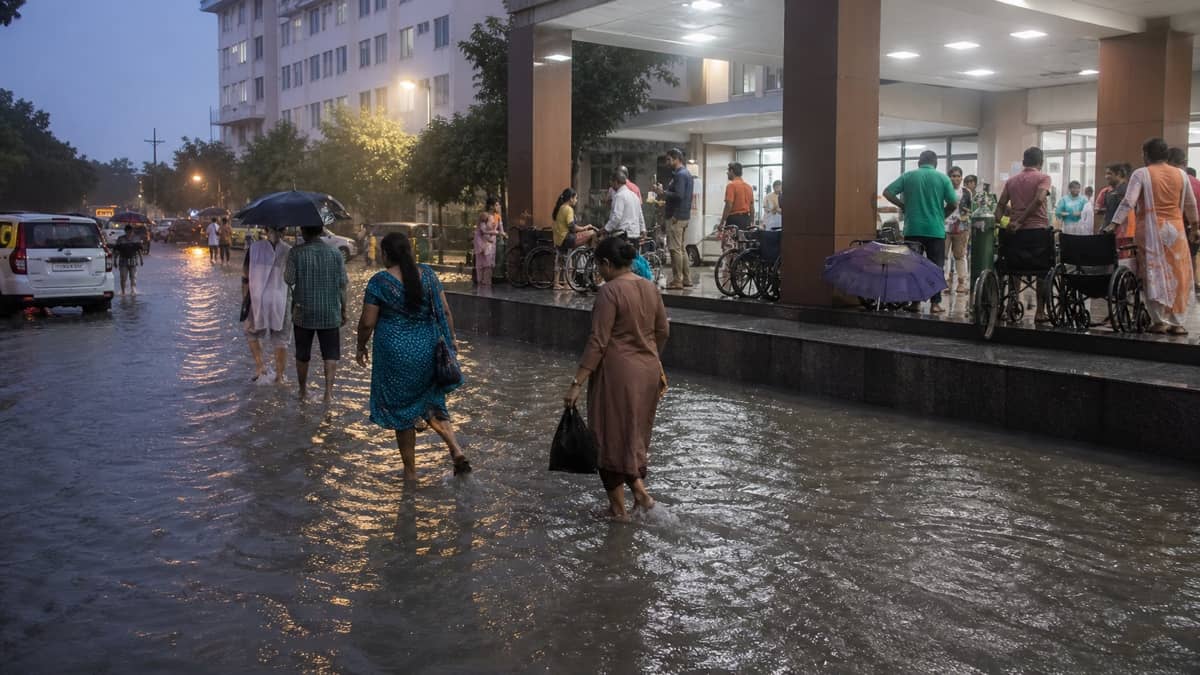
VARANASI: A sharp spell of evening rain exposed a familiar weakness at Banaras Hindu University’s hospital campus on Tuesday, leaving water across approaches used by patients, attendants and emergency visitors.
Varanasi received about 16 millimetres of rain during the spell, according to the local report. At the BHU medical complex, water collected on routes leading towards wards and the emergency area. People were seen moving slowly through the flooded stretch; some carried their footwear to keep it dry. The inconvenience was especially hard on older visitors and families already managing bags, medicines or a patient’s mobility.
There was no official report of a medical service being stopped, and water on a road should not be turned into an unsupported claim about clinical care. The access problem is serious enough on its own. A hospital route must remain usable by ambulances, wheelchairs and people who cannot safely judge the depth of a puddle. Even shallow water can conceal a broken edge, open drain or slippery surface.
Waterlogging was also reported on several city roads and lanes, including stretches around the Kashi Vishwanath route and Nai Sadak. The rain pulled the temperature down to about 27 degrees Celsius, offering relief from humidity while creating a difficult commute. Weather scientist Manoj Srivastava said rain remained possible over the following 48 hours.
For the BHU campus, the immediate response should include pumping or clearing trapped water, marking unsafe sections and keeping an unobstructed raised path to emergency services. The longer answer lies in mapping where the water arrives, whether drains are blocked or undersized, and whether recent construction has altered the slope. Repeated desilting is useful only if the outlet can carry the volume away.
Hospital administrators and civic agencies often divide responsibility at campus boundaries. Patients experience the route as one journey. A drain maintained inside the institution will not work if the external outfall is choked, while a clear municipal line cannot compensate for a campus depression where runoff collects. A joint inspection during or immediately after rain gives engineers better evidence than a dry-weather visit.
People travelling to the hospital during further showers should allow extra time and avoid driving quickly through standing water. Two-wheeler riders should not assume a submerged patch is level. Anyone accompanying a person with limited mobility should use a dry entrance identified by hospital staff rather than improvising through deeper water.
Tuesday’s downpour was not exceptional by monsoon standards, which is precisely why the scene matters. A major referral hospital cannot treat routine rain as a surprise. The test before the next spell is whether the route to care stays passable when Varanasi’s skies open again.