
Varanasi’s National Forensic Sciences University Campus Opens Its First Classes
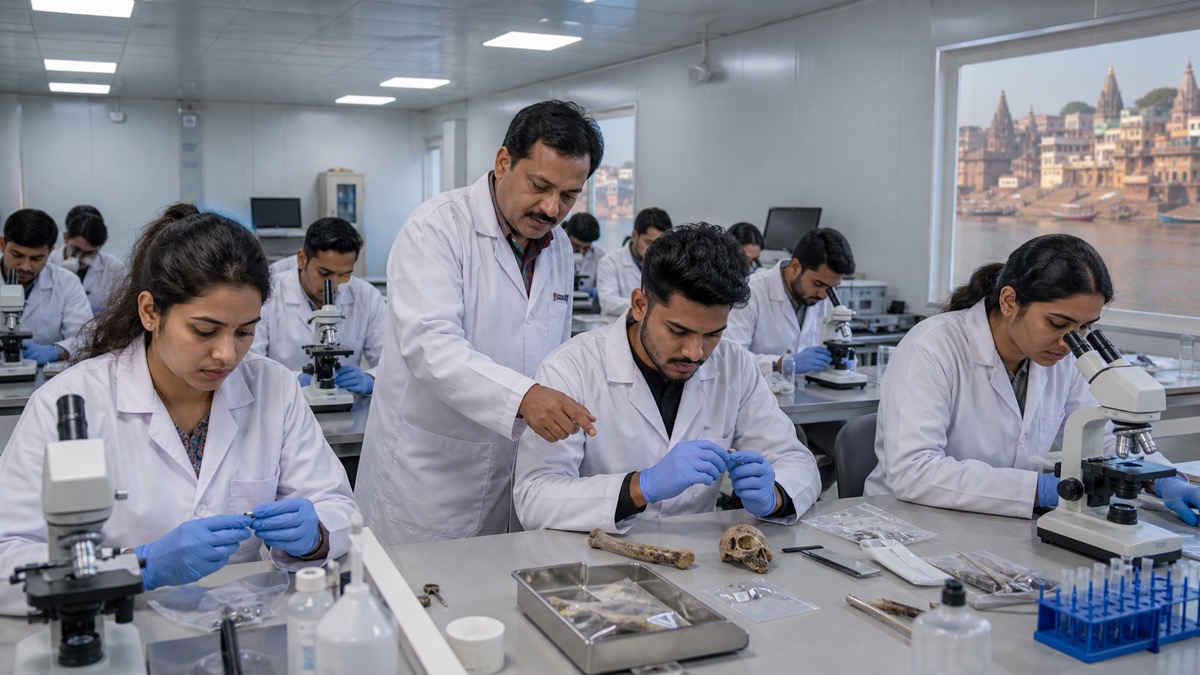
Varanasi’s newest university project has moved from announcement to classroom, with the National Forensic Sciences University beginning its first academic batch at a transit campus in Jalhupur. The opening gives Kashi a fifth university after a gap of roughly five decades and adds a specialised institution focused on the science used in criminal investigation, courts and public safety.
Two programmes have started with 30 seats each: a five-year integrated BSc-MSc course and a two-year MSc in forensic science. The reported fee is ₹65,000 per semester. Six assistant professors have been appointed for the initial teaching, while Dr Satish Kumar is heading the campus as director.
The present facility is temporary. A permanent campus is planned on about 50 acres at Shahanshahpur, where purpose-built laboratories, teaching blocks and student facilities can be developed. The transition timetable will matter to the first cohorts, who need certainty that laboratory access, libraries and practical training will expand in step with enrolment.
Forensic education is unusually dependent on equipment and procedure. Students cannot learn evidence recovery, toxicology, biology, chemistry, fingerprints or digital examination through lectures alone. Laboratories must be calibrated, samples documented and exercises designed around chain-of-custody standards. Faculty numbers and partnerships with police, hospitals, courts and accredited laboratories will therefore be as important as the university name on the gate.
Varanasi is a logical location for the expansion. The city serves a large eastern Uttar Pradesh population and is connected to neighbouring Bihar, while its police commissionerate, medical institutions and courts create demand for trained specialists. A local campus can make the field more accessible to students who would otherwise travel to Gujarat or another distant centre.
It can also improve public understanding of what forensic science can—and cannot—prove. Popular crime shows often present a laboratory result as instant certainty. Real analysis is slower, probabilistic and only as reliable as the way evidence was collected and preserved. A strong university should teach students to communicate limitations, avoid contamination and withstand scrutiny in court.
The first batch is a modest beginning: 60 advertised seats across two courses and six assistant professors at a transit site. Yet institutions are built through precisely such beginnings. Students enrolling now will judge the project by the quality of practical teaching, placement support and the pace of the Shahanshahpur campus. If those foundations hold, Varanasi could develop a durable forensic-science centre rather than simply adding another line to the city’s education map.
Sources and reporting
Based on university and local reporting on the first academic batch, course structure, faculty appointments and permanent-campus plan.
Related Stories
Sarnath Police Bring Two From Punjab in Fake GST Firm Case
Lohta Hit-and-Run: Hardoi Truck Driver Ankit Pal Arrested
Magic Van Hit-and-Run Kills Security Guard Near Mohansarai
DGP Flags 15-20 Overseas Gangsters, Opens New PS
Puja Specials via Varanasi: Amritsar, Ahmedabad and Kolkata Paths Listed