
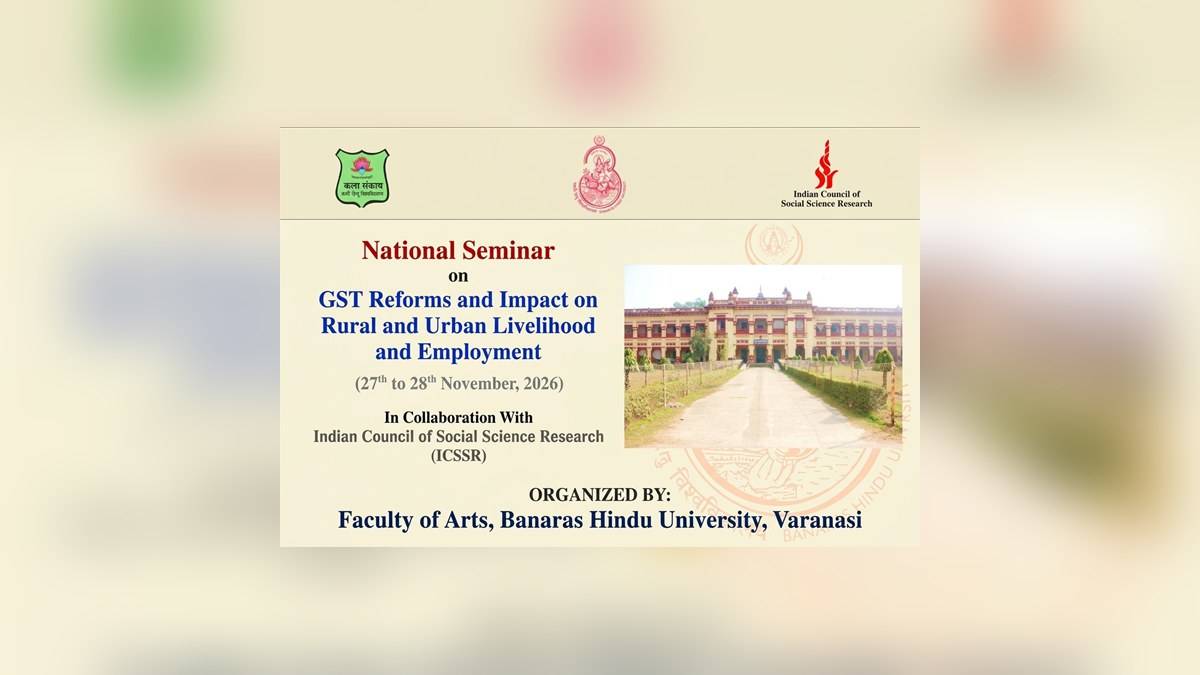
VARANASI: A two-day national seminar at Banaras Hindu University began on Friday, November 27, 2026, bringing researchers, tax practitioners and students together to examine how Goods and Services Tax reforms affect rural and urban livelihoods. The Faculty of Arts programme runs through November 28, with the university's official brochure identifying the Conference Hall at the Institute of Management Studies, Lanka, as the venue.
For Varanasi's small traders, artisans and students studying employment, the programme focuses on a practical question: how tax administration and compliance shape the ability to earn a living. Its published themes include cottage industries, handicrafts, rural enterprises, service-sector work and the urban informal economy. These are subjects for academic examination, rather than an announcement of new tax rates or benefits.
Anyone planning to attend the remaining day should first check participation arrangements with the organisers. The brochure's registration deadline was November 20, and its full-paper deadline was November 22. Although the university calendar describes the event as open to all, that listing does not establish that fresh registrations or unrestricted walk-in entry are available on November 28.
What the BHU programme covers
The official seminar brochure identifies the Indian Council of Social Science Research as the sponsor and places the event under the Faculty of Arts. The university event calendar lists November 27 and 28, with programme hours of 10 am to 5 pm IST. Opening reports identify the Centre for Tourism and Hospitality Studies as the organising centre.
The brochure sets out six objectives. They include examining the development of the GST framework, its relationship with employment and business activity, and the difficulties faced by small enterprises and informal workers. The organisers also want students and researchers to undertake policy-focused work connecting taxation with livelihoods, while bringing academic specialists and practitioners into the same discussion.
Its rural themes cover agriculture-linked businesses, cottage production, handicrafts, artisans and micro-enterprises. The urban section considers service-sector employment, start-ups, small traders and street vendors, alongside employment patterns affecting women and young people. A separate comparative section looks at income patterns, market opportunities and cost structures across rural and urban settings.
That range gives the seminar a local connection beyond a discussion of tax rules alone. A research paper about a rural craft enterprise and one about an urban service business can examine different working conditions under the same broad framework. The published programme explicitly allows those differences to be considered, rather than assuming that every kind of business experiences compliance in the same way.
What was reported from the opening
Two local reports on the opening identify former GST joint commissioner A. K. Banerjee as the chief guest. They describe his account of the progression from earlier sales and trade taxes through value added tax to GST, drawing on his administrative experience. The reports also identify Faculty of Arts dean Prof. Sushma Ghildyal as chair of the opening session.
Other speakers named in both reports include Prof. Ashish Bajpai, director of the Institute of Management Studies, commerce academic Prof. Akhil Mishra and advocate Ashwini Kumar Pani. Their contributions addressed the relationship between taxation and public benefits, tax awareness and employment, and the practical and legal effects of GST. These were seminar contributions; the reports do not establish that any recommendation has become a government decision.
Both accounts say the organisers received 55 research papers from a participant group that included academics, chartered accountants, advocates, research scholars and students. That figure refers to papers received. It should not be treated as a count of presentations completed, people attending a particular session, or recommendations adopted.
What participants should check
The brochure lists Dr. Ratna Shanker Mishra as convener and Dr. Binayak Kumar Dubey as co-convener. Their organising contact email is natconferencebhu@gmail.com. Prospective visitors should use the official programme to confirm the venue and remaining session arrangements, particularly because the advance submission and registration dates have passed.
The published academic requirements called for an abstract of up to 500 words with five keywords and a full paper of up to 6,000 words, including references. The brochure also specifies an anti-plagiarism policy and a best paper award for each main theme. These requirements explain the research format of the gathering; they do not reopen the submission window.
Expected outcomes include policy recommendations, closer academic and industry collaboration, and better student understanding of taxation and livelihood studies. Publication of proceedings or an edited volume is conditional on approval. No final set of findings or approved publication is established by the opening reports.
For other campus developments, see the earlier reports on BHU's MBA application window, library traineeships at IIT (BHU) and November 28 travel arrangements around BHU. Each concerns a separate notice or event.